
Exploring the Meaning of Desmios in Greek
δέσμιος means “prisoner” and occurs 17 times in Scripture, including Matthew 27, Mark 15, Acts 16, Acts 23, and Acts 25.
Gospel Occurrences
In Matthew 27:15–16 and Mark 15:6, it refers to the prisoner the governor would release at the feast. Barabbas is called a notable prisoner (Matthew 27:16).
Learn More →Acts Contexts
In Acts 16:25, it speaks of prisoners listening as Paul and Silas prayed and sang hymns. In Acts 23:18 and Acts 25:14, 25:27, Paul is identified as “the prisoner.”
Learn More →δέσμιος refers to a “prisoner,” a person held in custody and treated as confined under another’s authority. In the passages where it appears, it is used both for anonymous detainees in public proceedings and for Paul’s self-description while under guard.
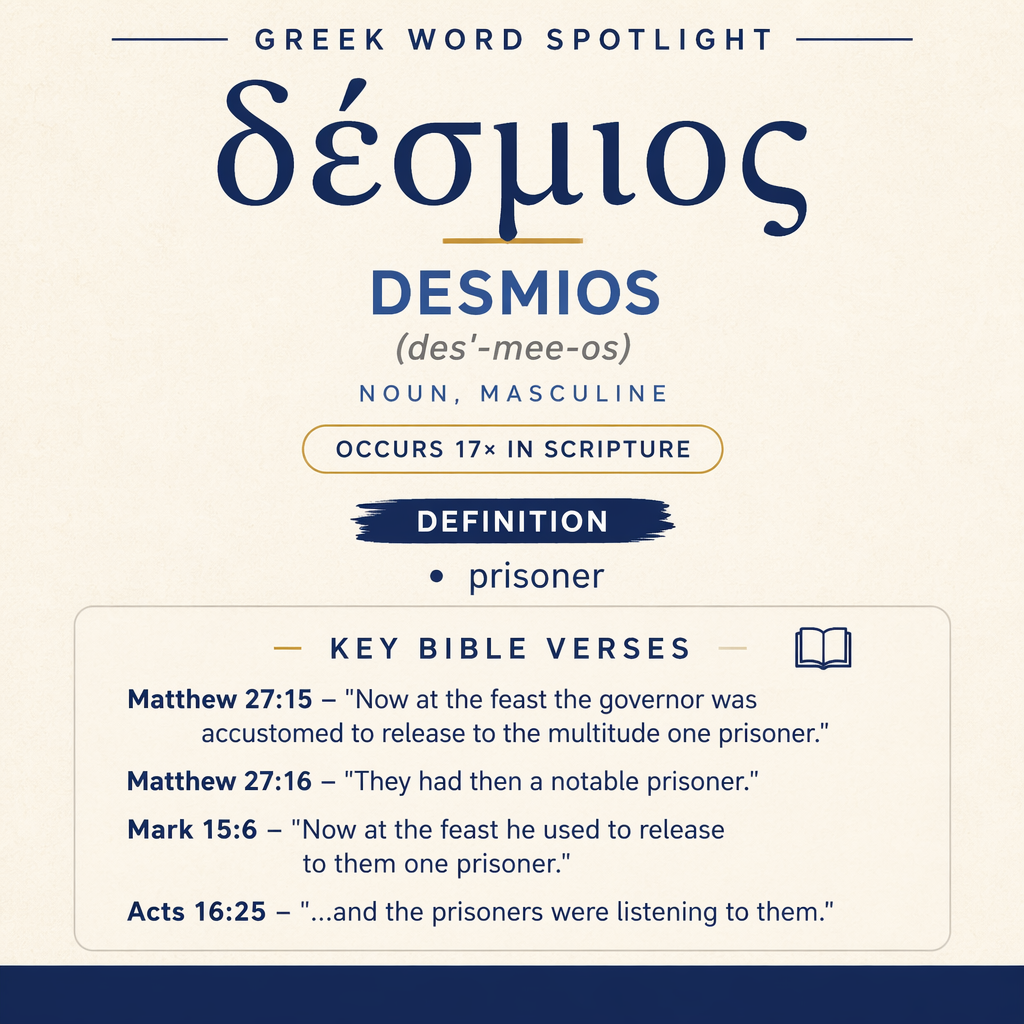
Occurrences
“Now at the feast the governor was accustomed to release to the multitude one prisoner, whom they desired.” (Matthew 27:15)
Here δέσμιος marks the individual whose status is decisive for the governor’s custom: the person is not merely a defendant or suspect, but someone already being held and thus available to be “release[d] to the multitude.” The word sets up a public, procedural setting in which custody and release are actions controlled by the governor and influenced by the crowd’s desire.

“They had then a notable prisoner, called Barabbas.” (Matthew 27:16)
δέσμιος identifies Barabbas by his legal condition—he is in custody—and the adjective “notable” highlights that his imprisonment has become publicly recognized. The word helps the narrative contrast the crowd’s awareness and choice: the figure at issue is already confined and known by name.
“Now at the feast he used to release to them one prisoner, whom they asked of him.” (Mark 15:6)
As in Matthew’s description of the feast custom, δέσμιος emphasizes a controlled transfer from confinement to freedom. The prisoner is the object of a request—“whom they asked of him”—so the word sits at the intersection of authority (the one who can release) and popular demand (those who ask).
“But about midnight Paul and Silas were praying and singing hymns to God, and the prisoners were listening to them.” (Acts 16:25)
δέσμιος here is plural and collective, portraying a group sharing confinement with Paul and Silas. The word frames the audience for the nighttime praying and singing: the people capable of “listening” are nevertheless confined persons, and their attention within the prison environment becomes part of the scene’s tension between restraint and response.
“The jailer, being roused out of sleep and seeing the prison doors open, drew his sword and was about to kill himself, supposing that the prisoners had escaped.” (Acts 16:27)
δέσμιος again appears in the plural, now as the focus of the jailer’s fear and inference. The word makes clear what would constitute disaster: if those under custody “had escaped.” The jailer’s reaction presupposes the prisoner’s expected state—confined and accounted for—and the opened “prison doors” threaten that expectation.
“So he took him, and brought him to the commanding officer, and said, “Paul, the prisoner, summoned me and asked me to bring this young man to you. He has something to tell you.”” (Acts 23:18)
δέσμιος is applied directly to Paul as an identifying label: “Paul, the prisoner.” It functions almost like an official designation in the mouth of the speaker, locating Paul within a chain of command. Even though Paul “summoned” and “asked,” his ability to act is portrayed within the constraints of being a prisoner, dependent on intermediaries and officers.
“As he stayed there many days, Festus laid Paul’s case before the king, saying, “There is a certain man left a prisoner by Felix;” (Acts 25:14)
δέσμιος expresses Paul’s continuing custody across administrative transitions. The phrase “left a prisoner by Felix” portrays imprisonment as a carried-over condition: Paul remains held, not because of a new action in the verse, but because prior authority left him in that state. The word thus fits a bureaucratic setting where the prisoner’s status persists while the case is discussed.
“For it seems to me unreasonable, in sending a prisoner, not to also specify the charges against him.” (Acts 25:27)
δέσμιος is used generically—“sending a prisoner”—within a statement about procedure and accountability. The term brings out the incongruity Festus names: a person may be transferred while still under custody, but the act of sending such a person should be accompanied by “charges.” The word keeps the focus on the detainee as someone moved under guard rather than traveling freely.
“When we entered into Rome, the centurion delivered the prisoners to the captain of the guard, but Paul was allowed to stay by himself with the soldier who guarded him.” (Acts 28:16)
δέσμιος appears as a group handed over—“delivered the prisoners”—showing the normal handling of detainees upon arrival. Against that backdrop, Paul’s situation is distinguished: though among those in custody, he “was allowed to stay by himself with the soldier who guarded him.” The word helps define the baseline condition (prisoners transferred to custody) from which Paul’s guarded but separate arrangement differs.
“After three days Paul called together those who were the leaders of the Jews. When they had come together, he said to them, “I, brothers, though I had done nothing against the people or the customs of our fathers, still was delivered prisoner from Jerusalem into the hands of the Romans,” (Acts 28:17)
δέσμιος frames Paul’s account of how he arrived in Rome: he “was delivered prisoner…into the hands of the Romans.” The word foregrounds transfer of custody (“delivered”) and the change of controlling authority (“into the hands”). In Paul’s speech, the term carries his claim of innocence alongside the reality of confinement, presenting imprisonment as an experienced condition imposed through official handover.
“For this cause I, Paul, am the prisoner of Christ Jesus on behalf of you Gentiles,” (Ephesians 3:1)
δέσμιος is integrated into Paul’s self-identification, now qualified by relationship: “the prisoner of Christ Jesus.” The word still denotes the concrete status of being held, but the phrasing ties that status to allegiance and purpose—“on behalf of you Gentiles.” In this sentence, imprisonment is not merely a legal category; it becomes part of how Paul frames his role and situation in relation to Christ Jesus and to the Gentiles addressed.
“I therefore, the prisoner in the Lord, beg you to walk worthily of the calling with which you were called,” (Ephesians 4:1)
δέσμιος again serves as Paul’s self-description, here with the qualifier “in the Lord.” The word gives weight to the appeal (“beg you”) by reminding readers of the speaker’s condition. Within the verse’s logic, the prisoner’s circumstance stands alongside exhortation: from within confinement, Paul urges a manner of life “worthily of the calling.”

Sense and Usage
Across these passages δέσμιος consistently designates a person held in custody, and the contexts show what that status entails in practice: a prisoner is someone authorities can release (Matthew 27:15; Mark 15:6), someone publicly recognized while confined (Matthew 27:16), someone expected to remain accounted for behind “prison doors” (Acts 16:27), and someone who can be transferred between jurisdictions and officers (Acts 28:16–17). The term therefore regularly appears alongside verbs of control and movement—“release,” “escaped,” “brought,” “left,” “sending,” “delivered”—because imprisonment is a social and legal condition defined by restraint and by the authority that restrains.
The word can be anonymous and collective, as in Acts 16:25–27, where “the prisoners” form the listening audience and the feared escapees. In those lines δέσμιος highlights the shared confinement that makes the prisoners a distinct group within the prison setting, the group whose whereabouts determine the jailer’s response. The term can also become a naming tag attached to an individual: “Paul, the prisoner” (Acts 23:18). Used this way, it functions like a shorthand description that immediately communicates Paul’s standing in the situation and explains why others mediate his requests.
In the administrative speeches of Acts 25, δέσμιος belongs to the vocabulary of official process. Festus speaks of a man “left a prisoner” and of “sending a prisoner” with specified charges (Acts 25:14, 25:27). The prisoner is not portrayed primarily by personal traits, but by custody status as it relates to governance: a prisoner is someone whose case must be accounted for and whose transfer demands formal clarity.
In Ephesians, Paul takes the same designation and places it inside relational phrases: “the prisoner of Christ Jesus” and “the prisoner in the Lord” (Ephesians 3:1; 4:1). Without changing the basic reference to imprisonment, these expressions frame confinement as bound up with Paul’s identity and mission. In Ephesians 3:1, the phrase “on behalf of you Gentiles” places his imprisonment in the context of service; in Ephesians 4:1, the prisoner’s condition provides a sober backdrop for moral exhortation. In both, δέσμιος functions rhetorically: the speaker’s restricted condition underscores the seriousness of what he says and the commitments that shape his life.
Imagery
δέσμιος carries the imagery of custody in motion and custody under guard: prisoners released at a feast, prisoners behind doors that can open, prisoners handed from one officer to another, and a prisoner allowed to stay “with the soldier who guarded him” (Acts 28:16). When Paul speaks as “the prisoner,” the term brings the physical reality of confinement into his speech—yet in Ephesians it also becomes a steady title from which he addresses others, so that imprisonment forms part of the scene of teaching and appeal rather than silencing it.
Sources: Lexical data from Strong’s Exhaustive Concordance and the Translators Brief Lexicon of Extended Strongs for Greek (STEPBible, CC BY). Occurrence data from the Translators Amalgamated Greek New Testament (STEPBible, CC BY). Scripture quotations from the World English Bible (public domain).




