Exploring the Meaning of Desme in Greek
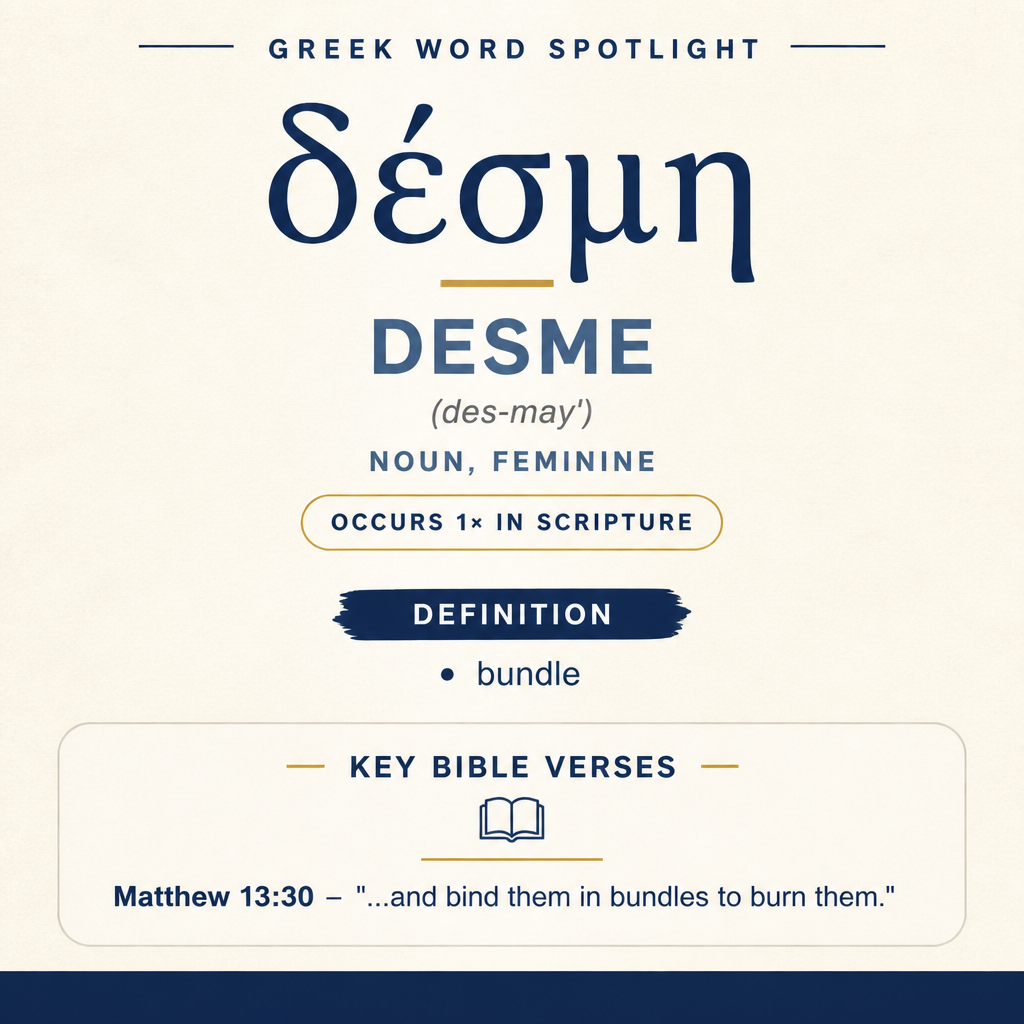
δέσμη means “bundle” and appears once in Scripture, in Matthew 13:30.
Verse Context
In Matthew 13:30 it appears in the harvest instruction to “gather up the darnel.”
Learn More →δέσμη means “bundle” and appears once in the New Testament, in the parable scene where harvest workers separate plants in the field. In that setting, the word names the gathered units of weeds prepared for burning.
Root and Related Words
δέσμη is connected with the verb desmeo (δεσμέω), “to shackle” (Strong’s G1196). The association highlights the idea of binding or fastening as the action that produces what δέσμη names in context.

Occurrences
“Let both grow together until the harvest, and in the harvest time I will tell the reapers, “First, gather up the darnel weeds, and bind them in bundles to burn them; but gather the wheat into my barn.” ’ ” (Matthew 13:30)
In this harvest instruction, δέσμη belongs to the sequence of actions carried out by “the reapers.” The speaker’s command begins with allowing both kinds of growth—wheat and “darnel weeds”—to remain together until “the harvest.” When harvest time arrives, the first step is not the storage of the valuable crop but the handling of the unwanted plants: “First, gather up the darnel weeds.” δέσμη then names what results from the next command: “bind them in bundles to burn them.” The weeds are not merely collected loosely; they are gathered into discrete, tied groupings that can be handled as units. This bundling serves a purpose stated immediately in the verse: the bundles are destined “to burn them.”
The contrast built into the final clause, “but gather the wheat into my barn,” clarifies the role of δέσμη in the scene. Bundles are linked with the weeds and their disposal, while wheat is linked with gathering into storage. δέσμη therefore functions as a concrete image of sorting at harvest: what is judged unfit is assembled into bound groupings, and what is valuable is gathered for keeping. The word does its work by giving the burning of weeds a tangible preparatory step—binding into bundles—rather than presenting destruction as sudden or chaotic.
Sense and Usage
The sense “bundle” fits the agricultural workflow implied by the verse: gathering, binding, and then burning. A bundle is not simply a heap; it is an arranged collection held together so that what has been gathered can be moved, stacked, or assigned to an outcome. In Matthew 13:30, the bundling is explicitly intentional (“bind them in bundles”) and timed (“in the harvest time”), suggesting an orderly process carried out under instruction. The word thus conveys organization and containment: the weeds are made into manageable units before their removal by fire.
Because the verse places δέσμη within the directive speech of the one who gives orders to the reapers (“I will tell the reapers”), the bundling is not incidental detail but part of the planned division of what has grown together. The field contains mixed growth until a decisive moment; then the reapers’ work includes a careful first action with the weeds. δέσμη, as the named product of binding, intensifies the picture of separation: plants that once stood among the wheat are gathered out, tied up, and set on a track toward burning. The bundling marks a transition from coexistence (“Let both grow together”) to separation and disposal (“First, gather up… bind them in bundles to burn them”).
The word also helps the verse hold together two different destinations. The weeds end in fire, and the wheat ends in a barn, but both outcomes are reached through gathering. δέσμη underlines that gathering can serve different ends: the same harvest activity that collects wheat for storage can also collect weeds for removal. The bundle, in this setting, is the practical form taken by what is gathered for burning.
Imagery
Matthew 13:30 attaches δέσμη to a vivid harvest image: weeds tied into bound groupings, ready to be burned. The picture is tactile and procedural—hands gathering stalks, cords tightening around them, and piles of bundles set aside—so that the coming fire is portrayed as the final step of a deliberate sorting rather than an impulsive act.
Sources: Lexical data from Strong’s Exhaustive Concordance and the Translators Brief Lexicon of Extended Strongs for Greek (STEPBible, CC BY). Occurrence data from the Translators Amalgamated Greek New Testament (STEPBible, CC BY). Scripture quotations from the World English Bible (public domain).