
Exploring the Meaning of Deka in Greek
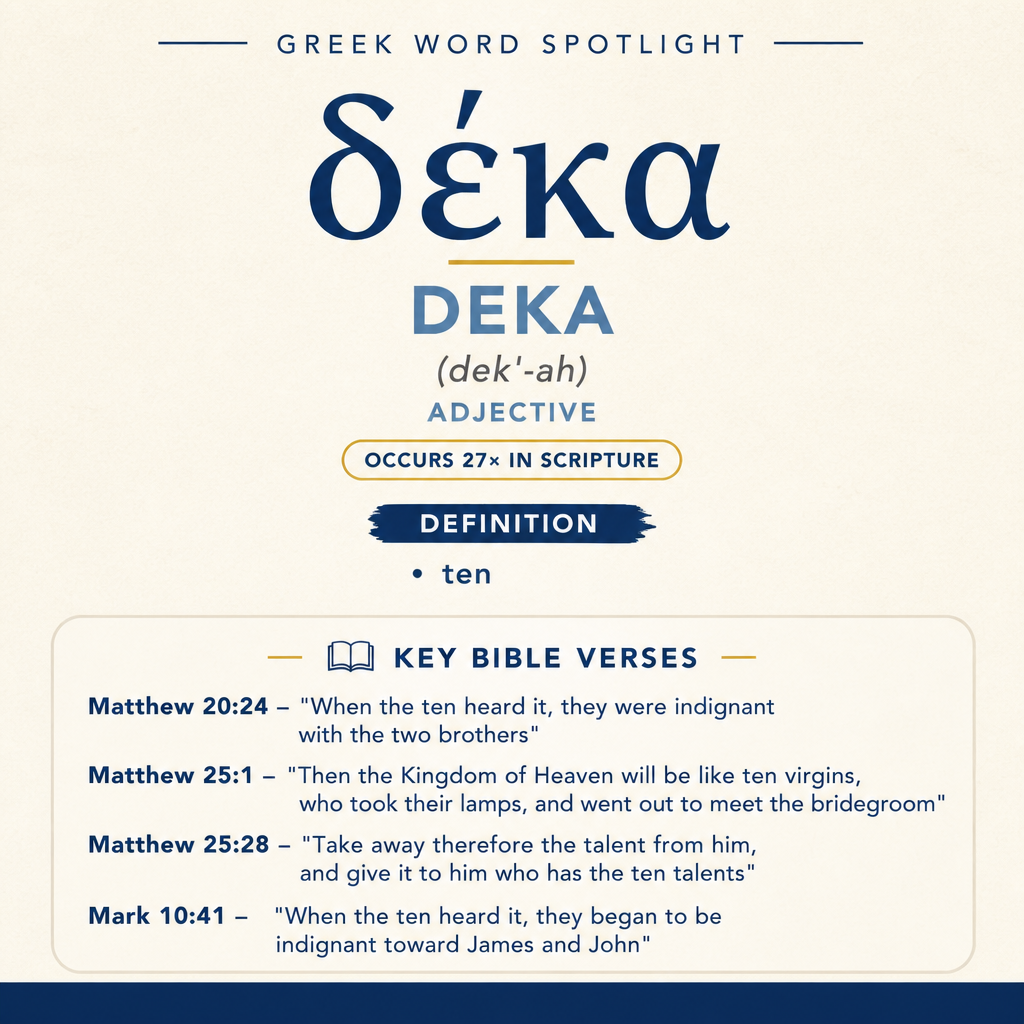
δέκα (Deka) means “ten” in Greek and occurs 27 times in Scripture, including Matthew 20:24 and Matthew 25:1.
Gospel Examples
It appears in Matthew 20:24 and Mark 10:41, where “the ten” were indignant. It also appears in Matthew 25:1 describing “ten virgins.”
Learn More →Occurrence Notes
δέκα occurs 27 times in Scripture. Listed references include Matthew 25:28 and Mark 10:41.
Learn More →δέκα means “ten.” In the passages where it appears, it functions as a concrete number that counts people, measures quantities of money, and sets the scale for comparisons in Jesus’ teaching and in narrative scenes.
Occurrences
Matthew 20:24 — “When the ten heard it, they were indignant with the two brothers.”
Here δέκα counts a defined group within the disciples: a set of ten reacting to the request or ambition of “the two brothers.” The number is not decorative; it frames the scene as a community response, with the indignation belonging to a specific majority group over against two individuals.
Matthew 25:1 — “Then the Kingdom of Heaven will be like ten virgins, who took their lamps, and went out to meet the bridegroom.”
In this parable opening, δέκα establishes the size of the group that acts together: “ten virgins” who all take lamps and go out to meet the bridegroom. The number gives the story a structured cast large enough for group dynamics, yet small enough for the listener to track as a single company moving with one purpose.
Matthew 25:28 — “Take away therefore the talent from him, and give it to him who has the ten talents.”
δέκα specifies the amount possessed by the recipient of a transferred “talent.” The number marks the recipient as already holding a substantial quantity, so that the command to give to “him who has the ten talents” lands as an intentional redistribution toward the one characterized by a higher total.
Mark 10:41 — “When the ten heard it, they began to be indignant toward James and John.”
As in Matthew 20:24, δέκα identifies the larger group contrasted with two named individuals, “James and John.” The number anchors the interpersonal tension: indignation is not merely an individual feeling but a collective reaction by ten toward the actions or aims of two.
Luke 13:4 — “Or those eighteen, on whom the tower in Siloam fell and killed them; do you think that they were worse offenders than all the men who dwell in Jerusalem?”
This saying uses a specific number to count victims of a disaster. δέκα is embedded within “eighteen,” which serves to fix the event as a concrete, countable tragedy. The number supports the question Jesus poses, keeping the focus on the fact of death and the temptation to assign moral rankings to those who suffered.
Luke 13:11 — “Behold, there was a woman who had a spirit of infirmity eighteen years. She was bent over, and could in no way straighten herself up.”
Again within “eighteen,” δέκα contributes to a duration: the woman’s condition is measured in years. The number gives weight to the description—this is not a brief ailment but a long-lasting bondage described in a way that can be pictured and felt as extended time.
Luke 13:16 — “Ought not this woman, being a daughter of Abraham whom Satan had bound eighteen long years, be freed from this bondage on the Sabbath day?”
Here the same duration reappears with added emphasis: “eighteen long years.” δέκα, as part of that number, belongs to an argument about what is fitting on the Sabbath. The quantified length of suffering strengthens the moral force of the question—release is urged in view of how long the binding has persisted.
Luke 14:31 — “Or what king, as he goes to encounter another king in war, will not sit down first and consider whether he is able with ten thousand to meet him who comes against him with twenty thousand?”
δέκα functions straightforwardly in “ten thousand,” setting one army’s size against another’s “twenty thousand.” The number is used for sober calculation: a king is pictured sitting down to weigh capabilities based on measurable force. The contrast between the two totals creates the pressure of the scenario and underlines the necessity of thoughtful assessment.
Luke 15:8 — “Or what woman, if she had ten drachma coins, if she lost one drachma coin, wouldn’t light a lamp, sweep the house, and seek diligently until she found it?”
In this parable, δέκα establishes the woman’s starting amount: “ten drachma coins.” That initial total makes the loss of “one” intelligible as a real diminishment of a defined set. The number gives the search its urgency and logic: she seeks until she finds because the missing coin belongs to a complete, countable whole.
Luke 17:12 — “As he entered into a certain village, ten men who were lepers met him, who stood at a distance.”
δέκα counts the men who meet Jesus: “ten men who were lepers.” The number gathers them into a single group marked by shared condition and shared action—meeting him while keeping distance. It sets up expectations about how a group responds and what a group receives in the encounter.
Luke 17:17 — “Jesus answered, “Weren’t the ten cleansed? But where are the nine?”
Here δέκα appears in a question that presumes a completed action affecting the whole group: “the ten” were cleansed. The number becomes a baseline for comparison, immediately paired with “the nine,” so that absence is measurable. The force of Jesus’ question depends on arithmetic clarity: if ten benefited, why does only one seem present?
Luke 19:13 — “He called ten servants of his and gave them ten mina coins, and told them, ‘Conduct business until I come.’”
δέκα is used twice, counting both people and units of money. “Ten servants” establishes a set of agents entrusted with responsibility, and “ten mina coins” establishes the quantity distributed for the task. The parallel use of the number creates an orderly picture of delegation: a defined group receives a defined allotment and a clear command for action during the master’s absence.

Sense and Usage
Across these passages, δέκα serves as a precise counting term that stabilizes scenes and arguments by fixing quantities in view. In narrative settings it identifies groups (“the ten,” “ten men”) so that response, conflict, and absence can be described in a way that is collectively accountable rather than vague. When δέκα marks money, it sets an inventory or total that makes gain, transfer, or loss intelligible in concrete terms: one can tell what someone has (“the ten talents”), what someone begins with (“ten drachma coins”), or what is entrusted for work (“ten mina coins”).
In Jesus’ teaching, the number is also used to set scale for reasoning. In Luke 14:31, “ten thousand” is not merely a large figure; it functions as a calculable strength weighed against “twenty thousand,” a contrast that invites deliberate evaluation based on measurable realities. Likewise, when δέκα forms part of “eighteen” in Luke 13, the effect is to place suffering and tragedy inside countable history—years endured and people killed—so that moral conclusions are not drawn from speculation but are confronted in the face of known facts.
δέκα can therefore highlight completeness of a set (as in groups counted as a whole), establish proportional loss within a whole (ten coins with one missing), or create a reference point for comparison (ten cleansed versus nine absent; ten thousand versus twenty thousand). In each case, the number serves clarity: it pins down how many are involved, how much is possessed, or how large the situation is, and then allows the surrounding statement or question to press its point with precision.
Imagery
The imagery attached to δέκα in these passages is often domestic or communal: a company moving together with lamps (Matthew 25:1), a household search that involves lighting a lamp and sweeping a house (Luke 15:8), and a group of afflicted men standing at a distance (Luke 17:12). Even where the scene expands to armies and kings (Luke 14:31), the number’s effect remains similar—bringing a situation into focus by giving it a definite size. In the questioning scenes, the number sharpens moral attention: it makes indignation traceable to a set group (Matthew 20:24; Mark 10:41) and makes gratitude—or its absence—measurable (“Weren’t the ten cleansed? But where are the nine?”; Luke 17:17).
Sources: Lexical data from Strong’s Exhaustive Concordance and the Translators Brief Lexicon of Extended Strongs for Greek (STEPBible, CC BY). Occurrence data from the Translators Amalgamated Greek New Testament (STEPBible, CC BY). Scripture quotations from the World English Bible (public domain).





