Exploring the Meaning of Deisidaimonia in Greek
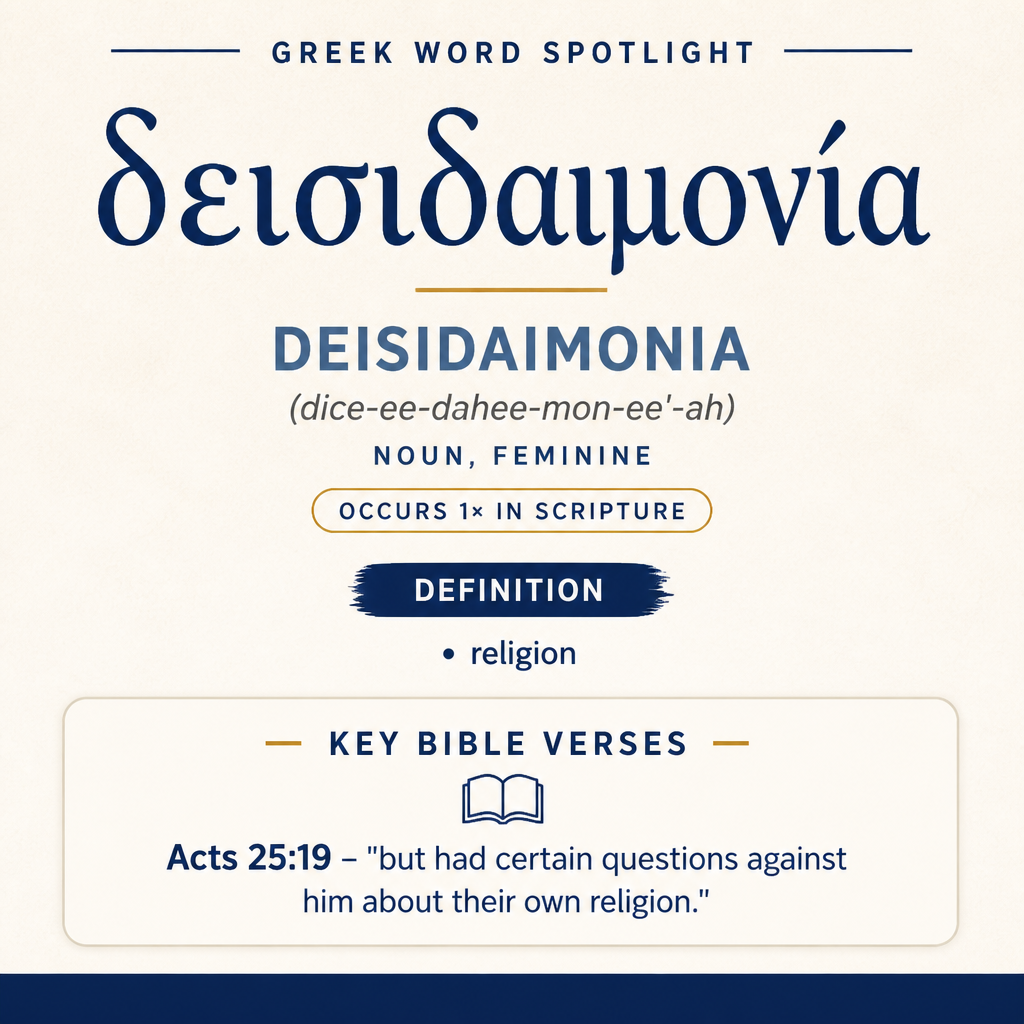
δεισιδαιμονία means “religion” and appears once in Scripture in Acts 25:19.
Context in Acts
In Acts 25:19, it refers to “their own religion” in questions raised against Paul. The verse also mentions “one Jesus, who was dead, whom Paul affirmed to…”.
Learn More →δεισιδαιμονία denotes “religion” and appears in the New Testament in a single narrative explanation of Paul’s case. In Acts 25:19 it is used to describe the subject matter of a dispute that had been brought before a Roman official.
Root and Related Words
δεισιδαιμονία (Deisidaimonia) derives from deisidaimonesteros (δεισιδαίμων), “religious” (Strong’s G1174). The derived noun expresses the concept as an abstract category rather than as a personal quality.

Occurrences
“but had certain questions against him about their own religion, and about one Jesus, who was dead, whom Paul affirmed to be alive.” (Acts 25:19)
In this report, the speaker frames the accusations against Paul as “certain questions” that belong to the sphere of “their own religion.” The noun functions to locate the debate within the internal commitments and concerns of the group being described (“their own”), rather than presenting it as a charge that is self-evidently criminal or political in character. The word marks the dispute as one of religious content and reference points: it concerns what that community recognizes as authoritative and significant within its religious life.
The clause that follows (“and about one Jesus…”) shows how “religion” is not an empty label here but the heading under which particular claims are being contested. The mention of “one Jesus” and the sharply drawn contrast—“who was dead” versus “whom Paul affirmed to be alive”—indicates that the religious questions include claims about a named figure and what is true of him. Within the sentence, δεισιδαιμονία helps group the controversy into a coherent category: questions arising from a religious framework, including dispute over the status of Jesus in light of death and Paul’s affirmation of life.
The use of “their own” in front of “religion” also shapes the perspective of the report. The speaker does not present the content as his own confession, but as the religious system of the accusers or disputants. δεισιδαιμονία therefore contributes to the narrative by explaining why the case has proven difficult to adjudicate on straightforward administrative grounds: the issues are internal to a religious sphere and hinge on a contested affirmation.
Sense and Usage
The sense “religion” in Acts 25:19 is concrete and case-specific: it refers to a recognizable body of religious commitments that can generate “questions” and disputes. The term is used in the pluralizing environment of “certain questions,” suggesting that “religion” is not merely private sentiment but a shared set of matters that can be argued, investigated, and reported to officials. At the same time, the phrasing “their own religion” situates the term as a descriptor from outside the group it names; it is the category by which an observer can summarize what is otherwise detailed and contentious.
In this setting, “religion” is also tied to claims about a person—“one Jesus”—and to assertions about his state (“dead” versus “alive”). δεισιδαιμονία thus covers not only practices or customs but the kinds of truth-claims and affirmations that a religious community debates. The word operates as a narrative bridge between two spheres: it translates the content of an intra-religious disagreement into a term intelligible in an official report. The result is a portrayal of the controversy as religiously grounded and therefore difficult to resolve by ordinary legal categories, since the central point of contention is what Paul “affirmed” in contrast to what others maintained.
Imagery
Although δεισιδαιμονία is an abstract noun, Acts 25:19 places it in a vivid forensic frame: a matter brought forward as “questions,” reported in a compressed summary, and focused around a disputed affirmation concerning Jesus. The word therefore carries the imagery of a courtroom explanation in which religious dispute is condensed into a single category—“their own religion”—while the sharp claim “alive” stands against the settled fact “was dead.”
Sources: Lexical data from Strong’s Exhaustive Concordance and the Translators Brief Lexicon of Extended Strongs for Greek (STEPBible, CC BY). Occurrence data from the Translators Amalgamated Greek New Testament (STEPBible, CC BY). Scripture quotations from the World English Bible (public domain).