Exploring the Meaning of Deiliao in Greek
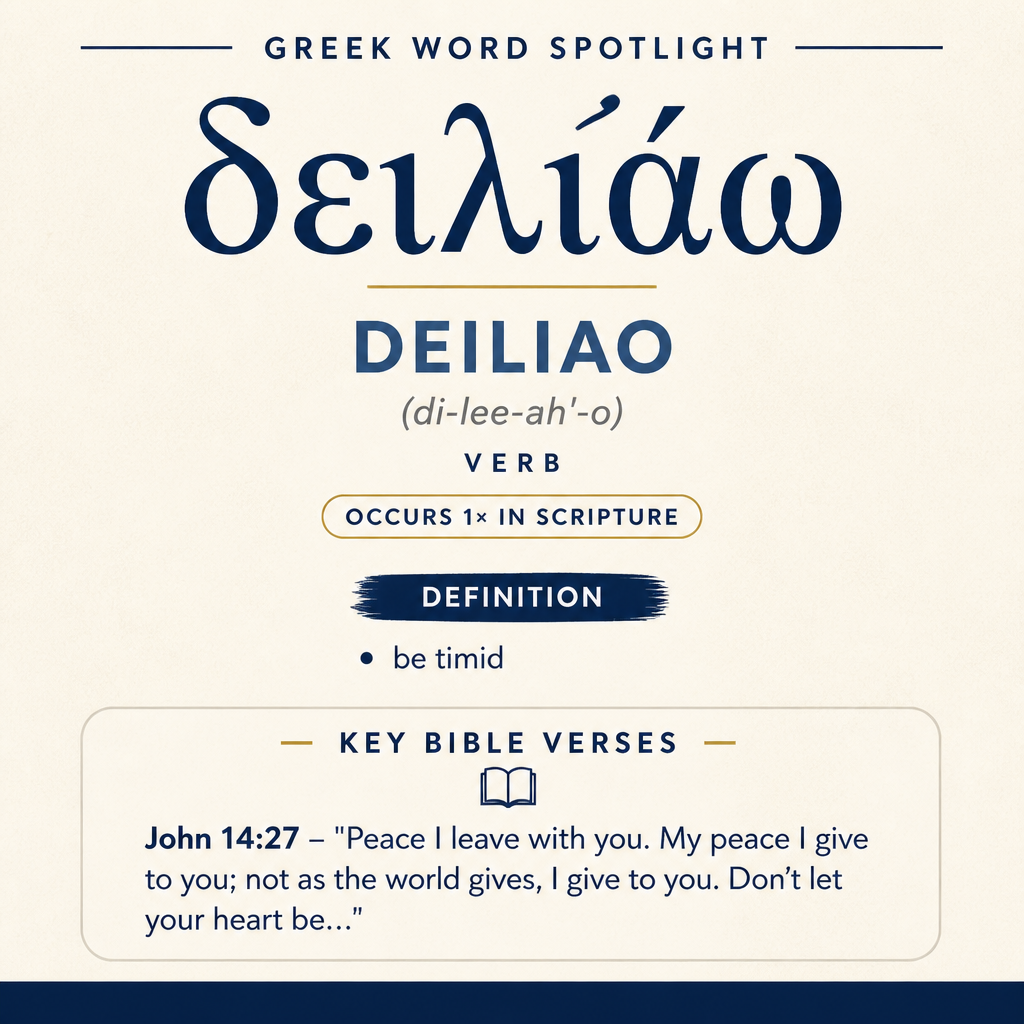
δειλιάω means “be timid” and appears once in Scripture, in John 14:27.
Scripture Occurrence
This verb occurs 1 time in Scripture. Its single occurrence is John 14:27.
Learn More →Verse Context
In John 14:27, Jesus speaks of giving peace, and says, “Don’t let your heart be troubled,” in the same verse context.
Learn More →δειλιάω means “be timid” and appears in the farewell discourse of Jesus in John 14:27. There it is set alongside the call not to let the heart be troubled, framing timidity as a response his gift of peace is meant to displace.
Root and Related Words
δειλιάω is derived from deilia (δειλία), “timidity” (Strong’s G1167). The verb expresses, in verbal form, what the related noun names.

Occurrences
“Peace I leave with you. My peace I give to you; not as the world gives, I give to you. Don’t let your heart be troubled, neither let it be fearful.” (John 14:27)
In this saying Jesus speaks in the first person—“I leave,” “I give”—and the direct object of his giving is “peace.” The command that follows addresses the inner person (“your heart”) and names two threatened conditions: a heart that is “troubled,” and a heart that becomes “fearful.” δειλιάω contributes the second of these: it marks the movement from calm to timidity, from settledness to a shrinking back. Within the verse’s own logic, timidity is not treated as an inevitable reflex but as something that can be resisted (“Don’t let…”), and it is resisted not by denial of circumstances but by receiving and resting in a particular kind of peace—“My peace,” distinguished from what “the world gives.”

The pairing of “troubled” and “fearful” gives the command a fuller emotional range. “Troubled” suggests agitation within the heart; “fearful” names the heart’s timidity as it faces what is ahead. δειλιάω, placed under the same prohibition as the troubled heart, paints timidity as an inward condition that competes with peace. The verse therefore uses the verb not to describe an external act but an internal yielding: the heart is envisioned as capable of being overtaken by timidity unless guarded.
The immediate framing also places timidity in contrast to gift. Peace is spoken of as something left behind and given—Jesus is the giver, the disciples are the recipients. Against that, timidity is not given; it is something that may seize the heart. In that contrast, δειλιάω functions as an unwanted counter-state to the peace that is being bestowed. The shape of the sentence highlights agency: the giver gives peace, but the hearers are told to refuse the heart’s slide into trouble and timidity.
Sense and Usage
The sense “be timid” fits the verse’s focus on the heart’s disposition. Timidity here is not a neutral personality trait but an acute inner posture that stands in tension with peace. The command “neither let it be fearful” treats timidity as something that can take hold of the heart in moments of pressure, uncertainty, or impending loss; it is precisely the kind of reaction Jesus addresses by naming and countering it.
Because δειλιάω is coordinated with “Don’t let your heart be troubled,” it takes on a distinctly relational and pastoral coloring in context. The verb serves as language for what happens inside someone who is unsettled: trouble can churn the heart, and timidity can then follow as the heart recoils. The verse does not separate the inner life into unrelated compartments; it presents trouble and timidity as neighboring states that threaten the same center—the heart—and that are answered by the same provision—peace.
Within the verse, peace is qualified: “not as the world gives.” Whatever distinctions are implied by that contrast, the line’s rhetorical force is clear inside the sentence itself: Jesus’ peace is sufficiently substantial to address the very fear that would otherwise arise. δειλιάω thus functions as the named opposite of what “My peace” aims to produce. The hearers are not merely told to feel better; they are told to refuse timidity because a different foundation has been placed under them—peace as a personal gift.
Grammatically, the command forms a tight parallel: “Don’t let… neither let…,” treating timidity as an outcome the heart might be permitted to adopt. That construction underscores that timidity is envisioned as something that can be allowed or disallowed, not simply suffered. The verb’s contribution is therefore both diagnostic and directive: it gives a name to an inward collapse, and it is used in a prohibition that calls for steadiness.
The placement of δειλιάω at the close of the verse also gives it a kind of emphasis. The verse begins with peace, moves through the distinction of Jesus’ giving from the world’s giving, and ends with the heart’s two dangers—trouble and timidity. Ending on “fearful” leaves the reader with the vivid picture of what peace is meant to prevent. The word therefore helps the verse land where it intends: not in abstract talk about peace, but in the practical guarding of the inner life against timidity.
Imagery
John 14:27 pictures the heart as a place that can be entered by competing forces: peace can be received as a gift, but trouble and timidity can press in and take hold. δειλιάω gives voice to the shrinking, fearful condition the verse warns against, so that the promise of peace is not vague but aimed at a concrete inner threat.
Sources: Lexical data from Strong’s Exhaustive Concordance and the Translators Brief Lexicon of Extended Strongs for Greek (STEPBible, CC BY). Occurrence data from the Translators Amalgamated Greek New Testament (STEPBible, CC BY). Scripture quotations from the World English Bible (public domain).