Exploring the Meaning of Dapanao in Greek
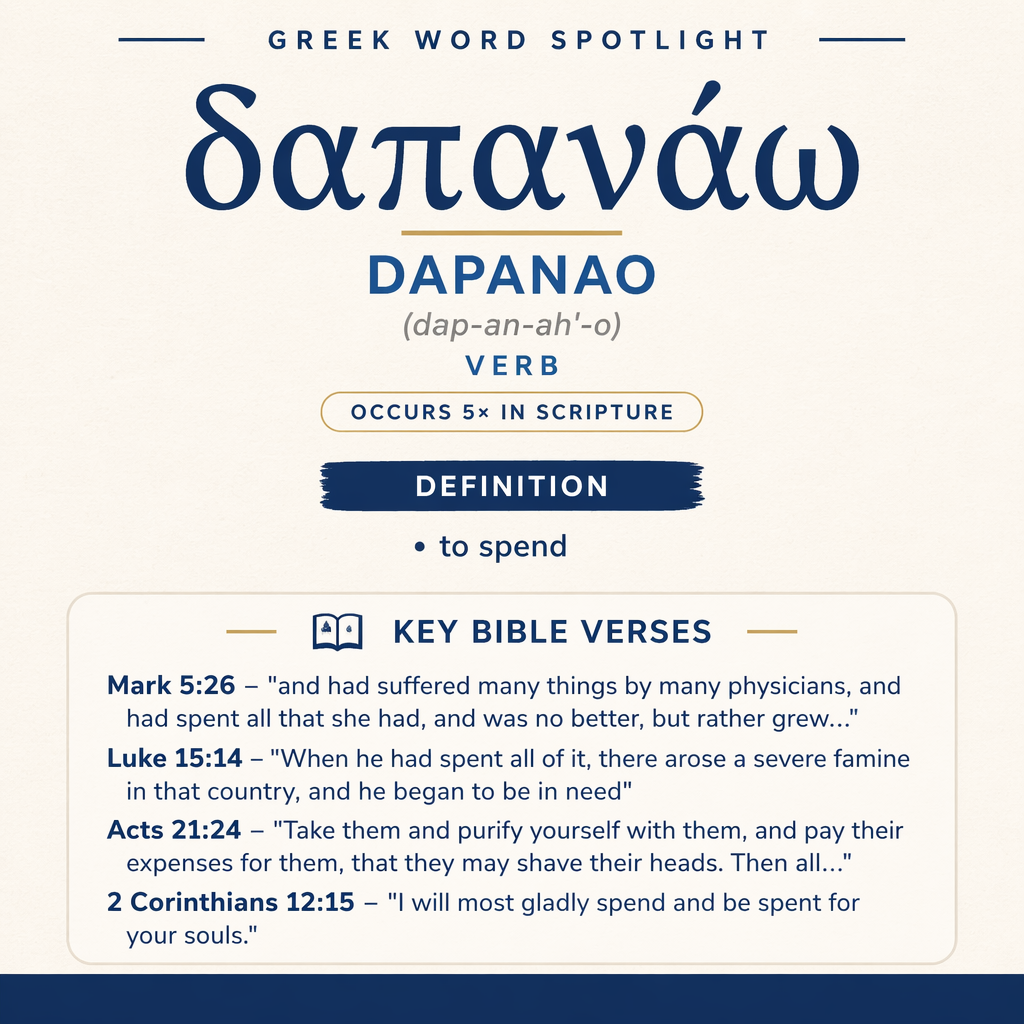
δαπανάω means “to spend,” appearing five times in Scripture: Mark 5:26, Luke 15:14, Acts 21:24, 2 Corinthians 12:15, and James 4:3.
Core Meaning
δαπανάω means “to spend.” It describes using up resources in various situations.
Learn More →Narrative Usage
In Mark 5:26 and Luke 15:14 it refers to spending all one has. These texts portray resulting need or worsening condition.
Learn More →Practical Uses
In Acts 21:24 it describes paying expenses for others. In 2 Corinthians 12:15 and James 4:3 it appears with spending for souls or pleasures.
Learn More →δαπανάω appears in narratives, instruction, and exhortation for the act of spending. Across its New Testament uses it can describe the depletion of money, the covering of another person’s expenses, the apostle’s self-giving, and the redirection of resources toward pleasure.
Root and Related Words
δαπανάω is related to dapane (δαπάνη), “cost” (Strong’s G1160), reflecting the idea of expenditure in view of what something requires.

Occurrences
“and had suffered many things by many physicians, and had spent all that she had, and was no better, but rather grew worse,” (Mark 5:26)
Here δαπανάω marks complete outlay: “all that she had” is gone. The verb sits among a chain of worsening results—many physicians, much suffering, no improvement—so the spending is not pictured as a neutral transaction but as an exhausting drain that accompanies ongoing affliction. The sense of “spent” carries the weight of diminishing resources in a situation that remains unresolved.
“When he had spent all of it, there arose a severe famine in that country, and he began to be in need.” (Luke 15:14)
In this scene the verb again has an “all the way through” force: “all of it” has been spent, leaving nothing held back for what comes next. The narrative ties the completed spending directly to vulnerability—once the famine arrives, he “began to be in need.” δαπανάω thus functions as the pivot between prior freedom of outlay and the new reality of want, showing how spending can empty a person’s reserves and expose them when conditions change.
“Take them and purify yourself with them, and pay their expenses for them, that they may shave their heads. Then all will know that there is no truth in the things that they have been informed about you, but that you yourself also walk keeping the law.” (Acts 21:24)
Here δαπανάω is embedded in a concrete, communal instruction: “pay their expenses for them.” Spending is directed outward, not toward the spender’s own needs, and it is attached to a specific aim within the larger plan (“that they may shave their heads”). The surrounding purpose clause (“Then all will know…”) frames the expenditure as part of a public course of action meant to demonstrate something about the actor’s conduct. The verb therefore contributes a practical, financial component to a larger social-religious strategy, where spending money is one step in a sequence of actions intended to produce a recognized outcome.
“I will most gladly spend and be spent for your souls. If I love you more abundantly, am I loved the less?” (2 Corinthians 12:15)
In this line δαπανάω is paired with a second expression (“and be spent”), intensifying the picture of expenditure. The spending is “most gladly,” so the action is presented as willing rather than reluctant, and its object is not money explicitly but service “for your souls.” The rhetorical question that follows (“am I loved the less?”) places the spending within a strained relational context: the speaker’s abundant love expresses itself through costly giving, even while the response he receives may be diminished. δαπανάω thus helps portray a pattern of self-outlay on behalf of others, where the cost is embraced despite the risk of being undervalued.
“You ask, and don’t receive, because you ask with wrong motives, so that you may spend it on your pleasures.” (James 4:3)
Here δαπανάω describes intended use: the request is aimed at getting something in order “that you may spend it.” The verb is morally situated by the surrounding phrases—“wrong motives” and “on your pleasures”—so spending is not merely an act of exchange but a disclosed purpose that exposes the heart behind the asking. The clause makes expenditure the endpoint of the desire: what is sought is sought for the sake of being spent in a certain direction.
Sense and Usage
Across these passages, δαπανάω consistently marks expenditure as a movement of resources outward until something is used up or assigned to a definite end. Two texts underline the depletion side of spending by coupling it with totality (“all that she had,” “all of it”) and then showing the resulting situation: continued sickness in Mark, and need intensified by famine in Luke. In both, spending does not achieve the hoped-for security or relief; the verb helps narrate the narrowing of options as reserves are exhausted.
Acts uses δαπανάω in a more targeted, transactional way—covering “expenses” for others—yet even there it is not presented as a bare financial detail. The spending is integrated into a sequence of actions designed to be seen and understood by a wider group, which highlights how expenditure can carry public implications: paying can enable a required action (“that they may shave their heads”) and can function as a visible sign within a broader claim about one’s manner of life.
In 2 Corinthians, the verb’s sphere expands from monetary outlay to personal outlay. The juxtaposition of “spend” with “be spent” portrays a life poured out beyond simple budgeting: the speaker’s resources, energy, and even the self are imagined as capable of being expended for another’s benefit. The language keeps the central idea of spending—costly giving that diminishes the giver’s store—while applying it to the relational and pastoral aim “for your souls.”
James, by contrast, places δαπανάω at the end of a motive chain. What matters is not only that something would be spent, but why and toward what end. The verb helps reveal that the desired gift is not sought as a means to obey, help, or endure, but as fuel for “pleasures.” In that setting, spending becomes diagnostic: it displays the intended direction of life and therefore the moral quality of the request.
Imagery and Emphasis
The imagery carried by δαπανάω in these texts is the imagery of diminishing stores and directed outlay—money emptied in search of healing (Mark 5:26), resources exhausted before hardship arrives (Luke 15:14), expenses deliberately covered to enable a public course of action (Acts 21:24), a servant’s willing self-expenditure for others (2 Corinthians 12:15), and requests shaped by the desire to turn received goods into personal gratification (James 4:3). In each case the verb brings the reader to the point where what one has is converted into use, with consequences that the surrounding context makes plain.
Sources: Lexical data from Strong’s Exhaustive Concordance and the Translators Brief Lexicon of Extended Strongs for Greek (STEPBible, CC BY). Occurrence data from the Translators Amalgamated Greek New Testament (STEPBible, CC BY). Scripture quotations from the World English Bible (public domain).