Exploring the Meaning of Gumnotes in Greek
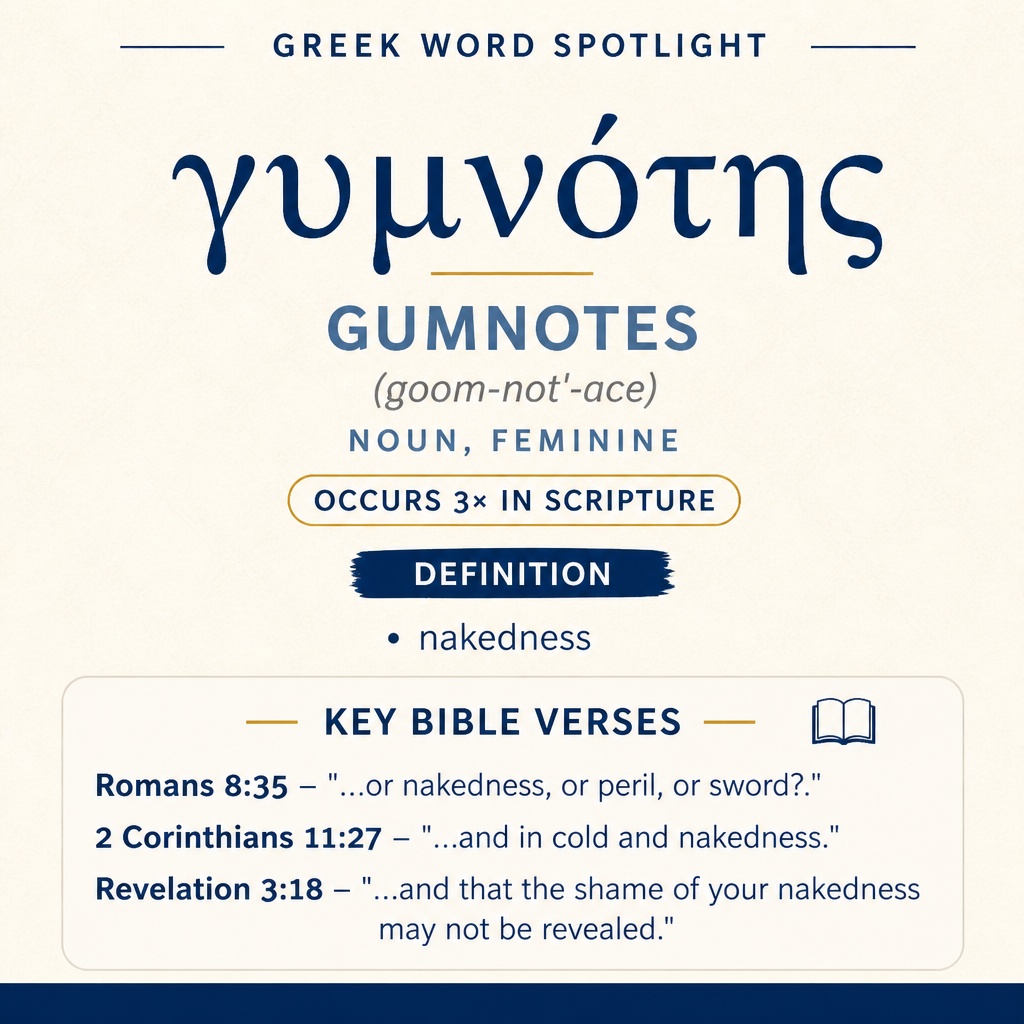
γυμνότης means “nakedness” and appears three times in Scripture: Romans 8:35, 2 Corinthians 11:27, and Revelation 3:18.
New Testament Uses
It occurs in Romans 8:35 among hardships named as possible separators from Christ’s love, and in 2 Corinthians 11:27 alongside cold and other deprivations.
Learn More →Revelation Context
In Revelation 3:18, it is contrasted with being clothed, as the counsel includes obtaining “white garments” to clothe oneself.
Learn More →γυμνότης means “nakedness” and appears in three New Testament passages. In these texts it functions as a concrete hardship, a condition of exposure, and an occasion for shame that calls for covering.
Root and Related Words
γυμνότης derives from gumnos (γυμνός), “naked” (Strong’s G1131). The noun expresses the state corresponding to that adjective.

Occurrences
“Who shall separate us from the love of Christ? Could oppression, or anguish, or persecution, or famine, or nakedness, or peril, or sword?” (Romans 8:35)
Here “nakedness” is placed within a rapid list of pressures that might seem capable of wrenching a person away from “the love of Christ.” The verse frames these items as challenges, each introduced as a possible agent of separation (“Could … ?”). In that setting, γυμνότης names an especially vulnerable kind of deprivation: it stands alongside “famine,” “peril,” and “sword,” so it reads as part of the lived experience of threat and need rather than as a merely private condition. The effect of including “nakedness” is to bring bodily exposure and lack of covering into the same rhetorical arena as violence and danger; it belongs to the catalog of realities that are confronted by the question, “Who shall separate us…?”

“in labor and travail, in watchings often, in hunger and thirst, in fastings often, and in cold and nakedness.” (2 Corinthians 11:27)
In this sequence, “nakedness” appears at the end of a chain of hardships described with the repeated preposition “in,” giving the impression of sustained conditions rather than isolated events. γυμνότης is coupled directly with “cold,” forming a pair that evokes exposure to the elements. The surrounding items—“labor and travail,” “watchings often,” “hunger and thirst,” and “fastings often”—all portray a pattern of physical strain and scarcity. Within that grouping, “nakedness” functions as a plain, bodily term: it intensifies the picture of vulnerability by indicating not only discomfort but also the absence of adequate covering when facing “cold.” The word thus contributes a stark concreteness to the list, sharpening the sense that these sufferings are tangible and endured in real circumstances.
“I counsel you to buy from me gold refined by fire, that you may become rich; and white garments, that you may clothe yourself, and that the shame of your nakedness may not be revealed; and eye salve to anoint your eyes, that you may see.” (Revelation 3:18)
In this counsel, γυμνότης is tied to “shame” and to the possibility of disclosure: “that the shame of your nakedness may not be revealed.” The verse sets three remedies side by side—“gold refined by fire,” “white garments,” and “eye salve”—and the middle item speaks directly to “nakedness.” Here “nakedness” is something that can be “clothe[d]” and something whose “shame” can be kept from being “revealed.” The word therefore carries a strong sense of exposure: it is not simply the state itself, but a condition that, when uncovered, becomes publicly apparent (“revealed”) and disgraceful (“shame”). The mention of “white garments” does not redefine the term, but it shows the kind of answer envisioned within the sentence: covering that prevents nakedness from becoming an unveiled, humiliating sight.
Sense and Usage
Across these passages, γυμνότης consistently denotes a real condition of nakedness, but the authors place that condition into different rhetorical frames. In Romans 8:35 it is one item in a set of extreme pressures—social, emotional, and physical—that are posed as potential separators from “the love of Christ.” The word’s contribution there is to ensure that the list includes the vulnerability of lacking covering, not only the dangers of conflict or scarcity. In 2 Corinthians 11:27 it is embedded in a first-person recital of endurance; paired with “cold,” it underscores exposure and need as part of a larger portrait of hardship. In Revelation 3:18 the term appears in a scene of admonition and remedy, where nakedness is presented as a condition that can bring “shame” precisely because it can be “revealed,” and therefore calls for being clothed.
These uses show how γυμνότης can function both as a straightforward descriptor of bodily state and as a powerful image within moral and communal speech. The Romans and Corinthians contexts keep the focus on lived adversity: nakedness is one more way a person can be brought low through lack and danger. Revelation uses the same concrete word but places it in a setting of counsel and correction: nakedness becomes not only a hardship but an exposure that carries “shame” when uncovered. Without changing the word’s basic sense, the different contexts guide the reader to feel its force either as deprivation among other threats, or as a condition whose exposure demands covering.
Imagery
The three texts together attach vivid imagery to γυμνότης. Romans 8:35 gathers it into a storm of terms—“oppression,” “anguish,” “persecution,” “famine,” “peril,” “sword”—so nakedness is heard as one of the harsh realities that press on a person’s life. 2 Corinthians 11:27 lets the reader sense it physically by placing it beside “cold,” like a night without sufficient covering. Revelation 3:18 heightens the visual dimension: nakedness is something that may be “revealed,” producing “shame,” and so the passage sets “white garments” as the fitting opposite image, a covering that prevents exposure.
Sources: Lexical data from Strong’s Exhaustive Concordance and the Translators Brief Lexicon of Extended Strongs for Greek (STEPBible, CC BY). Occurrence data from the Translators Amalgamated Greek New Testament (STEPBible, CC BY). Scripture quotations from the World English Bible (public domain).