Exploring the Meaning of Gregoreuo in Greek
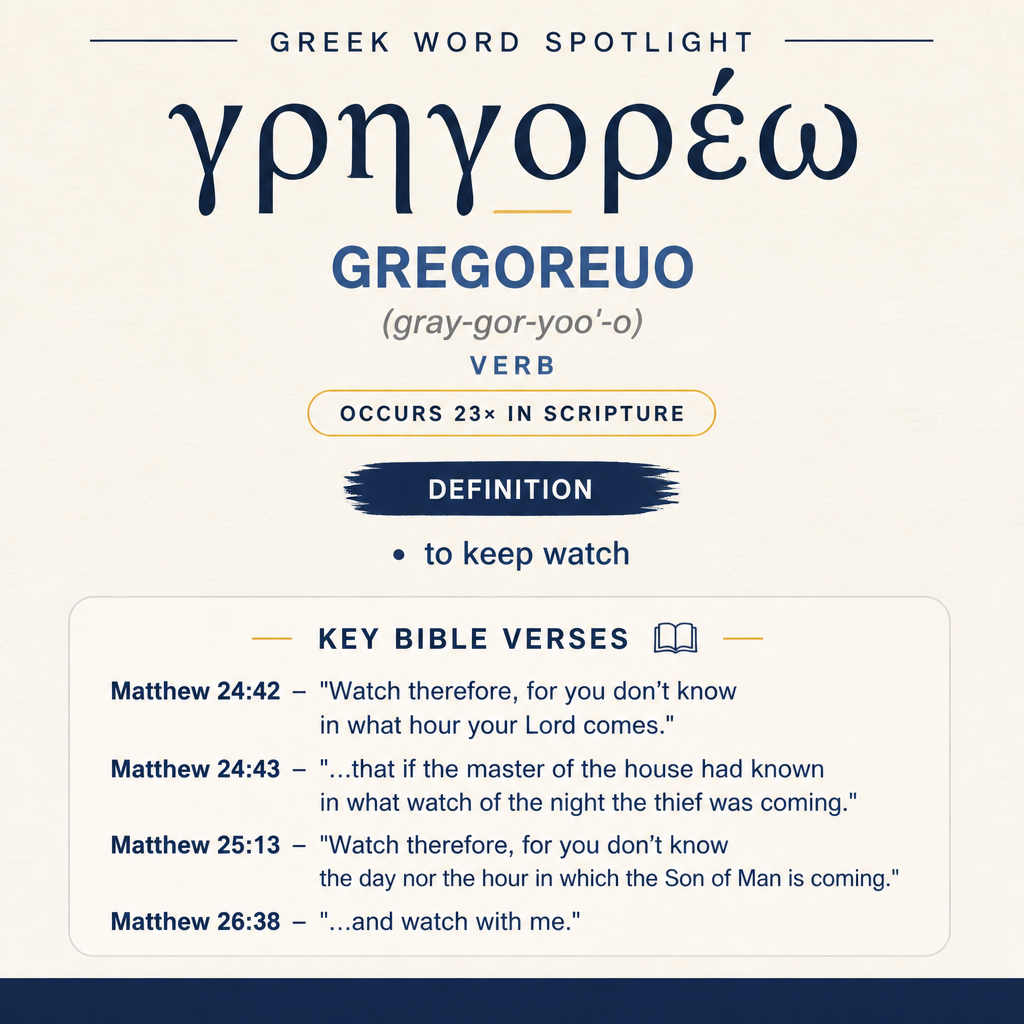
γρηγορέω means “to keep watch” and occurs 23 times in Scripture, including Matthew 24–26 and Mark 13.
Core Meaning
γρηγορέω means “to keep watch.” In the Gospels it is used as a direct call to watchfulness.
Learn More →Gospel Warnings
In Matthew 24:42 and 25:13 it appears with “Watch therefore,” because the timing is unknown. Matthew 24:43 frames watchfulness in terms of a master anticipating a thief.
Learn More →Gethsemane Command
In Matthew 26:38–41 Jesus tells his disciples to “watch with me” and “watch and pray.” He contrasts a willing spirit with weak flesh (26:41).
Learn More →γρηγορέω means “to keep watch,” a call to alertness that appears in Jesus’ teaching about unknown timing and in his summons to his disciples in a moment of distress. In the passages below it frames watchfulness as both practical vigilance and sustained attentiveness in prayer.
Occurrences
“Watch therefore, for you don’t know in what hour your Lord comes.” (Matthew 24:42)
Here γρηγορέω is an imperative grounded in uncertainty: the hour of the Lord’s coming is unknown. The force of the command is shaped by that ignorance; keeping watch is the appropriate posture when the decisive moment cannot be scheduled or predicted.
“But know this, that if the master of the house had known in what watch of the night the thief was coming, he would have watched, and would not have allowed his house to be broken into.” (Matthew 24:43)
In this illustration, keeping watch is pictured as a householder’s vigilance during “what watch of the night.” The verb is linked to preventing loss (“would not have allowed his house to be broken into”), so the action of watching is presented as active guarding in the face of a threat that comes at an unknown time.
“Watch therefore, for you don’t know the day nor the hour in which the Son of Man is coming.” (Matthew 25:13)
This command echoes the earlier emphasis on not knowing, but now the unknown is broadened to “the day nor the hour.” γρηγορέω functions as the practical conclusion drawn from that double uncertainty: watchfulness is the fitting response to the hidden timing of the Son of Man’s coming.
“Then he said to them, “My soul is exceedingly sorrowful, even to death. Stay here, and watch with me.”” (Matthew 26:38)
γρηγορέω is now placed in a relational setting: “watch with me.” The command is tied to Jesus’ stated anguish (“exceedingly sorrowful, even to death”), so keeping watch is framed as staying awake and attentive in companionship with him during a time of intense sorrow.
“He came to the disciples, and found them sleeping, and said to Peter, “What, couldn’t you watch with me for one hour?” (Matthew 26:40)
The verb is sharpened by contrast with “sleeping.” The question “couldn’t you watch… for one hour?” puts a concrete time frame on the expected vigilance. Watching is not an abstract ideal here; it is measurable perseverance—remaining alert for a defined span in solidarity with Jesus.
“Watch and pray, that you don’t enter into temptation. The spirit indeed is willing, but the flesh is weak.” (Matthew 26:41)
γρηγορέω is paired with prayer, and the purpose is stated: “that you don’t enter into temptation.” The explanation that follows (“The spirit indeed is willing, but the flesh is weak”) situates watchfulness amid human frailty; the command addresses a mismatch between willing intention and weak execution, calling for alertness that cooperates with prayer.
““It is like a man, traveling to another country, having left his house, and given authority to his servants, and to each one his work, and also commanded the doorkeeper to keep watch.” (Mark 13:34)
In this parable-like comparison, γρηγορέω is assigned as a specific responsibility: the doorkeeper is commanded “to keep watch.” The household context includes delegated authority and assigned work, and watchfulness appears as an ongoing duty within that entrusted arrangement while the man is away.
“Watch therefore, for you don’t know when the lord of the house is coming, whether at evening, or at midnight, or when the rooster crows, or in the morning;” (Mark 13:35)
The imperative is justified by the unpredictability of the lord’s return and is intensified by the list of possible times (“at evening, or at midnight, or when the rooster crows, or in the morning”). γρηγορέω thus implies sustained readiness across changing conditions and hours, not a brief moment of attention.
“What I tell you, I tell all: Watch.” (Mark 13:37)
γρηγορέω is universalized: the instruction is not restricted to a small circle but is addressed to “all.” The brevity of the command gives it the character of a standing order—an enduring directive that sums up the preceding warning about unknown arrival.
“He said to them, “My soul is exceedingly sorrowful, even to death. Stay here, and watch.” (Mark 14:34)
As in Matthew’s account, the command to watch is anchored in Jesus’ announced grief “even to death.” The wording “Stay here, and watch” links location and attentiveness: remaining present is part of keeping watch, as the disciples are summoned to a steady, wakeful accompaniment in the place where Jesus is praying.
“He came and found them sleeping, and said to Peter, “Simon, are you sleeping? Couldn’t you watch one hour?” (Mark 14:37)
Again, watching is contrasted with sleeping, and again it is measured by “one hour.” The address to Peter (“Simon…”) heightens the personal accountability of the failure: keeping watch is treated as an expected, concrete act of wakeful attention that can be kept or neglected.
“Watch and pray, that you may not enter into temptation. The spirit indeed is willing, but the flesh is weak.” (Mark 14:38)
The same coupling appears: watchfulness with prayer, directed toward avoiding entry into temptation. The concluding line about willing spirit and weak flesh explains why such vigilance is necessary; γρηγορέω is presented as the posture that resists the drift from good intention into vulnerable unpreparedness.

Sense and Usage
Across these sayings and scenes, γρηγορέω (“to keep watch”) consistently involves more than noticing; it is sustained alertness maintained over time. In the teaching passages (Matthew 24:42–43; Matthew 25:13; Mark 13:34–35, 37), watchfulness is demanded because the critical moment is unknowable in advance: “you don’t know in what hour,” “you don’t know the day nor the hour,” and “you don’t know when.” The point is not curiosity about timing but readiness that does not depend on a schedule. The illustration of a house threatened by a thief (Matthew 24:43) pushes the sense toward protective vigilance, an alertness that guards what is entrusted and prevents avoidable loss.
Mark’s household comparison (Mark 13:34–35) places watching within an ordered setting of responsibility: servants have “authority” and “work,” and a doorkeeper is commanded to keep watch. In that picture, keeping watch is part of faithful duty during a master’s absence; it is not a momentary glance but a task that extends through “evening… midnight… when the rooster crows… in the morning.” The list of time markers implies that watching must endure across the whole cycle of night and morning rather than being limited to a convenient hour.
In Gethsemane (Matthew 26:38–41; Mark 14:34, 37–38), the verb takes on a more intimate and spiritually urgent contour. Jesus requests watchfulness “with me,” tying it to presence and companionship at the point of his “exceedingly sorrowful” soul. The disciples’ sleep shows what watchfulness is not, and the repeated “one hour” underscores that the command expects perseverance through a set interval. Finally, “Watch and pray” binds vigilance to prayer as a means of not entering temptation; the explanation about willing spirit and weak flesh portrays watchfulness as a disciplined attentiveness that counters human weakness—an alert posture that supports prayer when resolve alone proves insufficient.
Imagery
The passages gather two dominant images around γρηγορέω: the night watch and the hour of trial. One image is domestic and temporal—a house, a doorkeeper, and the watches of the night—where keeping watch means staying ready through uncertain hours. The other is personal and immediate—disciples urged to stay awake alongside a sorrowful Jesus—where keeping watch means refusing the pull of sleep so that prayerful attentiveness can endure when temptation is near.
Sources: Lexical data from Strong’s Exhaustive Concordance and the Translators Brief Lexicon of Extended Strongs for Greek (STEPBible, CC BY). Occurrence data from the Translators Amalgamated Greek New Testament (STEPBible, CC BY). Scripture quotations from the World English Bible (public domain).