Exploring the Meaning of Gnome in Greek
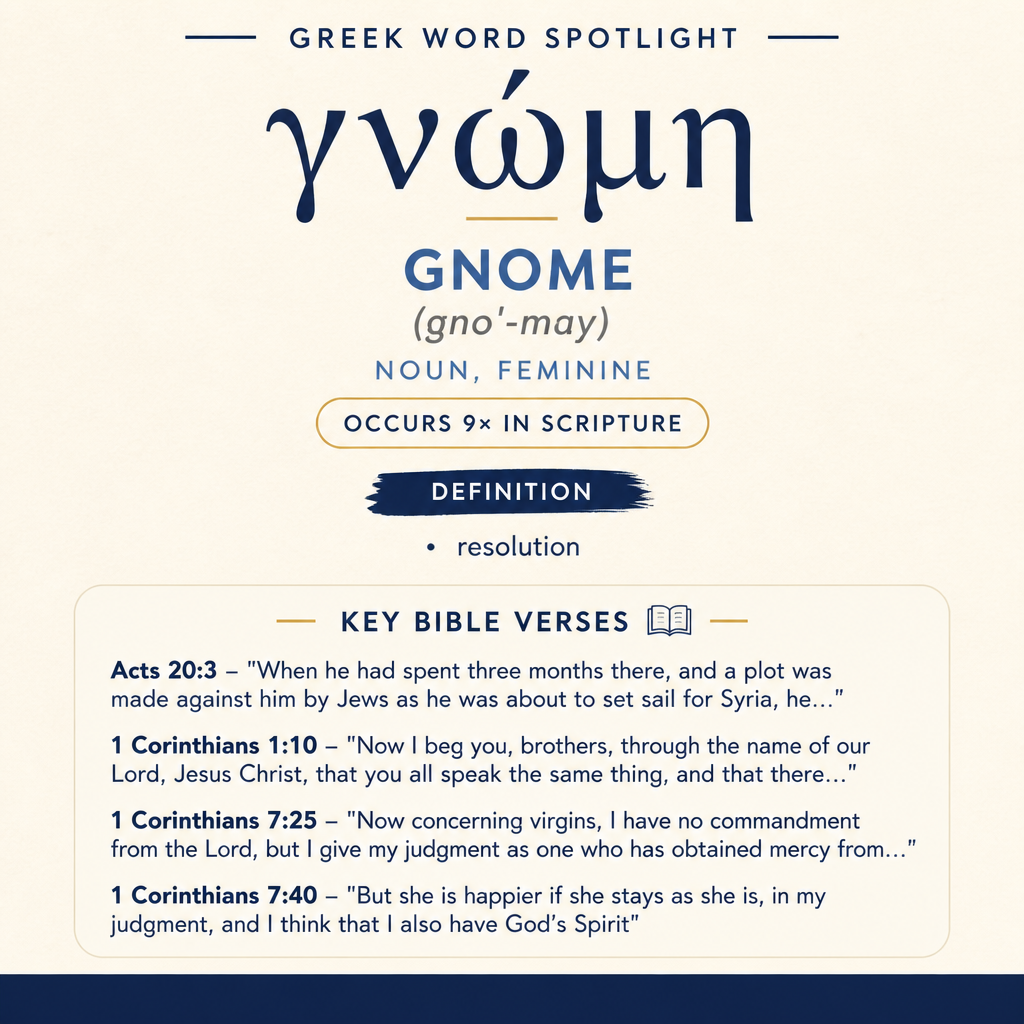
γνώμη means “resolution” and occurs 9 times in Scripture, including Acts 20:3, 1 Corinthians 7:25, and Revelation 17:13.
Core Meaning
γνώμη is defined as “resolution.” In several occurrences it is rendered as “judgment” or “consent” in the verse wording provided.
Learn More →Pauline Usage
In 1 Corinthians 7:25 and 7:40, Paul uses γνώμη for his “judgment.” In 2 Corinthians 8:10 it appears as a “judgment” offered for what is expedient.
Learn More →United Purpose
In Revelation 17:13 and 17:17, γνώμη appears in the phrase “one mind.” There it describes a shared resolution connected with giving power and authority to the beast.
Learn More →γνώμη expresses a settled resolution in contexts that range from personal travel plans to apostolic counsel and unified political purpose. In the passages where it appears, it can describe a determination someone forms, a judgment someone gives, or a single-minded resolve shared by a group.
Occurrences
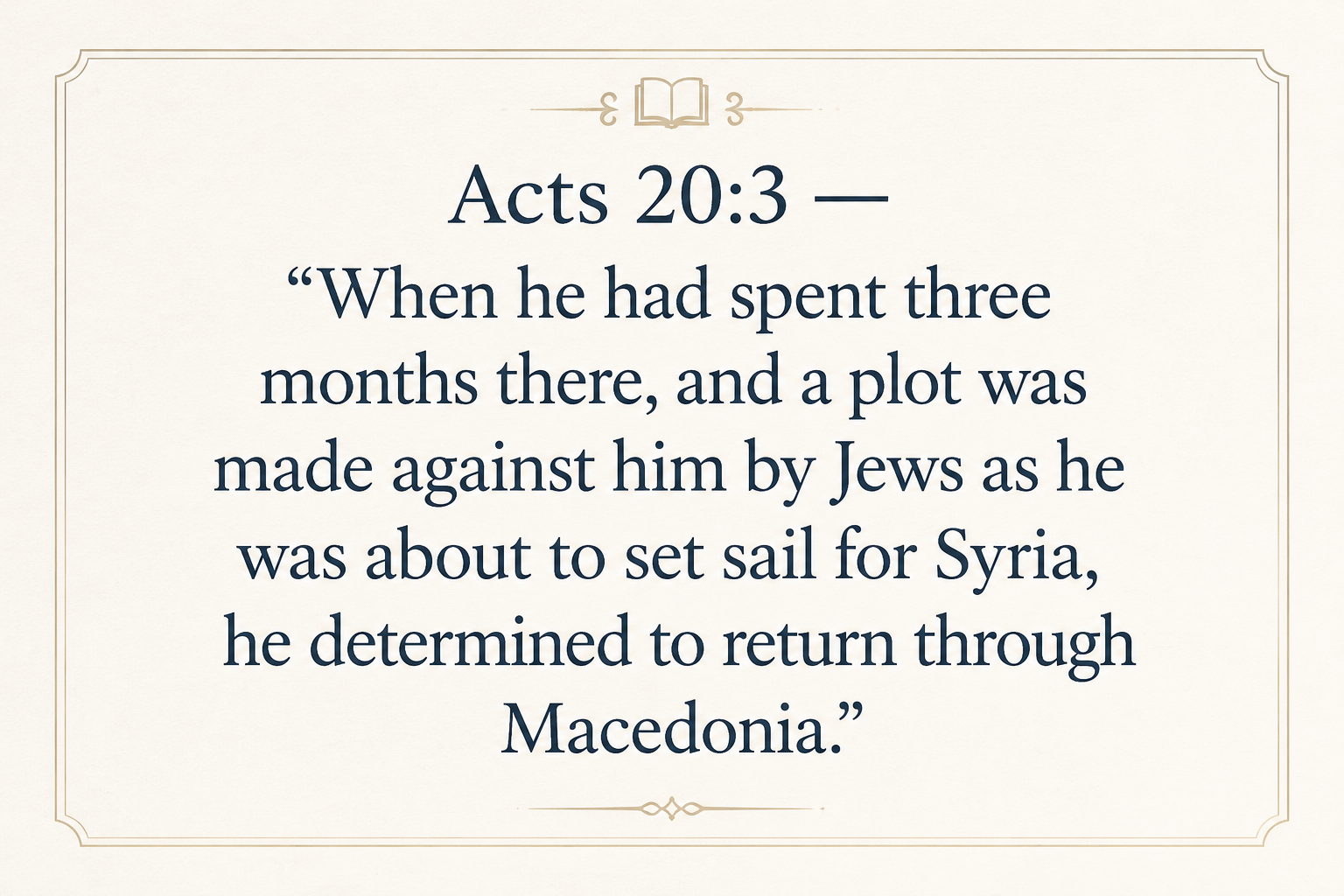
Acts 20:3 — “When he had spent three months there, and a plot was made against him by Jews as he was about to set sail for Syria, he determined to return through Macedonia.”
Here γνώμη marks a practical resolution made under pressure. The verse presents a change of route prompted by danger (“a plot was made against him”) at the very moment of departure (“about to set sail for Syria”). The word contributes the idea of a deliberate, decisive turn: not a drifting preference, but a firm decision that governs action—he “determined to return through Macedonia.” In this scene, resolution is shown as adaptive and purposive: a fixed decision taken in response to circumstances, with an immediate effect on movements and plans.
1 Corinthians 1:10 — “Now I beg you, brothers, through the name of our Lord, Jesus Christ, that you all speak the same thing, and that there be no divisions among you, but that you be perfected together in the same mind and in the same judgment.”
In this appeal for unity, γνώμη is paired with “the same mind,” and the aim is the absence of “divisions.” The word functions as the shared resolution that would hold a community together: not merely aligned thoughts, but aligned conclusions and determinations that shape speech and communal life (“that you all speak the same thing”). The verse frames γνώμη as a communal anchor—an agreed settlement that helps “perfect” the group into cohesion, so that common confession and common direction displace factional fragmentation.
1 Corinthians 7:25 — “Now concerning virgins, I have no commandment from the Lord, but I give my judgment as one who has obtained mercy from the Lord to be trustworthy.”
Here γνώμη is explicitly distinguished from “commandment.” The speaker offers a resolution that carries personal responsibility and pastoral weight, presented as “my judgment,” and it is given from a position of moral credibility (“trustworthy”). The word contributes the sense of a decided counsel—something settled enough to guide others—while still marked as the speaker’s own considered resolution rather than an imposed directive. The contrast in the verse helps define the register of γνώμη: a firm, articulated decision offered for guidance.
1 Corinthians 7:40 — “But she is happier if she stays as she is, in my judgment, and I think that I also have God’s Spirit.”
γνώμη again appears as personal judgment, attached to a specific recommendation about remaining “as she is.” The verse places the resolution in a reasoned assessment (“she is happier if…”) rather than in coercion. The final clause (“I think that I also have God’s Spirit”) underscores that this resolution is not casual; it is offered with a claim of spiritual discernment, even while remaining the speaker’s own determination. In this setting, γνώμη functions as a settled evaluative conclusion meant to direct a life decision.
2 Corinthians 8:10 — “I give a judgment in this: for this is expedient for you who were the first to start a year ago, not only to do, but also to be willing.”
In this exhortation, γνώμη is a stated judgment aimed at what is “expedient.” The resolution is tied to encouraging completion of an earlier initiative (“the first to start a year ago”) with both action (“to do”) and intention (“to be willing”). The word contributes a sense of a concrete, directive resolution that evaluates what should be done now in light of prior beginnings. It is not abstract evaluation; it is a settled determination expressed to move people from an initial start to willing follow-through.
Philemon 1:14 — “But I was willing to do nothing without your consent, that your goodness would not be as of necessity, but of free will.”
Here γνώμη appears in the sphere of “consent,” and the verse contrasts necessity with free willingness. The word contributes the idea that a resolution matters ethically because it reveals whether goodness is compelled or freely chosen. The speaker’s restraint (“willing to do nothing without your consent”) highlights respect for another person’s settled decision. In this context, γνώμη is the enabling condition for voluntary goodness: an action becomes truly “of free will” when it proceeds from a person’s own resolution rather than from external pressure.
Revelation 17:13 — “These have one mind, and they give their power and authority to the beast.”
In this apocalyptic scene, γνώμη is collective and unified (“one mind”), and it leads directly to a decisive transfer (“they give their power and authority to the beast”). The word contributes the sense of a shared resolution that coordinates multiple agents into a single directed act. The emphasis is not on deliberation but on convergence: disparate parties become operationally one by embracing the same settled determination, expressed here as surrendering authority in a coordinated political movement.
Revelation 17:17 — “For God has put in their hearts to do what he has in mind, to be of one mind, and to give their kingdom to the beast, until the words of God should be accomplished.”
This verse again presents γνώμη as unified resolve (“to be of one mind”), but it frames that resolve within a larger divine purpose (“God has put in their hearts to do what he has in mind”). The resolution results in a concrete political act (“to give their kingdom to the beast”) and persists toward an endpoint (“until the words of God should be accomplished”). γνώμη here functions as the inner settled determination that makes coordinated action possible and sustained; it is the decision-shaping center from which the transfer of a kingdom proceeds.

Sense and Usage
Across these passages, γνώμη consistently operates as a settled resolution that issues in direction and action. In Acts, it is an individual determination that redirects travel in the face of threat; the resolution is practical and immediate, shaping a concrete plan. In the Corinthian letters, the word often occupies the space where counsel is needed: it can describe a judgment offered without claiming the force of a command (1 Corinthians 7:25), a personal evaluative conclusion meant to guide a life choice (1 Corinthians 7:40), and an expressed judgment about what is expedient and how willingness should match action (2 Corinthians 8:10). In these settings, γνώμη is a formed decision articulated for the sake of others—clear enough to orient behavior, yet presented in a way that can respect conscience and voluntariness.
That ethical dimension becomes especially visible in Philemon 1:14. There, the concern is not merely what happens, but how it happens: goodness that flows from necessity is contrasted with goodness that arises from free will. γνώμη belongs to the latter sphere; it is tied to consent and voluntary resolve. This shows that resolution is not only a cognitive conclusion but also a moral posture: the settled decision to act freely can preserve the integrity of “goodness.”
In 1 Corinthians 1:10, γνώμη is framed as something a community can share: “the same judgment” accompanies “the same mind,” and the result sought is wholeness rather than division. Here resolution is not simply private; it is a corporate settling on a common determination that governs speech and relationships. Revelation intensifies that corporate aspect in a different direction: unified resolve becomes the engine of political surrender, as a plurality acts as one to hand over “power and authority” and even “their kingdom.” These two poles—church unity in shared judgment and political unity in shared purpose—show γνώμη as a powerful coordinative force: when many embrace one resolution, they can move together with remarkable decisiveness.
Finally, the occurrences together display how γνώμη can be both inwardly located and outwardly evident. It can be framed as something held “in mind” or “in hearts” (Revelation 17:17), yet it is known by its outcomes: a rerouted journey, counsel that guides choices, a completed willingness to act, consent that keeps goodness free, or a united transfer of authority. In every case, resolution is the hinge between deliberation and deed—the point at which intention becomes a settled decision capable of directing behavior.
Imagery
The passages supply vivid scenes where γνώμη shows itself as motion and transfer. In Acts 20:3 it is the concrete pivot of an itinerary—one determination sending a traveler back through Macedonia instead of outward by sea. In Revelation 17:13 and 17:17 it appears as the coordinated act of giving: unified resolve becomes the inner alignment that enables kingdoms and authority to be handed over as a single decisive movement, sustained “until the words of God should be accomplished.”
Sources: Lexical data from Strong’s Exhaustive Concordance and the Translators Brief Lexicon of Extended Strongs for Greek (STEPBible, CC BY). Occurrence data from the Translators Amalgamated Greek New Testament (STEPBible, CC BY). Scripture quotations from the World English Bible (public domain).