Understanding the Significance of Gelos in Greek
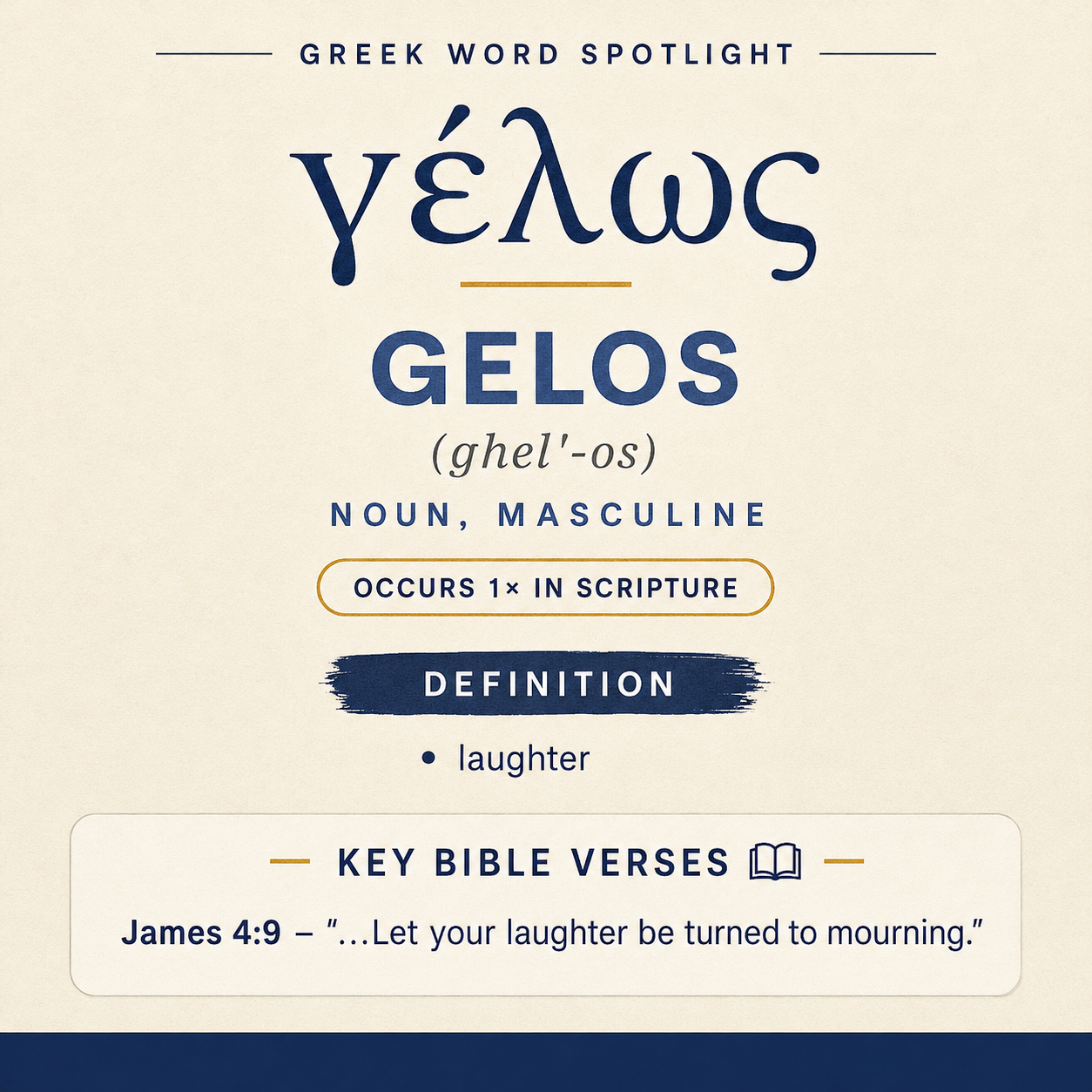
γέλως means “laughter” and appears once in Scripture, in James 4:9.
Biblical Occurrence
This word occurs 1 time in Scripture. Its single occurrence is in James 4:9.
Learn More →James 4:9 Context
In James 4:9, laughter is addressed directly: “Let your laughter be turned to mourning.”
Learn More →γέλως means “laughter” and appears once in the New Testament, in James 4:9. In that context it is named as something to be exchanged for a posture of grief.
Root and Related Words
γέλως (Gelos) derives from the verb gelao (γελάω), “to laugh” (Strong’s G1070). The noun presents laughter as a thing that can be spoken of, evaluated, and directed, rather than simply an action that happens.

Occurrences
“Lament, mourn, and weep. Let your laughter be turned to mourning, and your joy to gloom.” (James 4:9)
Here γέλως functions as a named element of a person’s emotional and social life—something that can be addressed directly and commanded. The line “Let your laughter be turned to mourning” places laughter alongside other outward expressions (“weep”) and interior states (“gloom”), treating it as an identifiable response that may characterize someone’s present condition. Within the verse’s sequence of imperatives (“Lament, mourn, and weep”), laughter stands as a contrasting mood to the grief being urged; it is the concrete marker of a frame of mind that James calls to be reversed. The command is not merely to stop laughing, but to undergo a change so thorough that what had issued in laughter now issues in “mourning,” with “joy” likewise redirected to “gloom.” In this way the noun is part of a paired transformation: laughter ↔ mourning, joy ↔ gloom. γέλως thus contributes a specific, recognizable expression that can be “turned” into its opposite.

Sense and Usage
Because James 4:9 is the only occurrence, its use there provides the main profile of γέλως in Scripture: it denotes laughter as an observable expression that can be singled out and contrasted with other expressions of emotion. The verse treats laughter as something that has a moral and situational appropriateness: it belongs to a state that, in this admonition, must yield to lamentation. In the structure of the sentence, laughter is not discussed as an abstract concept in isolation; it is framed relationally—set against mourning and paired with joy in a twofold reversal. That pairing shows how γέλως can function rhetorically: it stands for a kind of lightness or cheer that is being challenged by the call to grieve.
The imperative “Let your laughter be turned to mourning” also implies that laughter can be considered almost like a possession (“your laughter”), something attached to the addressees as a feature of their current stance. The language of being “turned” signals change rather than suppression. In this single verse, then, γέλως is not merely the sound or act of laughing; it is a named emotional register, publicly legible, that James can set under a summons to repentance-like sorrow. The noun’s placement between commands to lament and to weep anchors it in the sphere of visible human response, while its parallel with “joy” shows it can represent the outward expression corresponding to an inner gladness. Both are called to yield to their darker counterparts (“mourning…gloom”), giving the word a sharp contrastive force in the passage.
Imagery
James 4:9 paints laughter as something that can be exchanged, as if one emotional soundscape gives way to another: from laughter to mourning, from joy to gloom. In that picture, γέλως evokes the audible, social side of human feeling—what others would notice—now deliberately redirected into the quieter, heavier expressions of lament and weeping named in the verse.
Sources: Lexical data from Strong’s Exhaustive Concordance and the Translators Brief Lexicon of Extended Strongs for Greek (STEPBible, CC BY). Occurrence data from the Translators Amalgamated Greek New Testament (STEPBible, CC BY). Scripture quotations from the World English Bible (public domain).