Understanding the Significance of Buthos in Greek
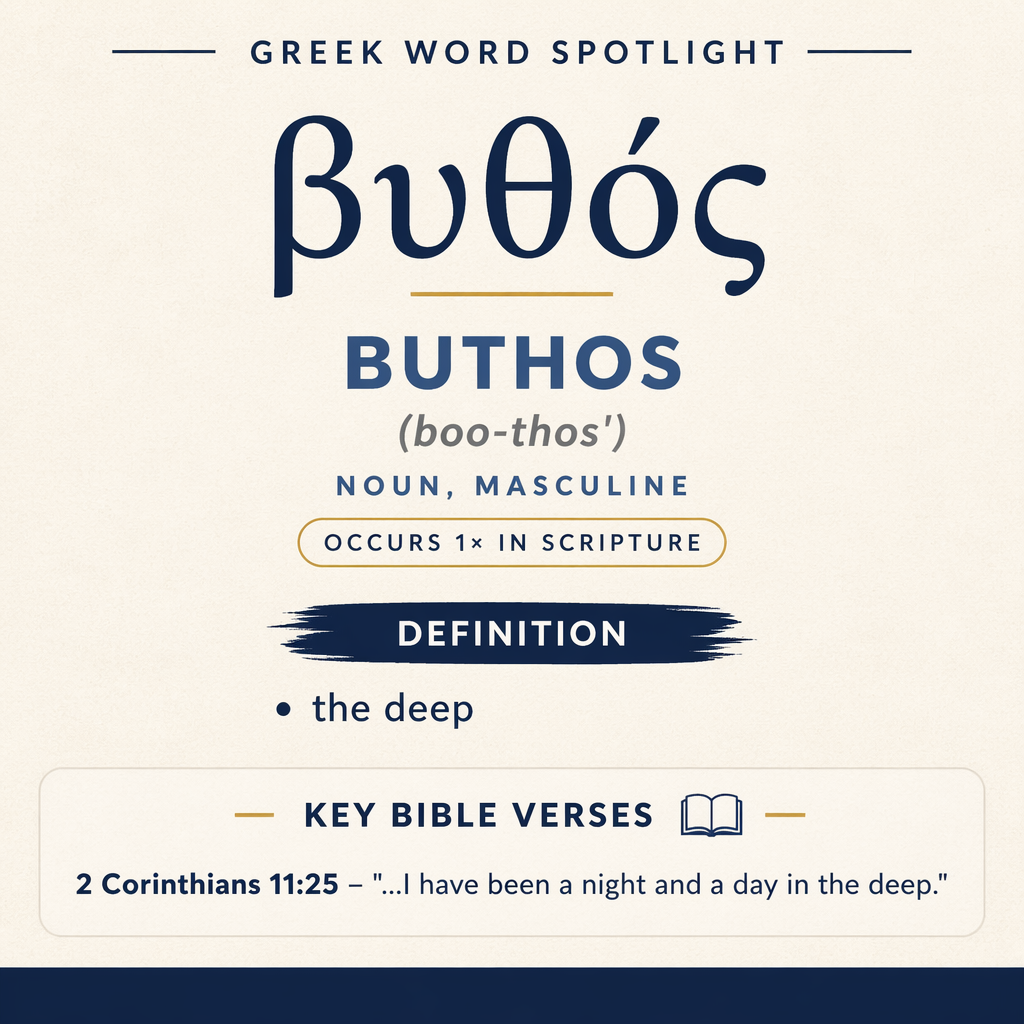
βυθός means “the deep” and appears once in Scripture, in 2 Corinthians 11:25.
Scripture Occurrence
It occurs 1 time in Scripture. The occurrence is in 2 Corinthians 11:25.
Learn More →Context in Verse
In 2 Corinthians 11:25, Paul recounts suffering shipwreck and spending “a night and a day” in the deep.
Learn More →βυθός means “the deep” and appears in a single New Testament setting where Paul recounts the hazards he endured in his ministry. The word functions as a compact image of overwhelming, life-threatening circumstances within a catalog of physical sufferings.
Root and Related Words
βυθός (Buthos) is connected with βάθος (bathos), “depth” (Strong’s G899). The related term frames βυθός within the realm of depth-language, describing a condition marked by profound downwardness rather than a surface experience.

Occurrences
“Three times I was beaten with rods. Once I was stoned. Three times I suffered shipwreck. I have been a night and a day in the deep.” (2 Corinthians 11:25)
Here βυθός appears at the end of a tightly stacked list of hardships: beatings, stoning, and repeated shipwreck. The sequence culminates in an experience that is not merely a moment of danger but an extended ordeal: “a night and a day.” By naming “the deep,” Paul gives a location to his suffering that is both physical and situational—a place where ordinary supports fail and where the body’s survival is pressed to its limits. The phrase “in the deep” does not describe a distant fear but a lived condition, set alongside other concrete acts of violence and disaster.
The syntax and pacing of the sentence place emphasis on duration and exposure. The repeated “Three times… Once… Three times…” prepares the reader for another counted event, but instead of a number Paul gives a span of time: “a night and a day.” Within that temporal frame βυθός becomes the scene of endurance. The word gathers into itself the implied circumstances of being separated from safety after “shipwreck,” and it portrays Paul’s suffering as something that continued through darkness and daylight without relief. “The deep” is not presented as scenery but as the environment in which the apostle’s body remained, hour after hour.
In this verse, βυθός also works rhetorically as the closing image of the line. Beatings and stoning are human-inflicted assaults; shipwreck introduces the chaos of disaster; “the deep” then gives the reader a final, stark setting—depth itself—where helplessness is heightened by the sheer immensity and threat suggested by being beneath or surrounded by deep waters. The word’s force lies in how it compresses that terror and vulnerability into a single noun, leaving the reader with the sensation of sinking, exposure, and isolation that can follow catastrophe at sea.
Sense and Usage
In its lone attestation, βυθός is a concrete term that communicates an extreme environment through the idea of depth. “The deep” is not an abstract metaphor here; it is tied directly to “shipwreck” and to the measured span “a night and a day.” The word therefore functions as a locative marker—where Paul was—yet the choice of this particular depth-word does more than say “water.” It highlights a condition defined by distance from land, distance from rescue, and the engulfing character of deep waters.
Because βυθός is used without embellishment—no adjectives, no extended description—its meaning is carried by its place in the narrative and by the experiential details surrounding it. The verse supplies three interpretive anchors: (1) it follows “Three times I suffered shipwreck,” connecting “the deep” with maritime disaster; (2) it is framed as personal experience (“I have been…”), presenting the deep as endured reality rather than an imagined hazard; and (3) it includes a time span that emphasizes exposure. In this way, the definition “the deep” operates not as a mere geographical note but as a shorthand for a sustained, perilous situation.
The related word βάθος (“depth”) helps clarify the conceptual domain in which βυθός speaks: depth as a defining feature. Within 2 Corinthians 11:25, depth is not discussed in technical terms; it is invoked to convey the kind of place where depth matters—where one’s position relative to the surface becomes a matter of life and death. The noun βυθός, therefore, contributes a vivid boundary to Paul’s list: it shifts the reader from injuries inflicted on land to a vulnerability experienced in a vast, deep setting.
Finally, βυθός serves the passage by intensifying the sense of accumulated hardship. The earlier items in the verse are counted episodes; “the deep” is presented as a prolonged interval. That contrast allows “the deep” to carry a weight beyond a single impact: it becomes the emblem of endurance through time. The definition “the deep” is thus enacted in the verse as a depth-experience that stretches through darkness and light, remaining constant while time passes.
Imagery
In 2 Corinthians 11:25, βυθός evokes an elemental scene: a person alive but exposed, held in the realm of deep water long enough to measure it as “a night and a day.” The word’s imagery is sharpened by its position after “shipwreck,” so that “the deep” functions as the aftermath of disaster rather than a neutral location. Its starkness matches the austere style of the list, offering no narrative flourish—only a blunt, memorable picture of depth endured.
Sources: Lexical data from Strong’s Exhaustive Concordance and the Translators Brief Lexicon of Extended Strongs for Greek (STEPBible, CC BY). Occurrence data from the Translators Amalgamated Greek New Testament (STEPBible, CC BY). Scripture quotations from the World English Bible (public domain).