Exploring the Meaning of Buthizo in Greek
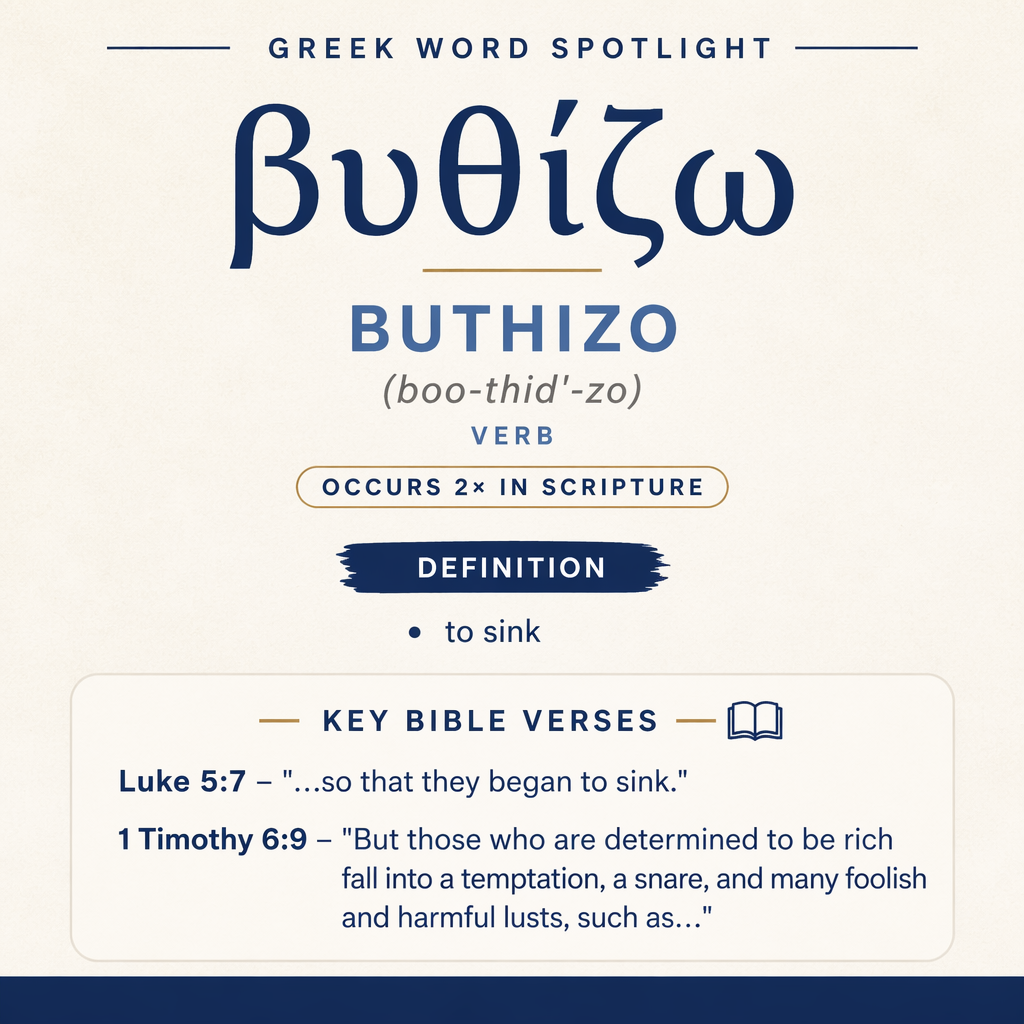
βυθίζω means “to sink” and appears twice in Scripture: Luke 5:7 and 1 Timothy 6:9.
Scripture Occurrences
This word occurs 2 times in Scripture: Luke 5:7 and 1 Timothy 6:9.
Learn More →Usage Contexts
In Luke 5:7, it appears in a narrative about two boats being filled. In 1 Timothy 6:9, it appears in a warning about harmful desires.
Learn More →βυθίζω expresses the action of sinking, appearing once in a literal account of overloaded boats and once in a moral warning that portrays people being drowned in calamity. In both settings, it supplies a vivid downward movement that frames the danger created by an overwhelming load.
Root and Related Words
βυθίζω is derived from bythos (βυθός), “the deep” (Strong’s G1037). The related noun evokes depth as a place into which something can descend.

Occurrences
“They beckoned to their partners in the other boat, that they should come and help them. They came, and filled both boats, so that they began to sink.” (Luke 5:7)
Here βυθίζω is tied to an immediate, physical crisis on the water. The scene moves quickly: one boat signals another for help; both arrive; both are filled. The verb then describes what starts happening to the boats as a direct consequence of being filled—so full that they “began to sink.” The wording makes the sinking the first visible sign that the situation has exceeded safe limits: the abundance in the boats produces a downward movement that threatens the very vessels meant to carry it. The detail that they “began” to sink suggests the onset of the process rather than its completion; the danger is in motion and demands urgent response.
The verse also places the action in a shared effort: “partners in the other boat” come “and help them,” yet the help leads to both boats being filled, so the risk spreads. βυθίζω, therefore, does not merely describe an isolated mishap; it marks the point where success (full boats) turns into peril (boats starting to go down). In this narrative snapshot, sinking functions as a concrete boundary between what can be borne and what overwhelms.
“But those who are determined to be rich fall into a temptation, a snare, and many foolish and harmful lusts, such as drown men in ruin and destruction.” (1 Timothy 6:9)
In this warning, βυθίζω is used to portray what certain desires do to people. The movement is again downward, but the object is “men,” and the setting is not a lake but a chain of moral and spiritual hazards. The sentence builds in stages: a determination “to be rich” leads to a “temptation,” then a “snare,” then “many foolish and harmful lusts.” The verb appears at the end as the cumulative effect of these forces—lusts “such as drown men in ruin and destruction.” The imagery treats ruin and destruction like a deadly depth into which a person can be driven under.
The verb’s placement gives it a summarizing force: after listing multiple dangers, it portrays the final outcome in a single, forceful motion. “Fall into” already suggests descent, and βυθίζω intensifies the picture by depicting the victim not merely stumbling but being pulled down until overwhelmed. The drowning is not accidental; it arises from being “determined” and then ensnared. Within the verse’s logic, the action captures the way a person can be engulfed by consequences that are both “foolish” and “harmful,” ending in “ruin and destruction.”
Sense and Usage
Across its two New Testament occurrences, βυθίζω consistently supplies a sense of downward movement into a depth that brings danger. In Luke it is the natural result of overfilling: the boats are filled to the point where sinking begins. The verb fits a scene where weight and capacity are in view; it presents sinking as the bodily response of the vessel to a load it cannot safely carry.
In 1 Timothy the same action is applied to human life through vivid imagery. The verse does not depict water directly, yet it uses drowning language to describe how a person can be overcome by a progression of inward and outward pressures: temptation, a snare, and lusts. βυθίζω thus serves as a bridge from the physical world of sinking to a moral warning that depicts catastrophe as being submerged. The word’s force lies in its portrayal of being carried downward beyond control—whether a boat going under from an excessive catch or a person being overwhelmed by destructive desires.
The two contexts also highlight different aspects of the action. Luke stresses immediacy and visibility: the sinking begins as the boats are filled, and the danger is observable in the moment. 1 Timothy stresses outcome and consequence: the drowning culminates in “ruin and destruction,” presenting the end-state of a path that starts with a settled determination and continues through entrapment. In both cases, βυθίζω expresses not a neutral descent but a threatening one—an action that signals loss of safety and the need for rescue, restraint, or deliverance.
Imagery
βυθίζω carries a heavy, downward imagery that makes abstract warning tangible. Luke 5:7 frames the motion in a concrete picture of boats taking on more than they can bear: fullness turns perilous as they “began to sink.” 1 Timothy 6:9 takes the same kind of motion and places it in the realm of desire and consequence: people can be “drown[ed]…in ruin and destruction” when cravings and traps press them down. Together, these passages link sinking with being overwhelmed—by weight in one case and by destructive impulses in the other.
Sources: Lexical data from Strong’s Exhaustive Concordance and the Translators Brief Lexicon of Extended Strongs for Greek (STEPBible, CC BY). Occurrence data from the Translators Amalgamated Greek New Testament (STEPBible, CC BY). Scripture quotations from the World English Bible (public domain).