Exploring the Meaning of Brecho in Greek
βρέχω means “to rain down” and appears in Matthew 5:45; Luke 7:38, 7:44; Luke 17:29; James 5:17; and Revelation 11:6.
Core Meaning
βρέχω is defined as “to rain down.” It is used of rain from the sky and also of wetting with tears.
Learn More →Where It Appears
This verb occurs 7 times in Scripture. The listed occurrences include Matthew, Luke, James, and Revelation.
Learn More →Usage Snapshots
Luke 7:38 and 7:44 use it for wetting Jesus’ feet with tears. Luke 17:29 and James 5:17 use it for rain, and Revelation 11:6 for withholding rain.
Learn More →βρέχω means “to rain down,” a verb used in the New Testament both for literal rainfall and for other kinds of “raining” that descend and soak, whether tears on feet or fire from the sky. Its occurrences set the word in scenes of ordinary providence, intimate grief, catastrophic judgment, and prophetic restraint.
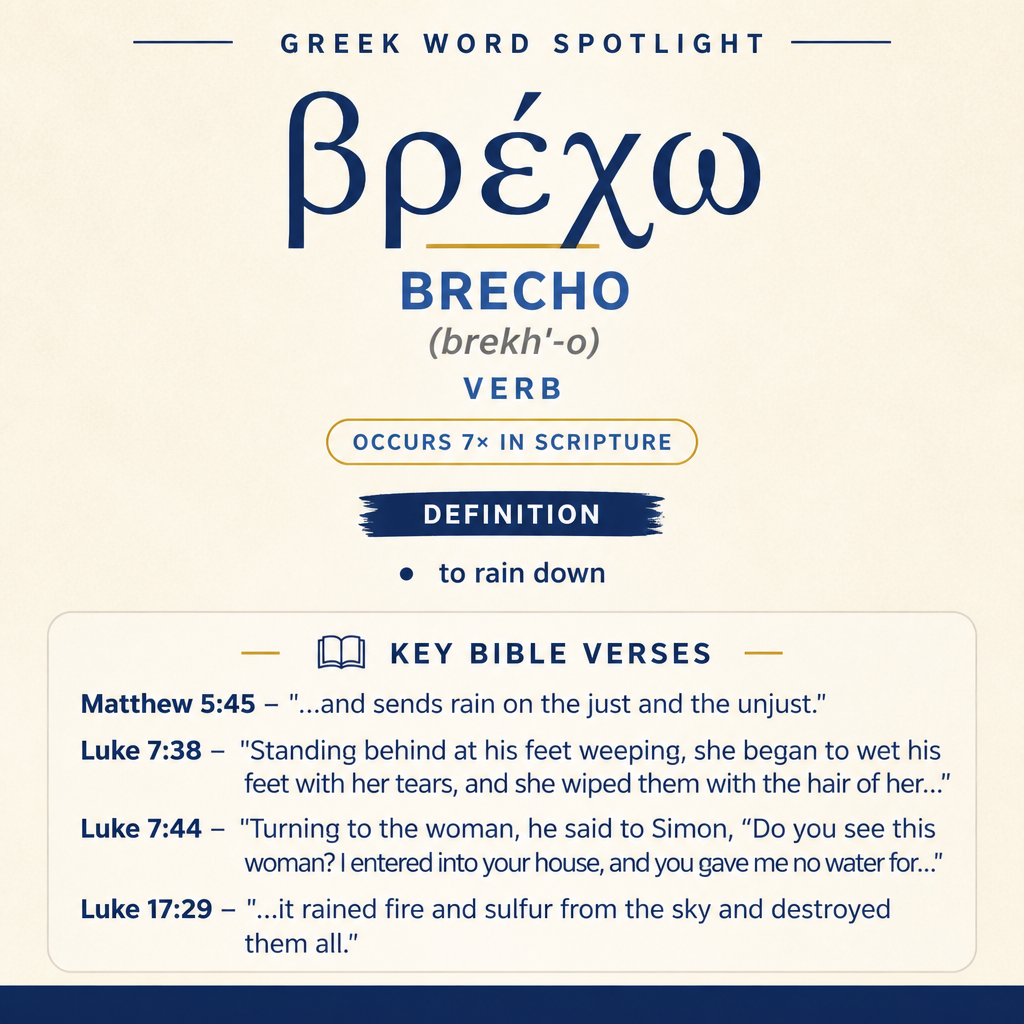
Occurrences
Matthew 5:45: “that you may be children of your Father who is in heaven. For he makes his sun to rise on the evil and the good, and sends rain on the just and the unjust.”
Here βρέχω describes rain as something “sent” from heaven, paired with the rising sun. The action is not random weather but an act that reaches both moral opposites named in the line: “the evil and the good,” “the just and the unjust.” In this setting, “to rain down” evokes a downward gift that falls broadly and impartially, without being restricted to those who merit it. The verse places rain alongside sunlight as a public, visible action that affects everyone under the sky.

Luke 7:38: “Standing behind at his feet weeping, she began to wet his feet with her tears, and she wiped them with the hair of her head, kissed his feet, and anointed them with the ointment.”
βρέχω is applied to tears: her weeping becomes a kind of “raining down” that wets Jesus’ feet. The word makes the physical effect central—his feet become wet—so that her grief is not only internal emotion but a tangible outpouring that falls and soaks. The sequence of actions keeps the wetting in view: tears wet, hair wipes, kisses follow, and ointment anoints. In this intimate scene, the verb’s downward motion is scaled to the closeness of feet and tears, but the imagery remains the same: something descends in sufficient quantity to soak.
Luke 7:44: “Turning to the woman, he said to Simon, “Do you see this woman? I entered into your house, and you gave me no water for my feet, but she has wet my feet with her tears, and wiped them with the hair of her head.”
The verb returns as Jesus contrasts two forms of foot-wetting: expected “water for my feet” versus her tears. βρέχω highlights the woman’s act as a real washing effect, not merely symbolic; the feet are wet either way, but the source differs. The contrast also sharpens the social setting (“I entered into your house”) by framing her tear-wetting as an improvised provision where a host withheld customary water. The verb thus helps Jesus point to an observable result—wet feet—as evidence within the house that answers his question, “Do you see this woman?”
Luke 17:29: “but in the day that Lot went out from Sodom, it rained fire and sulfur from the sky and destroyed them all.”
In this saying, βρέχω intensifies the image of catastrophe by describing destruction as something that “rained” from above. The objects that rain down—“fire and sulfur”—are named as coming “from the sky,” keeping the vertical direction explicit. The result is totalizing: “destroyed them all.” The verb presents judgment as a falling, enveloping event, like a storm, but with lethal contents. The scene’s timing (“in the day that Lot went out”) underscores suddenness: the descent occurs on a marked day, and the rain-down action becomes the decisive turning point.
James 5:17: “Elijah was a man with a nature like ours, and he prayed earnestly that it might not rain, and it didn’t rain on the earth for three years and six months.”
βρέχω here is framed by negation and duration: it “might not rain,” and in fact “it didn’t rain” for an extended period. The verb’s ordinary sense—rain falling on land—is tied to the phrase “on the earth,” identifying the ground as the recipient of what would otherwise descend. The passage uses the verb to depict a withheld downward flow, a prolonged absence that matches the timespan given. Within James’s argument, the rain-down action becomes a measurable, public outcome linked to prayer: the sky’s usual giving is shut off and time passes under that dryness.
Revelation 11:6: “These have the power to shut up the sky, that it may not rain during the days of their prophecy. They have power over the waters, to turn them into blood, and to strike the earth with every plague, as often as they desire.”
βρέχω is again negated, but now the restraint is described as an exercised “power”: they can “shut up the sky, that it may not rain.” The verb depends on the sky as the source and implies rain as something normally released downward, but here it is prevented “during the days of their prophecy,” tying the lack of rainfall to a defined prophetic period. In the broader sentence, this prevented rain stands alongside other actions that affect the created order (“power over the waters,” “strike the earth with every plague”), so that “may not rain” is one element of a larger pattern of controlled, directed effects on earth and waters.

Sense and Usage
Across its uses, βρέχω consistently pictures something descending from above and producing wetness or an inundating effect. When the object is literal rain (Matthew 5:45; James 5:17; Revelation 11:6), the verb naturally aligns with the sky as source and the earth as recipient: rain is “sent,” it falls “on the earth,” and it can be blocked when the sky is “shut up.” These contexts let the verb carry a concrete sense of downward giving: rain arrives from above, touches the ground, and does so either freely (Matthew) or under restraint (James; Revelation). The negated forms in James and Revelation show that βρέχω can be the focal point not only of an event but of its absence—what matters is that the expected downward fall does not occur, and the lack itself is counted in time (“three years and six months”) or bounded by a ministry (“during the days of their prophecy”).
The same downward imagery becomes striking when the “rain down” action is transferred to other substances. In Luke 7:38 and 7:44, tears function as the falling liquid, and the scene keeps the verb’s physical outcome in view: the feet are wet, then wiped. By using the same verb as weather scenes, Luke’s narrative makes her weeping feel abundant and continuous enough to resemble rainfall, yet concentrated onto a small area—feet within arm’s reach. The effect is both intimate and measurable: wetness is the proof of her grief and her care, and it enables the next actions (wiping, kissing, anointing) to be narrated as responses to something that has genuinely soaked.
In Luke 17:29, βρέχω functions as a forceful metaphorical extension: what falls is “fire and sulfur.” The downward movement is emphasized (“from the sky”), but the point is not wetting; it is overwhelming descent that results in destruction. The verb therefore supports a semantic pattern visible across the passages: βρέχω marks an above-to-below movement that can be beneficent (rain for “the just and the unjust”), withheld (no rain “on the earth”), intimate (tears wetting feet), or devastating (fire and sulfur destroying all). In each case, the verb helps the reader picture an event that comes from above and reaches its target with unavoidable contact—either because it falls widely over “the evil and the good,” or because it falls directly onto the very feet being tended, or because it falls from the sky with catastrophic effect.
Imagery
The passages together make βρέχω an evocative verb of descent: rain sent from heaven, tears falling in grief, and fire-and-sulfur raining in judgment. Even where the action is prevented, the imagery depends on an imagined opening of the sky; to “shut up the sky” assumes rain as a normal downward movement that can be released or restrained. The word’s scenes range from gentle, everyday weather to moments where what falls defines the moral and emotional weight of the narrative—impartial generosity in Matthew, vulnerable devotion in Luke, sudden ruin in Luke 17, and prophetic authority in Revelation.
Sources: Lexical data from Strong’s Exhaustive Concordance and the Translators Brief Lexicon of Extended Strongs for Greek (STEPBible, CC BY). Occurrence data from the Translators Amalgamated Greek New Testament (STEPBible, CC BY). Scripture quotations from the World English Bible (public domain).