Understanding the Meaning of Bosor in Greek
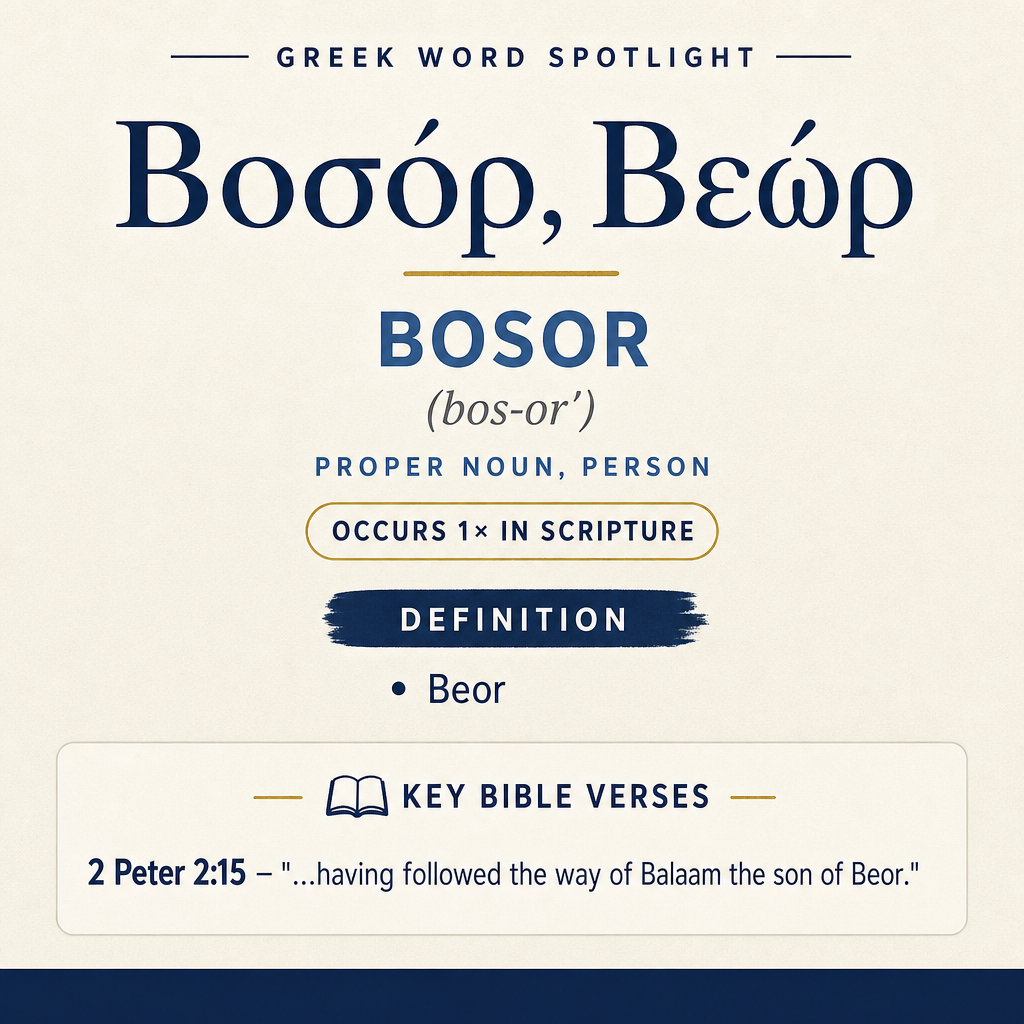
Βοσόρ (Βεώρ), transliterated Bosor, means Beor and appears once in Scripture in 2 Peter 2:15.
Verse Context
In 2 Peter 2:15 it identifies “Balaam the son of Beor.” The verse mentions loving “the wages of wro” in the provided text.
Learn More →Bosor is the name Beor. It appears in the New Testament in a single reference where it functions to identify a father in a patronymic description.
Occurrences
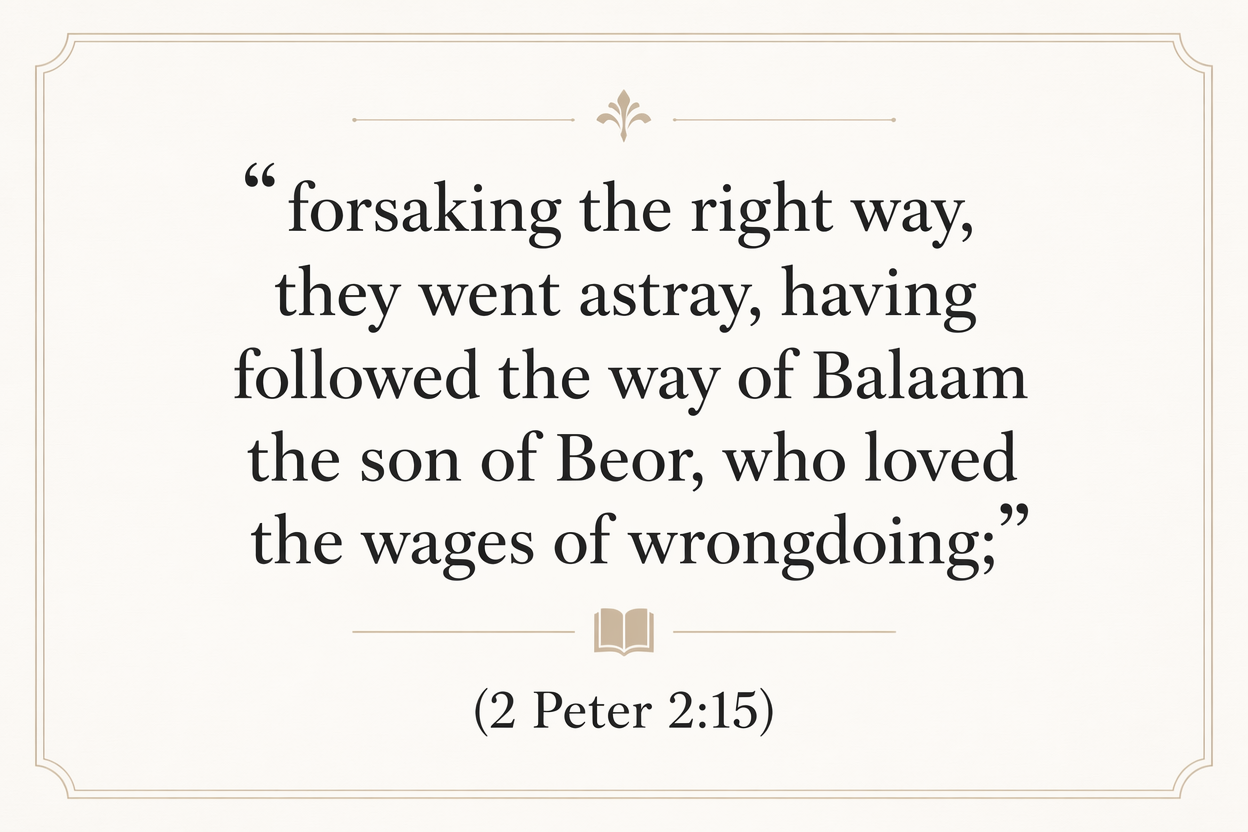
“forsaking the right way, they went astray, having followed the way of Balaam the son of Beor, who loved the wages of wrongdoing;” (2 Peter 2:15)
In this sentence, Bosor (Beor) anchors the phrase “Balaam the son of Beor” as a precise identification of the figure whose “way” is being followed. The surrounding clauses build a moral trajectory: “forsaking the right way” and “went astray” are set over against the “right way,” and the reference to Balaam is presented as an emblem of that departure. Within that argument, the proper name does not introduce a separate action of its own; it supplies lineage, tightening the reference so that the reader understands which Balaam is meant. By naming Beor as Balaam’s father, the text establishes an identifiable character whose “way” can be held up as a pattern—specifically a pattern bound to “the wages of wrongdoing.”
The immediate context also shows how the patronymic phrase contributes to the force of the warning. The audience is not merely told that some have wandered; they are told that this wandering has taken a recognizable shape: it is “the way of Balaam the son of Beor.” The name Beor therefore participates in a rhetorical move from general description (“went astray”) to concrete identification (a named person in a father-son relation). In the flow of the verse, this identification enables the closing characterization to land with more weight: the one being referenced “loved the wages of wrongdoing.” Naming Beor keeps the reference fixed on a particular Balaam, so that the moral assessment attaches to a definite example rather than an anonymous type.

Sense and Usage
As a proper name glossed “Beor,” Bosor functions as a referential label rather than a descriptive term. In 2 Peter 2:15 it appears embedded in a familial designation: “Balaam the son of Beor.” This is the most basic usage of a personal proper noun in narrative and exhortation: it points to a person, and it does so in a way that secures identity by attaching that person to a known relation (“son of”). The name’s semantic contribution is therefore not an added quality, but a narrowing of reference—marking out the father whose name distinguishes the son being invoked.
Because the verse is framed as moral exhortation, the name’s function is also polemical: it helps draw a boundary around the example being used. The author describes a movement away from “the right way” toward an alternate “way,” and that alternate “way” is tied to a named individual. The father’s name operates as part of that identification, much like a formal designation, which supports the author’s intent to make the example unmistakable. In this setting, Bosor (Beor) is not an ornament; it is a stabilizing detail that supports the argument by fastening it to a definite, historically recognizable referent.
The verse also shows the kind of discourse where such a name is apt to appear: a warning that relies on recognizable precedent. The clause “having followed the way of Balaam the son of Beor” makes the act of “following” hinge on an already-established “way” associated with that figure. Bosor contributes indirectly to this by giving the figure a fuller, more specific designation, which in turn allows the “way” ascribed to him to be treated as a known trajectory. The personal name therefore serves the text’s movement from ethical diagnosis (wandering) to ethical illustration (a named pattern), and it does this through straightforward identification.
Imagery
The lone occurrence places Bosor within the imagery of paths and travel: “the right way” versus going astray. The name itself carries no pictured object in the sentence, but it stands at the point where the metaphor of a “way” is attached to a personal exemplar: “the way of Balaam the son of Beor.” In the verse’s compact wording, that attachment turns the imagery of wandering into a concrete warning—misdirection is not only a movement off-course, but a choice to trace a named route marked by love for “the wages of wrongdoing.”
Sources: Lexical data from Strong’s Exhaustive Concordance and the Translators Brief Lexicon of Extended Strongs for Greek (STEPBible, CC BY). Occurrence data from the Translators Amalgamated Greek New Testament (STEPBible, CC BY). Scripture quotations from the World English Bible (public domain).