Understanding the Meaning of Bibrosko in Greek
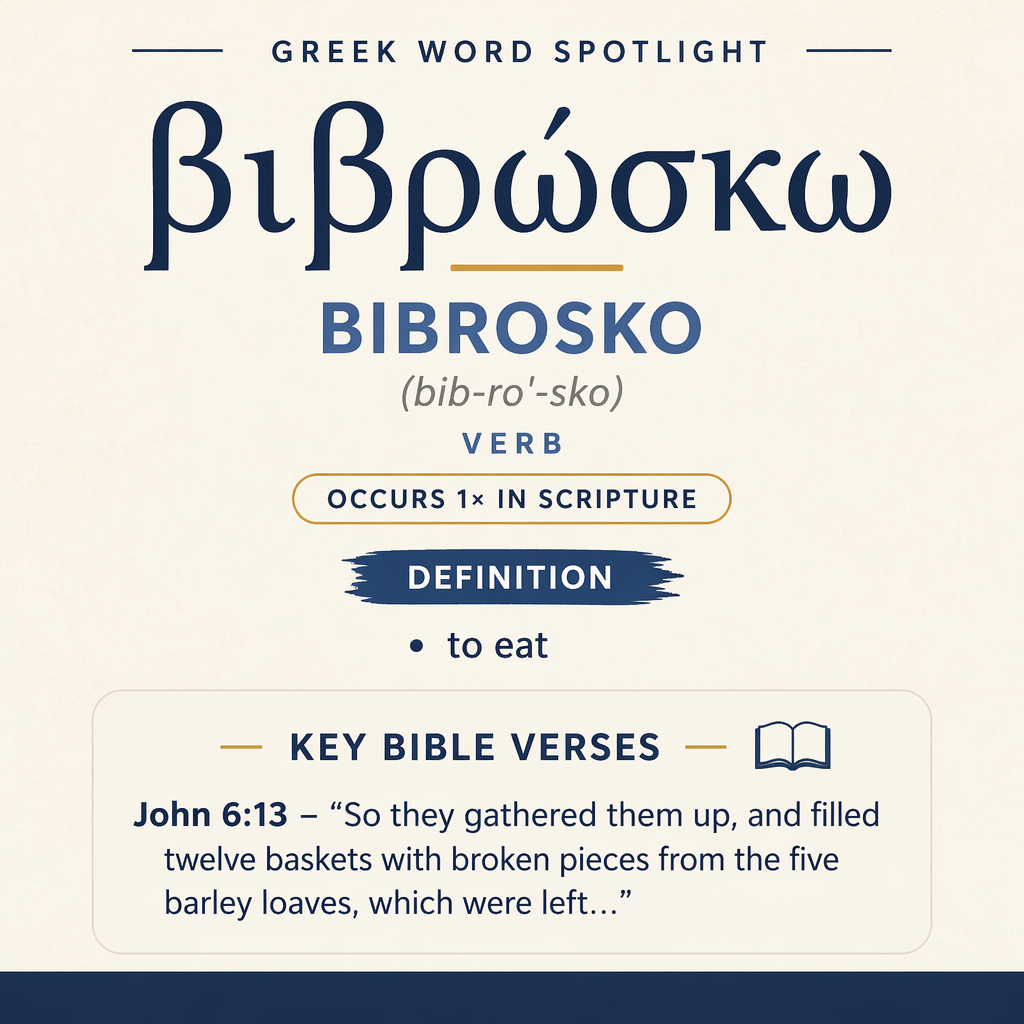
βιβρώσκω means “to eat” and appears once in Scripture, in John 6:13.
Scripture Occurrence
This verb occurs 1 time in Scripture. Its single occurrence is in John 6:13.
Learn More →Verse Context
In John 6:13, it appears in the account where twelve baskets were filled with leftover broken pieces from five barley loaves.
Learn More →βιβρώσκω means “to eat” and appears in the account of the crowd being fed from five barley loaves. In its lone New Testament attestation, it marks the act of eating as the human response to a provision that proves more than sufficient.
Root and Related Words
βιβρώσκω (Bibrosko) is related to bosko (βόσκω), “to feed” (Strong’s G1006). The relationship aligns the act of eating with the larger scene of food being given and taken in a setting of shared provision.

Occurrences
“So they gathered them up, and filled twelve baskets with broken pieces from the five barley loaves, which were left over by those who had eaten.” (John 6:13)
In John 6:13, “had eaten” identifies the people as recipients who have already taken their share of the loaves. The verse is focused on what follows that eating: the gathering of “broken pieces” and the filling of “twelve baskets” with what remains. Within that sequence, the act of eating is not narrated for its own sake, but functions as a hinge between two concrete moments—initial distribution (implied by the availability of loaves to eat) and the careful collection of leftovers (explicitly described). The wording “left over by those who had eaten” ties the remaining pieces directly to the completed act of consumption: the leftovers are not merely unused supplies, but fragments that exist after the crowd’s hunger has been addressed.
The verb also helps define the perspective of the verse. The scene is not told from the vantage point of preparation (“five barley loaves”) nor simply of inventory (“twelve baskets”), but from the vantage point of outcome: people have eaten, and what remains is measured. By placing eating before the mention of surplus, the sentence makes the abundance of what is gathered more striking: the baskets are filled not because no one ate, but after eating has taken place. The “broken pieces” are therefore read as the remainder of a real meal, not as untouched bread, and the verse presents that remainder as substantial enough to be collected deliberately and counted in an orderly way (“twelve baskets”).
Finally, “had eaten” locates the action in the completed past relative to the gathering. The crowd’s eating is treated as a finished event that explains why there are fragments at all and why they are now being gathered. The verse gives eating a communal contour: it is “those who had eaten” as a group, and the leftovers are described in relation to that group experience of taking food and being satisfied enough to leave pieces behind.
Sense and Usage
Across its attested use, “to eat” is expressed in a way that is concrete and ordinary, naming the basic physical act that turns food into nourishment. In John 6:13 that ordinariness matters: the verse does not present eating as a metaphorical action within the sentence itself, but as the plain event that precedes gathering and counting. The setting is defined by tangible objects—“five barley loaves,” “broken pieces,” and “twelve baskets”—and the verb fits that tangible frame by identifying the most natural thing done with loaves: they are eaten.
At the same time, the verb’s placement within the sentence shapes how the reader evaluates the result. Eating is the assumed goal of food, and the text expressly affirms that goal has been met (“those who had eaten”). Only then does it highlight the extent of what remains (“filled twelve baskets”). The meaning “to eat,” therefore, carries a subtle narrative force here: it anchors the later measurement of surplus in the prior reality of consumption. The fragments are not evidence of failure to distribute, but evidence of such ample provision that even after a group has eaten, a large quantity can be collected. The sentence thus uses the simple act of eating to establish the baseline against which “left over” is understood.
The wording also distinguishes between the whole loaves and what becomes of them through eating. The verse speaks of “broken pieces from the five barley loaves.” Within the logic of the sentence, “broken pieces” are the form the loaves take in the aftermath of the crowd’s eating. The verb “to eat” thus belongs to a chain of implied actions: loaves are present, pieces are broken, people eat, and pieces remain to be gathered. Even without describing each step explicitly, the mention of eating confirms that the bread has passed through the hands and mouths of many, moving from a small counted quantity (“five barley loaves”) into scattered remnants significant enough to fill multiple containers.
Because this is a single attestation, the semantic range displayed here is concentrated: “to eat” denotes actual eating in the setting of a shared meal. The context supplies the contours of that act—many participants (“those who had eaten”), an identifiable food source (“five barley loaves”), and a clearly observed aftermath (“left over,” “twelve baskets”). In this usage, the verb stands as a marker of completion and satisfaction within the story’s flow: eating has occurred, and the remaining bread is what follows that completed act.
Imagery
The imagery attached to “to eat” in John 6:13 is the imagery of a finished meal and its carefully gathered remains. The scene is quiet but vivid: bread that has been broken into pieces, a group that has eaten, and a deliberate collecting that fills baskets with what is left. The verb keeps the verse grounded in bodily reality—people actually ate—and that reality frames the striking picture of abundance after consumption.
Sources: Lexical data from Strong’s Exhaustive Concordance and the Translators Brief Lexicon of Extended Strongs for Greek (STEPBible, CC BY). Occurrence data from the Translators Amalgamated Greek New Testament (STEPBible, CC BY). Scripture quotations from the World English Bible (public domain).