Understanding the Meaning of Bibliaridion in Greek
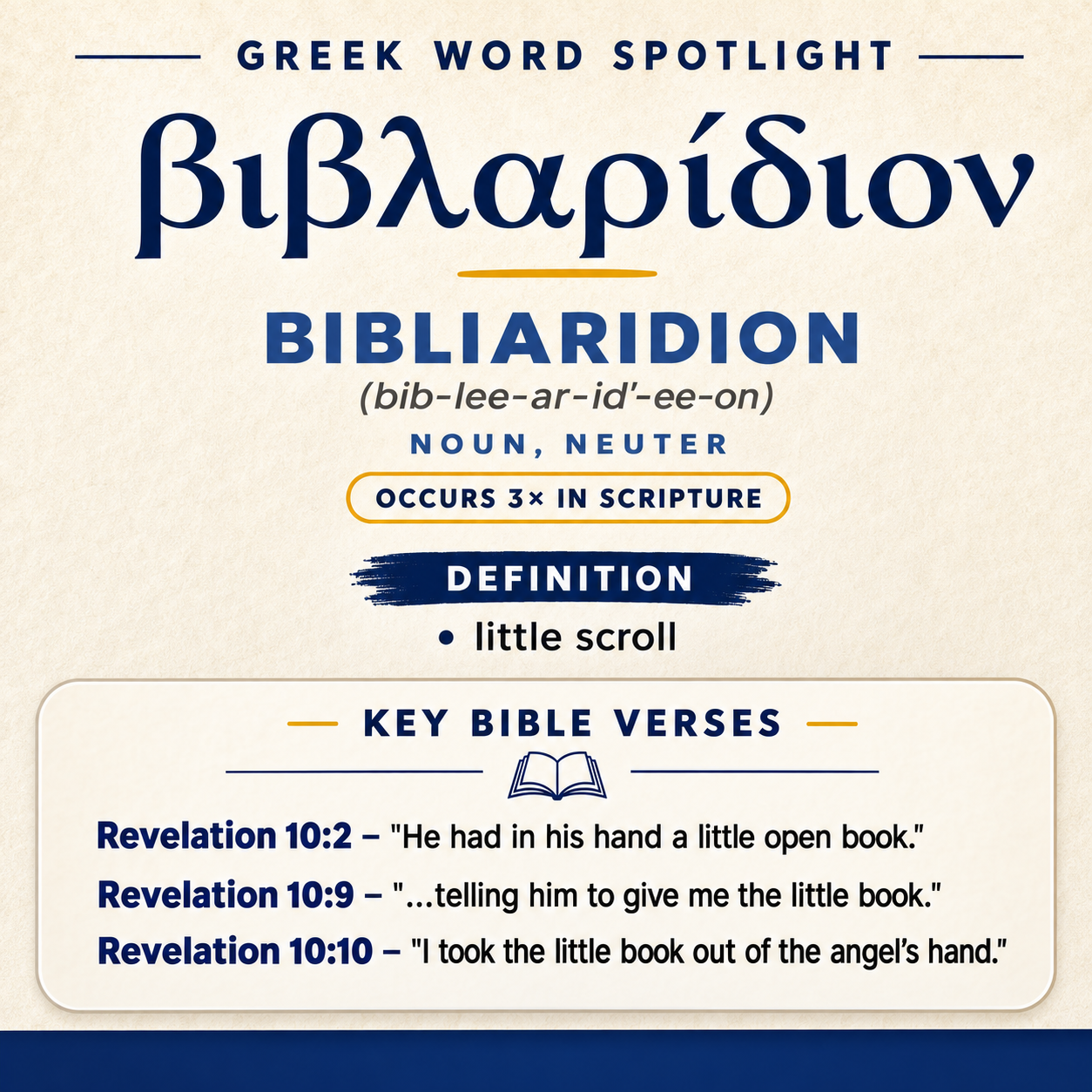
βιβλαρίδιον means “little scroll” and appears three times in Revelation 10:2, 10:9, and 10:10.
Revelation Context
In Revelation 10:2, an angel holds a little open book while standing on sea and land.
Learn More →Taken and Eaten
In Revelation 10:9–10, John takes the little book from the angel and eats it; it is sweet as honey in his mouth.
Learn More →Bibliaridion means “little scroll” and appears in Revelation 10 within a single tightly linked vision: an angel holds the little scroll, and John is commanded to take it and eat it.
Root and Related Words
Biblion (βιβλίον), “scroll” (Strong’s G975), stands behind bibliaridion as the related word from which it is derived. In Revelation 10 the derived form helps keep attention on a scroll specifically presented as small and handled directly in the scene.

Occurrences
“He had in his hand a little open book. He set his right foot on the sea, and his left on the land.” (Revelation 10:2)
Here the little scroll is introduced as an object already “open” and already “in his hand.” The scene is visual and spatial: the angel’s stance spans “the sea” and “the land,” while the little scroll is held ready, not put away or sealed. The word marks the scroll as a discrete, portable item within the vision—something that can be possessed, displayed, and passed from hand to hand. Its being open in the angel’s hand also frames it as accessible within the moment of the vision, prepared for the action that will follow.
“I went to the angel, telling him to give me the little book. He said to me, “Take it, and eat it. It will make your stomach bitter, but in your mouth it will be as sweet as honey.”” (Revelation 10:9)
In this verse the little scroll becomes the focus of a direct request and a direct command. John approaches (“I went to the angel”), asks for the little scroll, and receives instruction on what to do with it: “Take it, and eat it.” The little scroll is thus not merely a prop; it is something intended to be received and internalized through a startling, concrete action. The saying that follows attaches a two-stage bodily experience to the act of eating: sweetness “in your mouth” and bitterness in “your stomach.” The little scroll is the tangible medium of that experience—something that produces an immediate taste and a later internal effect. The word’s “little” quality keeps the command imaginable within the narrative logic: the scroll is small enough to be taken and eaten, yet significant enough to carry a message that affects the one who consumes it.
“I took the little book out of the angel’s hand, and ate it. It was as sweet as honey in my mouth. When I had eaten it, my stomach was made bitter.” (Revelation 10:10)
This occurrence narrates the fulfillment of the command with careful attention to physical detail. The little scroll is transferred “out of the angel’s hand,” emphasizing that it is a real item within the vision’s action sequence, capable of being grasped and removed. John then “ate it,” and the predicted effects occur in the same order given in the prior verse: sweetness first (“as sweet as honey in my mouth”), then bitterness after ingestion (“my stomach was made bitter”). The little scroll is therefore the immediate cause of a sensory contrast that unfolds over time—first on the tongue, then in the stomach—so the word anchors the vision’s message in an embodied, memorable action rather than in abstract description alone.
Sense and Usage
Across these three verses, “little scroll” functions as a concrete object with a consistent set of narrative roles: it is held, requested, given, taken, and eaten. Its “littleness” is not treated as a minor detail but as part of how the scroll operates in the scene. A scroll large enough to be unfurled for reading could remain primarily visual, but the little scroll in Revelation 10 is handled at close range and brought into the body. The term helps the reader track an item that moves from display (“in his hand a little open book”) to personal possession (“give me the little book”) to internal experience (“take it, and eat it”).
The usage also shows how a physical object can bear an experience described in sensory terms without changing the basic sense of the word itself. The little scroll remains a scroll; what changes is its relation to the characters and the effects associated with consuming it. The text presents a tight coupling between object and outcome: the little scroll is the thing taken, and the sweetness and bitterness are the paired results. The sweetness is located “in your mouth,” suggesting an immediate reception that is pleasant; the bitterness is located in the “stomach,” suggesting a deeper, later impact that is difficult. The little scroll thus marks the point where revelation is not only seen or held but taken in, producing a complex response within the one who receives it.
Finally, the little scroll’s openness in the first occurrence and its consumption in the latter two together highlight a movement from availability to assimilation. In Revelation 10:2 it is already “open,” poised for use. In Revelation 10:9–10 it is not merely inspected; it is eaten, so that what was external becomes internal. Within the boundaries of these verses, bibliaridion helps frame revelation as something that can be both sweet to receive and bitter to carry, with the small scroll serving as the concrete vehicle for that twofold experience.
Imagery
The imagery attached to the little scroll in Revelation 10 is vivid and tactile: an open scroll in an angel’s hand; a prophet-like figure reaching to take it; and the surprising act of eating it, followed by sweetness and bitterness. The word gathers these actions around a single, manageable object—small enough to be held and consumed—so that the vision’s message is pictured not only as something presented from above but as something taken in and felt within.
Sources: Lexical data from Strong’s Exhaustive Concordance and the Translators Brief Lexicon of Extended Strongs for Greek (STEPBible, CC BY). Occurrence data from the Translators Amalgamated Greek New Testament (STEPBible, CC BY). Scripture quotations from the World English Bible (public domain).