
Exploring the Meaning of Basileion in Greek
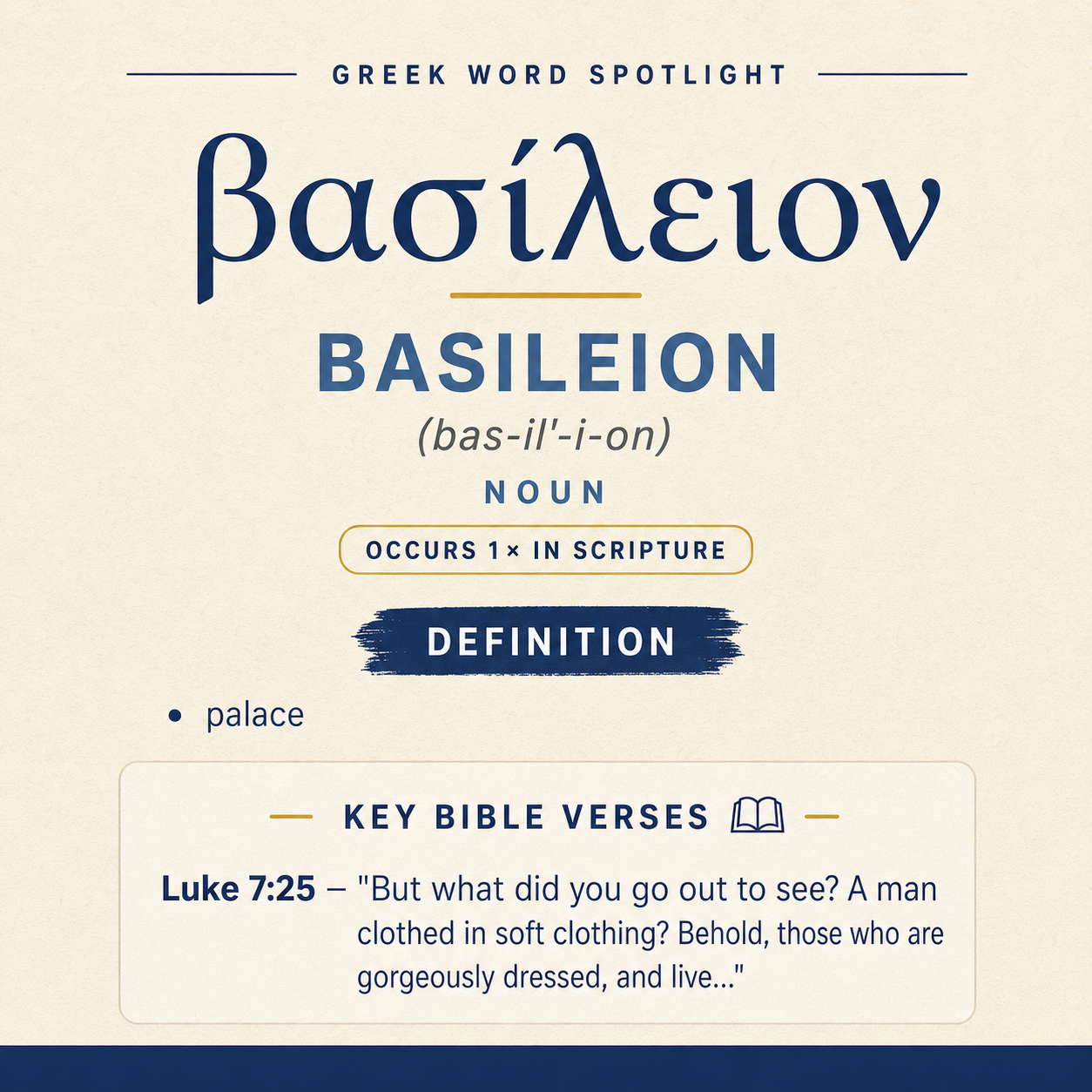
βασίλειον means “palace” and appears once in Scripture, in Luke 7:25.
Scripture Occurrence
This word occurs 1 time in Scripture. Its single occurrence is in Luke 7:25.
Learn More →Verse Context
In Luke 7:25, it appears in a question about people in soft clothing and those gorgeously dressed.
Learn More →Basileion means “palace” and appears once in the New Testament, in Jesus’ question about what people expected to find when they went out to see John the Baptist. In that single setting it evokes an elite residence associated with royal life and the comforts that attend it.
Root and Related Words
Basileion derives from basileios (βασίλειος), meaning “kingly” (Strong’s G934). The related adjective frames the noun in the orbit of royalty: what belongs to a king and what is characteristic of a king’s sphere.
Occurrences
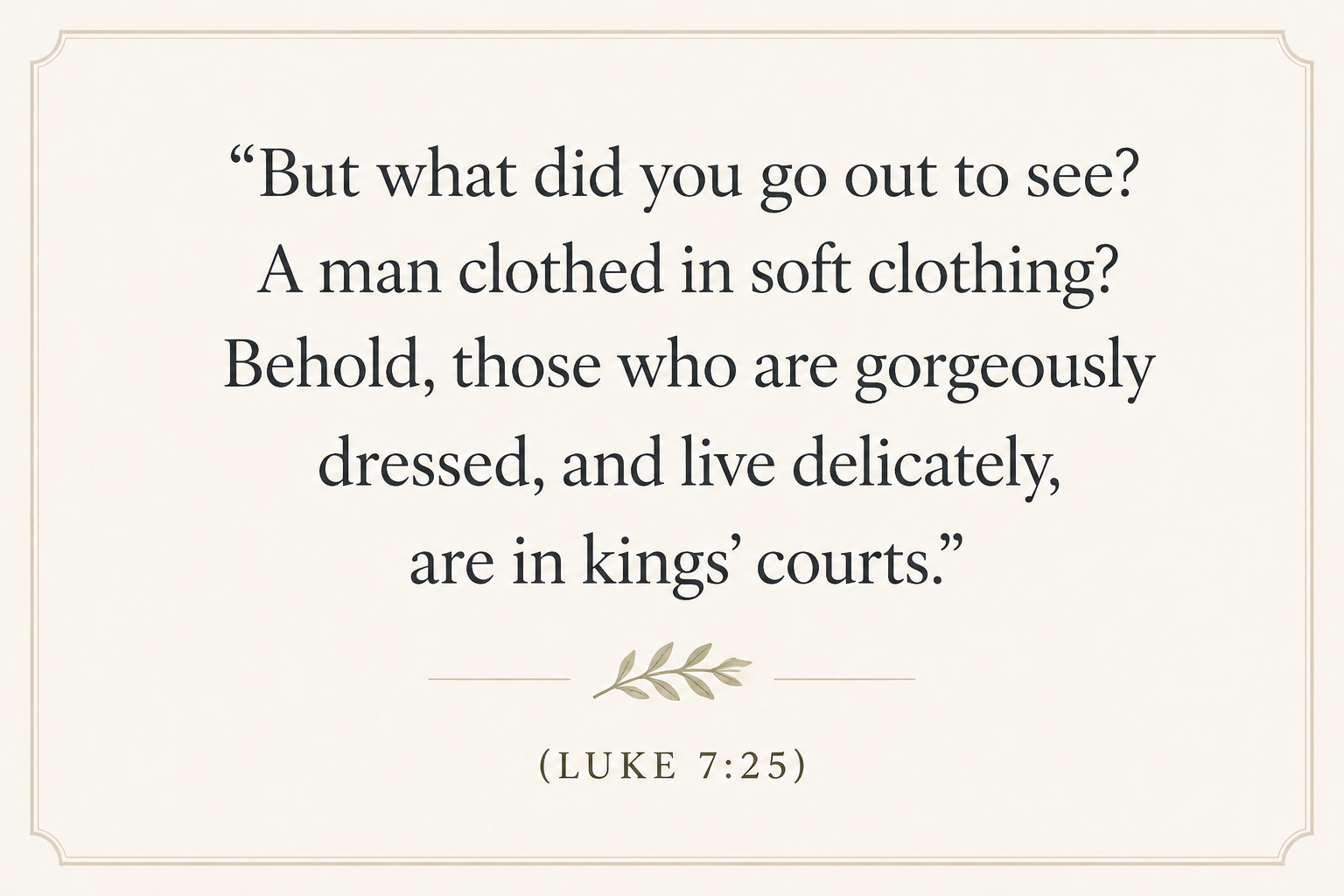
“But what did you go out to see? A man clothed in soft clothing? Behold, those who are gorgeously dressed, and live delicately, are in kings’ courts.” (Luke 7:25)
In Luke 7:25, basileion sits inside a contrast created by a sequence of questions. The verse turns on what people “go out to see,” and the imagery tightens from the general (“a man”) to the specific (“clothed in soft clothing”). The word translated “kings’ courts” supplies a definite social location for such a figure: not the open place where one would “go out” to hear a prophet, but a palace setting where “those who are gorgeously dressed” and who “live delicately” are found.
The logic of the sentence depends on the palace as a recognizable environment. It is not merely a building; it is the setting in which a certain kind of life is expected and sustained. The description “gorgeously dressed” fits the palace because a palace is imagined as a place where fine clothing belongs. Likewise “live delicately” fits because palace life is pictured as sheltered, pampered, and maintained by resources not available everywhere. Basileion anchors these traits in a concrete sphere: whatever else “soft clothing” might suggest, the verse says the proper habitat for such luxury is the king’s palace.
The contrast also works geographically and socially. The question “what did you go out to see?” implies movement outward, away from ordinary centers of power and comfort; the palace, by contrast, represents the place one would not need to “go out” to find luxury. Basileion therefore sharpens the rhetorical point: if the goal were spectacle and refinement, one would look in royal residences, not in the setting where John was encountered. The word helps the saying draw a line between two worlds—one marked by delicacy and display, the other by the kind of public, demanding ministry implied by the whole frame of the question.
Sense and Usage
Because basileion is attested here in a plural expression (“kings’ courts”), its sense is carried by the palace as an institution as much as by the palace as architecture. The verse does not pause to describe the palace itself; instead it assumes the palace as a shared reference point for luxury, status, and refined living. The palace is the social address of people whose clothing and manner of life announce privilege. In other words, the palace functions as a shorthand for an ordered world where dress, comfort, and access correspond to rank.
The palace in this scene is also defined by who belongs there. Luke 7:25 points to “those who are gorgeously dressed” and who “live delicately” as the palace’s inhabitants. Basileion thus carries a sense of enclosure and belonging: certain persons are “in” that place; their lifestyle and presentation match it. The prepositional idea (“are in”) matters: it is not that such people occasionally visit palaces, but that palaces are where they reside and are typically found. Basileion supplies the setting that makes the descriptive clauses plausible and coherent.
At the same time, the palace is not presented neutrally. It is introduced as the location that would fit a mistaken expectation—going out to see a man dressed in soft clothing. The verse uses the palace as an implied counterexample to the true object of interest. That rhetorical function does not require basileion to carry a negative evaluation in itself; rather, it uses the palace as a clear emblem of a different kind of life than the one associated with John. The term therefore helps draw a distinction between prophetic witness and courtly refinement by locating refinement where it naturally belongs.
In this way, basileion contributes both concreteness and contrast. Concreteness: it names a specific kind of place, more definite than a generic “house,” and tied to “kings.” Contrast: it sets up an implied mismatch between luxurious clothing and the setting where John was found. The palace is not the scene of the audience’s “going out”; it is the obvious alternative scene they would have chosen if their aim had been luxury and spectacle. The word’s force in Luke 7:25 lies in how quickly it calls up that alternative world and allows the saying to dismiss it with a simple pointer: “Behold … are in kings’ courts.”
Imagery
Luke 7:25 uses the palace as a scene filled with texture—soft clothing, gorgeous dress, delicate living—without describing the structure itself. Basileion stands as the imagined interior space behind those outward signs, the place where royal proximity and cultivated comfort meet, and where the trappings of high status are at home.
Sources: Lexical data from Strong’s Exhaustive Concordance and the Translators Brief Lexicon of Extended Strongs for Greek (STEPBible, CC BY). Occurrence data from the Translators Amalgamated Greek New Testament (STEPBible, CC BY). Scripture quotations from the World English Bible (public domain).





