
Exploring the Meaning of Basileia in Greek
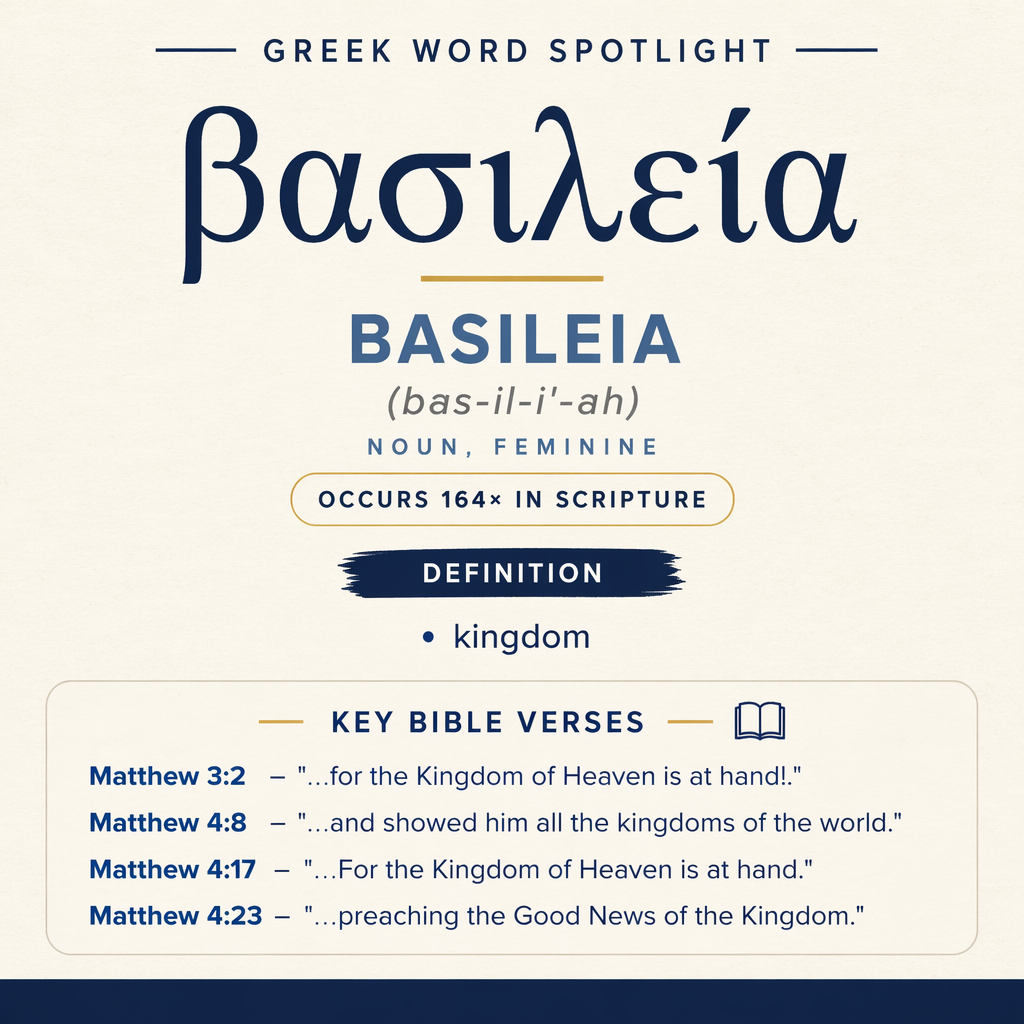
βασιλεία means “kingdom” and appears 164 times in Scripture, including Matthew 3:2; 4:8; 4:17; 4:23; and 5:3–20.
Core Meaning
βασιλεία is defined as “kingdom.” In Matthew, it appears in the phrase “Kingdom of Heaven.”
Learn More →Matthew Emphasis
Matthew 3:2 and 4:17 proclaim, “Repent, for the Kingdom of Heaven is at hand.” Matthew 4:23 speaks of “the Good News of the Kingdom.”
Learn More →Range of Use
Matthew 4:8 uses the plural: “all the kingdoms of the world, and their glory.” Matthew 5 links “the Kingdom of Heaven” with blessing and entering it.
Learn More →βασιλεία names a “kingdom” in scenes that range from John’s and Jesus’ opening proclamation to prayer, ethics, and the contrast between God’s reign and the world’s realms. In the passages cited here, the word anchors hope (“at hand”), belonging (“theirs is”), conduct (“enter”), and petition (“come”).
Occurrences
Matthew 3:2 — “Repent, for the Kingdom of Heaven is at hand!”
Here βασιλεία is the announced reality that makes repentance urgent. The phrase “of Heaven” frames this kingdom as belonging to heaven rather than to earthly politics, and “is at hand” casts it as approaching near enough to demand an immediate change of life.
Matthew 4:8 — Again, the devil took him to an exceedingly high mountain, and showed him all the kingdoms of the world, and their glory.
In this temptation scene, βασιλεία appears in the plural and is explicitly “of the world,” paired with “their glory.” The word functions as an object of display and implied desire: multiple kingdoms are presented as visible, impressive domains that can be surveyed from a height.
Matthew 4:17 — From that time, Jesus began to preach, and to say, “Repent! For the Kingdom of Heaven is at hand.”
Jesus’ preaching repeats the same core announcement: repentance is demanded because the “Kingdom of Heaven” has drawn near. In this context, βασιλεία serves as the headline of his message, setting the horizon for what his preaching is calling people toward.
Matthew 4:23 — Jesus went about in all Galilee, teaching in their synagogues, preaching the Good News of the Kingdom, and healing every disease and every sickness among the people.
βασιλεία is the content of “Good News,” and it is placed alongside teaching and healing as a central feature of Jesus’ activity. The kingdom is not merely mentioned; it is proclaimed as news, and the scene associates that proclamation with concrete benefit to “the people” through widespread healing.
Matthew 5:3 — “Blessed are the poor in spirit, for theirs is the Kingdom of Heaven.
In the Beatitudes, βασιλεία becomes a stated possession: “theirs is.” The kingdom is linked to a condition described as “poor in spirit,” and the present tense gives the blessing a settled claim rather than a distant possibility.
Matthew 5:10 — Blessed are those who have been persecuted for righteousness’ sake, for theirs is the Kingdom of Heaven.
Again the kingdom is declared to belong to a defined group: those persecuted “for righteousness’ sake.” βασιλεία here provides the counterweight to persecution; it names the realm to which the persecuted truly belong, even when opposed by others.
Matthew 5:19 — Whoever, therefore, shall break one of these least commandments, and teach others to do so, shall be called least in the Kingdom of Heaven; but whoever shall do and teach them shall be called great in the Kingdom of Heaven.
This saying places βασιλεία as a sphere in which people are evaluated and spoken of—“called least” or “called great.” The kingdom is the setting for distinctions based on practice (“do”) and instruction (“teach”), and even “these least commandments” matter because they affect one’s standing within the kingdom’s community.
Matthew 5:20 — For I tell you that unless your righteousness exceeds that of the scribes and Pharisees, there is no way you will enter into the Kingdom of Heaven.
Here βασιλεία is something one “enter[s] into,” and entrance is conditioned by righteousness described comparatively: it must “exceed” that of recognized religious groups. The kingdom is portrayed with a boundary—there is an “into”—and the statement stresses that entry is not automatic.
Matthew 6:10 — Let your Kingdom come. Let your will be done on earth as it is in heaven.
In prayer, βασιλεία is addressed to God directly: “your Kingdom.” The request “come” treats the kingdom as something awaited and invoked, and its nearness is tied to God’s will being enacted “on earth as it is in heaven,” linking kingdom-coming with the alignment of earthly life to heavenly order.
Matthew 6:13 — Bring us not into temptation, but deliver us from the evil one. For yours is the Kingdom, the power, and the glory forever. Amen.’
This doxology attaches βασιλεία to God as an everlasting possession: “yours is the Kingdom.” Placed after the plea for deliverance, the kingdom belongs to the one who rescues from “the evil one,” and it is grouped with “the power, and the glory forever,” giving the prayer a concluding note of divine sovereignty.
Matthew 6:33 — But seek first God’s Kingdom, and his righteousness; and all these things will be given to you as well.
βασιλεία becomes the object of deliberate pursuit: “seek first.” The kingdom is paired with “his righteousness,” and prioritizing it is presented as the proper ordering of desires, with the promise that “all these things” will follow as a gift rather than the main target of seeking.
Matthew 7:21 — Not everyone who says to me, ‘Lord, Lord,’ will enter into the Kingdom of Heaven; but he who does the will of my Father who is in heaven.
Once more the kingdom is something one may or may not “enter into,” and the criterion is not speech (“says to me”) but obedience (“does the will”). The phrase “my Father who is in heaven” matches the repeated “Kingdom of Heaven,” keeping the kingdom tied to the Father’s will and authority.
Sense and Usage
Across these passages, βασιλεία consistently marks a domain that can be approached, sought, entered, and confessed as God’s own. The word’s force shifts with its grammatical setting: it can be announced as near (“is at hand”), possessed by certain people (“theirs is”), invoked in prayer (“come”), or treated as a realm with thresholds and status (“enter into,” “called least…called great”).
The contrast between “the kingdoms of the world” and the “Kingdom of Heaven” clarifies that βασιλεία can speak of multiple, visible realms associated with glory, and also of a single kingdom characterized by heaven and belonging to God. In the temptation narrative (Matthew 4:8), the plural stresses variety and scale—“all the kingdoms”—and their attractiveness is underscored by “their glory.” In the rest of the occurrences, the singular “Kingdom of Heaven” or “God’s Kingdom” concentrates attention on one supreme realm, not presented as a spectacle but as a decisive reality bearing on repentance, righteousness, and prayer.
Ethically, βασιλεία serves as a measuring context. Matthew 5:19–20 locates “least” and “great” within the kingdom and portrays entrance as contingent, not on public religious identity, but on surpassing righteousness. Matthew 7:21 presses the same direction by distinguishing verbal profession from doing the Father’s will. In this set of sayings, the kingdom is not merely a comforting idea; it is the sphere in which teaching, obedience, and righteousness have consequences.
At the same time, βασιλεία carries strong assurance. Twice the Beatitudes attach the kingdom to people in distressing or lowly conditions (“poor in spirit,” “persecuted”), granting them a present claim—“theirs is.” Thus the word can simultaneously convey boundary (some will not enter) and gift (some already possess). In prayer and confession (Matthew 6:10, 6:13), the kingdom is tied to God’s will and permanence, anchoring human requests in the conviction that God holds ultimate rule.
Imagery
The imagery surrounding βασιλεία in these passages alternates between nearness and height. It is “at hand,” close enough to press repentance and shape daily seeking, yet the “kingdoms of the world” are shown from “an exceedingly high mountain,” distant and panoramic. The Kingdom of Heaven, by contrast, is spoken into the present—possessed by the blessed, entered through righteousness, and prayed into earthly life as God’s will is done “on earth as it is in heaven.”
Sources: Lexical data from Strong’s Exhaustive Concordance and the Translators Brief Lexicon of Extended Strongs for Greek (STEPBible, CC BY). Occurrence data from the Translators Amalgamated Greek New Testament (STEPBible, CC BY). Scripture quotations from the World English Bible (public domain).




