Exploring the Meaning of Bareo in Greek
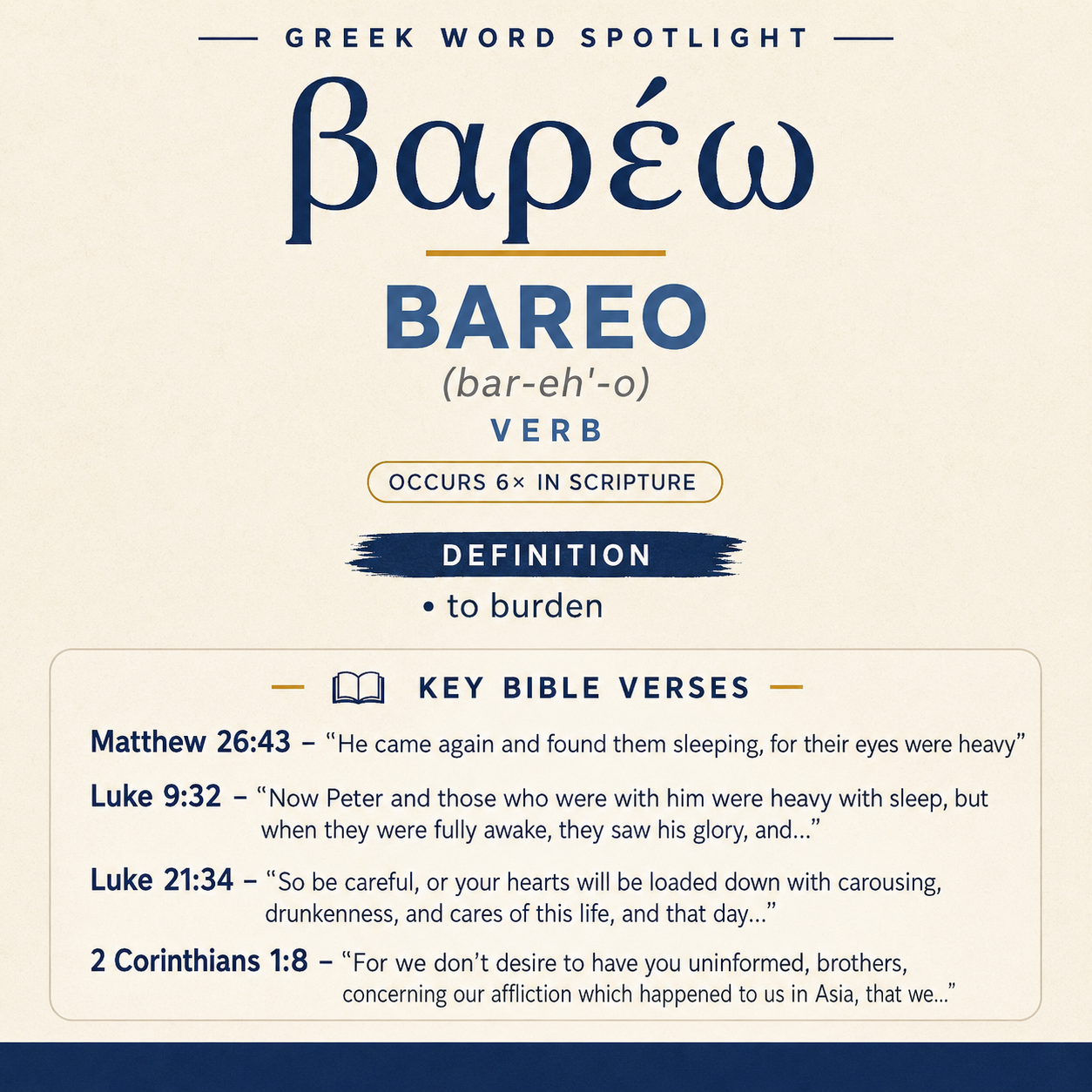
βαρέω means “to burden” and appears six times in Scripture (Matthew 26:43; Luke 9:32; Luke 21:34; 2 Corinthians 1:8; 2 Corinthians 5:4; 1 Timothy 5:16).
Gospel Usage
In Matthew 26:43 and Luke 9:32, it describes eyes or people being heavy with sleep. In Luke 21:34, it warns of hearts being loaded down with life’s cares and excesses.
Learn More →Pauline Usage
In 2 Corinthians 1:8 and 5:4, it appears with affliction and being burdened while groaning. In 1 Timothy 5:16, it refers to not burdening the assembly.
Learn More →βαρέω expresses the idea of being burdened. It appears in scenes of physical drowsiness, inward pressure that weighs on the heart, overwhelming affliction, groaning under mortal limits, and practical situations where a community can be loaded down.
Root and Related Words
βαρέω corresponds to the adjective barys (βαρύς), “weighty” (Strong’s G926), from which the verb-form is derived.

Occurrences
“He came again and found them sleeping, for their eyes were heavy.” (Matthew 26:43)
Here the burden is located in the body: “their eyes were heavy.” The wording portrays sleep as a weight that presses on the eyes, making wakefulness difficult. Within the moment described—Jesus returning and finding them asleep again—the verb sharpens the contrast between the urgent situation and the disciples’ physical inability to keep watch.
“Now Peter and those who were with him were heavy with sleep, but when they were fully awake, they saw his glory, and the two men who stood with him.” (Luke 9:32)
The heaviness is again tied to sleep, but the scene adds movement from burden to alertness: they “were heavy with sleep,” and only later “when they were fully awake” do they perceive “his glory” and “the two men who stood with him.” The verb frames sleep as a weighing force that delays perception; the shift into wakefulness marks a release from that weight, allowing vision and recognition within the event.
““So be careful, or your hearts will be loaded down with carousing, drunkenness, and cares of this life, and that day will come on you suddenly.” (Luke 21:34)
In this warning the burden falls on “your hearts,” and the weight comes from specific pressures: “carousing, drunkenness, and cares of this life.” The verb pictures these factors as something that loads down the inner life, making it sluggish or unready, with the practical consequence that “that day” can arrive “suddenly.” The burdened heart is not merely tired; it is pressed down by competing desires and anxieties named in the sentence.
“For we don’t desire to have you uninformed, brothers, concerning our affliction which happened to us in Asia, that we were weighed down exceedingly, beyond our power, so much that we despaired even of life.” (2 Corinthians 1:8)
Here the verb is used for the crushing effect of “affliction.” The description “weighed down exceedingly, beyond our power” intensifies the sense of burden by placing it beyond normal capacity, and the result is stated plainly: “so much that we despaired even of life.” The verb therefore contributes more than the fact of suffering; it portrays affliction as a pressure so heavy it pushes a person past perceived strength and into despair.
“For indeed we who are in this tent do groan, being burdened, not that we desire to be unclothed, but that we desire to be clothed, that what is mortal may be swallowed up by life.” (2 Corinthians 5:4)
The burden here is connected to embodied existence: “we who are in this tent do groan, being burdened.” The groaning is not aimless; it is set alongside a desire—“not…to be unclothed, but…to be clothed”—and an intended outcome: “that what is mortal may be swallowed up by life.” βαρέω helps articulate the felt weight of mortality as something carried in the present, producing groaning while also orienting the speaker toward a hoped-for transformation described in the verse.
“If any man or woman who believes has widows, let them relieve them, and don’t let the assembly be burdened, that it might relieve those who are widows indeed.” (1 Timothy 5:16)
This occurrence places the burden in a communal setting. The instruction distinguishes two layers of responsibility: believers who “has widows” are to “relieve them,” so that “the assembly” is not burdened and remains able to “relieve those who are widows indeed.” The verb frames burden as a load that can fall on an organized group, affecting its capacity to act. It thus functions in an orderly, practical argument about distributing care so that the community’s resources and attention are not weighed down in a way that hinders the most urgent cases.
Sense and Usage
Across these passages, βαρέω consistently operates as weight-language applied to different spheres of experience. In Matthew 26:43 and Luke 9:32 the weight is physical and immediate: sleep presses on the eyes and on the disciples themselves, shaping what they can do and what they can notice. The verb does not simply report that they slept; it depicts sleep as an oppressive heaviness, a load that overcomes alertness.
Luke 21:34 extends the same weight-imagery to the interior life. The heart can be “loaded down” not by a physical condition but by patterns of indulgence (“carousing,” “drunkenness”) and by ongoing pressures (“cares of this life”). The verb therefore fits a moral-exhortational context, where being burdened is linked to vulnerability—an unprepared heart meets an unexpected day.
In 2 Corinthians 1:8 the burden is the felt intensity of affliction: it is described as “beyond our power,” indicating a load measured against the capacity to bear it. The verse gives the experiential endpoint—despair—so βαρέω carries the sense of pressure that can compress a person’s endurance and hope. In 2 Corinthians 5:4 the burden is more existential: “in this tent” the speaker groans under mortal limits. The word helps connect bodily frailty with longing, because the verse contrasts two conditions (“unclothed” and “clothed”) and aims at a final swallowing up of “what is mortal.” βαρέω thus supports language about the present weight of mortality without turning that weight into the final word.
Finally, 1 Timothy 5:16 shows that burden can be social and administrative. The “assembly” can carry loads of care; if those loads are placed without discernment, the group’s ability to respond to “widows indeed” is affected. In this setting βαρέω helps express the reality that responsibilities can accumulate and become heavy, and that wise action can prevent unnecessary loading down.
Imagery
The verb’s imagery is concrete: eyes that droop under heaviness, disciples pressed down by sleep until wakefulness opens their sight, hearts weighted by a mix of pleasures and worries, sufferers crushed beyond strength, groaning bodies bearing mortal weight, and a congregation carrying (or being spared) an added load. In each case, the word draws attention to what pressure does: it lowers, presses, and limits—whether the limitation is watchfulness, readiness, endurance, or communal capacity.
Sources: Lexical data from Strong’s Exhaustive Concordance and the Translators Brief Lexicon of Extended Strongs for Greek (STEPBible, CC BY). Occurrence data from the Translators Amalgamated Greek New Testament (STEPBible, CC BY). Scripture quotations from the World English Bible (public domain).