
Understanding the Meaning of Acheim in Greek
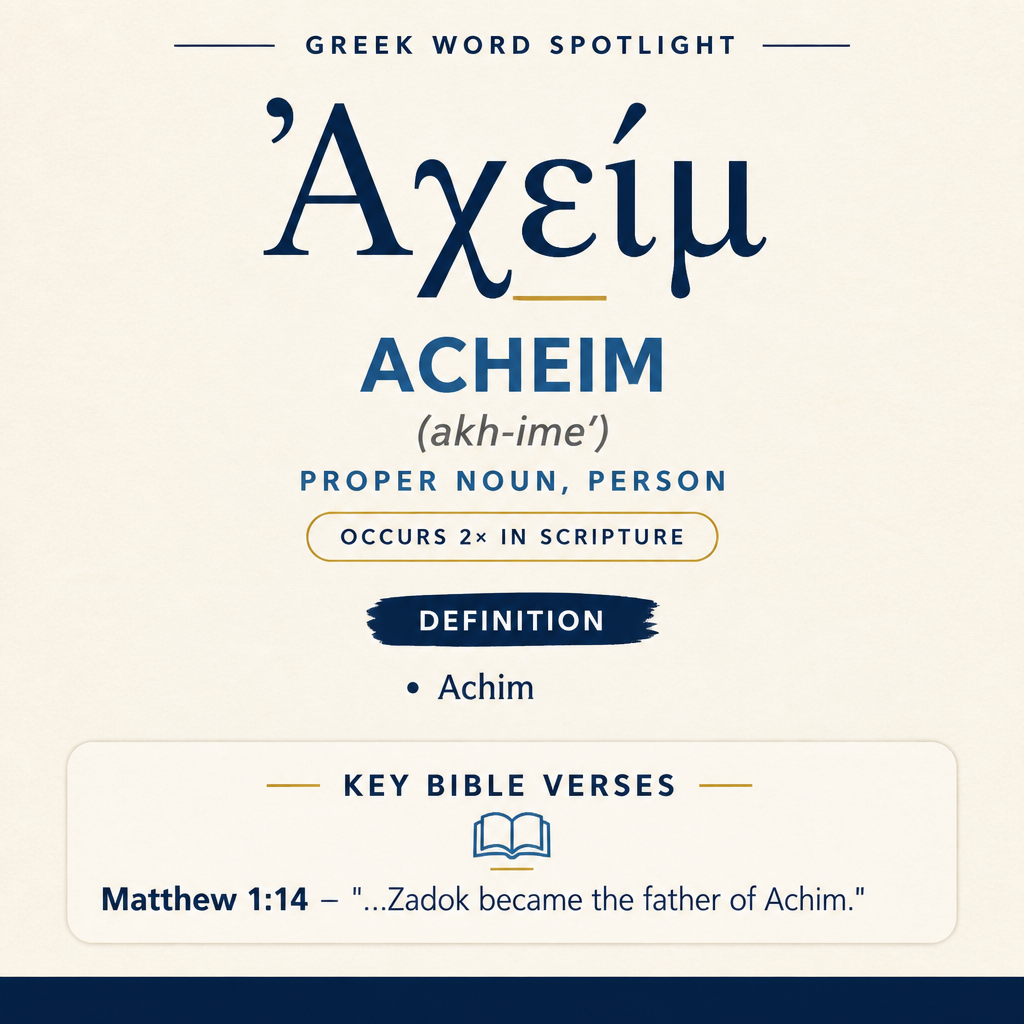
Ἀχείμ means “Achim” and appears twice in Scripture, including in Matthew 1:14.
Biblical Context
In Matthew 1:14, Achim appears in a genealogy: Zadok fathered Achim, and Achim fathered Eliud.
Learn More →Ἀχείμ refers to Achim and appears in Matthew’s genealogy of Jesus, where the name functions inside a chain of father-to-son relationships. In this setting, the name marks one link in a carefully ordered sequence of descent.
Occurrences
“Azor became the father of Zadok. Zadok became the father of Achim. Achim became the father of Eliud.” (Matthew 1:14)
In Matthew 1:14, Achim is placed between two other named figures—Zadok and Eliud—within a tightly patterned series of sentences. The repeated clause “became the father of” makes the contribution of the name straightforward and concrete: Achim is the person whose identity is defined here by his position in a generational line. The verse presents Achim in two complementary roles in the same breath: first as the son of Zadok (“Zadok became the father of Achim”), and then as the father of Eliud (“Achim became the father of Eliud”).
This double placement gives the name a bridging function. Matthew does not pause to describe Achim’s actions, character, or setting; the narrative work of the name is genealogical. Yet that genealogical work is not merely a list-like filler: the sentence structure highlights succession, continuity, and connection. Achim’s appearance is therefore not isolated but relational, embedded in the movement of ancestry from one generation to the next. The verse also shows how the genealogy advances by increments: each individual is named, then immediately tied to the one before and after, so that Achim serves as a necessary connector in the forward motion of the line.
The immediate context within the verse also shows that the naming is selective and purposeful. Achim is one of several names in a short span, and the text’s rhythm depends on each name carrying its own weight as a distinct person in the chain. The repetition of the formula means the focus stays on lineage rather than biography. Within that literary frame, Achim contributes as a stable point of reference: the line passes through him, and the reader is guided past him to Eliud, just as the reader has been guided from Azor through Zadok to Achim.

Sense and Usage
As a personal name, Achim functions as an identifier rather than a descriptive term. In Matthew 1:14 it does not label an office, a place, or a trait; it simply names a person. The verse’s form clarifies what the name accomplishes: it anchors a specific relationship of descent in both directions—upward to a father and downward to a son—so that the genealogy’s structure remains unbroken at that point.
The immediate co-text shows how Matthew uses such names to build a continuous sequence. Each named figure is introduced only to be positioned within familial links. This kind of usage gives the name its significance: it is meaningful by placement. Achim is not presented as an isolated individual but as a member of a lineage whose coherence depends on each link being stated. The genealogy’s repeated language (“became the father of”) turns each name into a node in a relational network, and Achim’s node is defined precisely by its connections to Zadok and Eliud in the wording of the verse.
Because the verse states both who fathered Achim and whom Achim fathered, the name simultaneously marks reception and transmission within the genealogy. That twofold role is the primary way Achim’s identity is framed here. In this style of writing, a name does not need additional descriptors to be functional: the relationships supply the information the genealogy is built to convey. Achim therefore operates as a necessary step in the line’s progression, making it possible for the genealogy to move from the earlier names in the verse (“Azor,” “Zadok”) to the later name (“Eliud”) without a gap.
The verse also demonstrates how Matthew maintains clarity through repetition and short clauses. The repeated pattern prevents confusion about who is connected to whom: the reader does not have to infer relationships; they are stated directly. Achim benefits from—and contributes to—this clarity. By appearing in a sentence that names both his father and his son, Achim is distinctly located in the family line in a way that is both concise and explicit.
Imagery in Context
Although Achim is not associated here with a narrated event or a physical setting, the verse carries the concrete imagery of family succession. The repeated statements of fatherhood create a mental picture of generations linked one to the next: Azor to Zadok, Zadok to Achim, Achim to Eliud. Within that picture, Achim stands as one generational link—briefly named, firmly placed, and immediately connected on both sides—so that the genealogy reads not as scattered names but as an ordered line of descent.
Sources: Lexical data from Strong’s Exhaustive Concordance and the Translators Brief Lexicon of Extended Strongs for Greek (STEPBible, CC BY). Occurrence data from the Translators Amalgamated Greek New Testament (STEPBible, CC BY). Scripture quotations from the World English Bible (public domain).





