Exploring the Meaning of Acheiropoietos in Greek
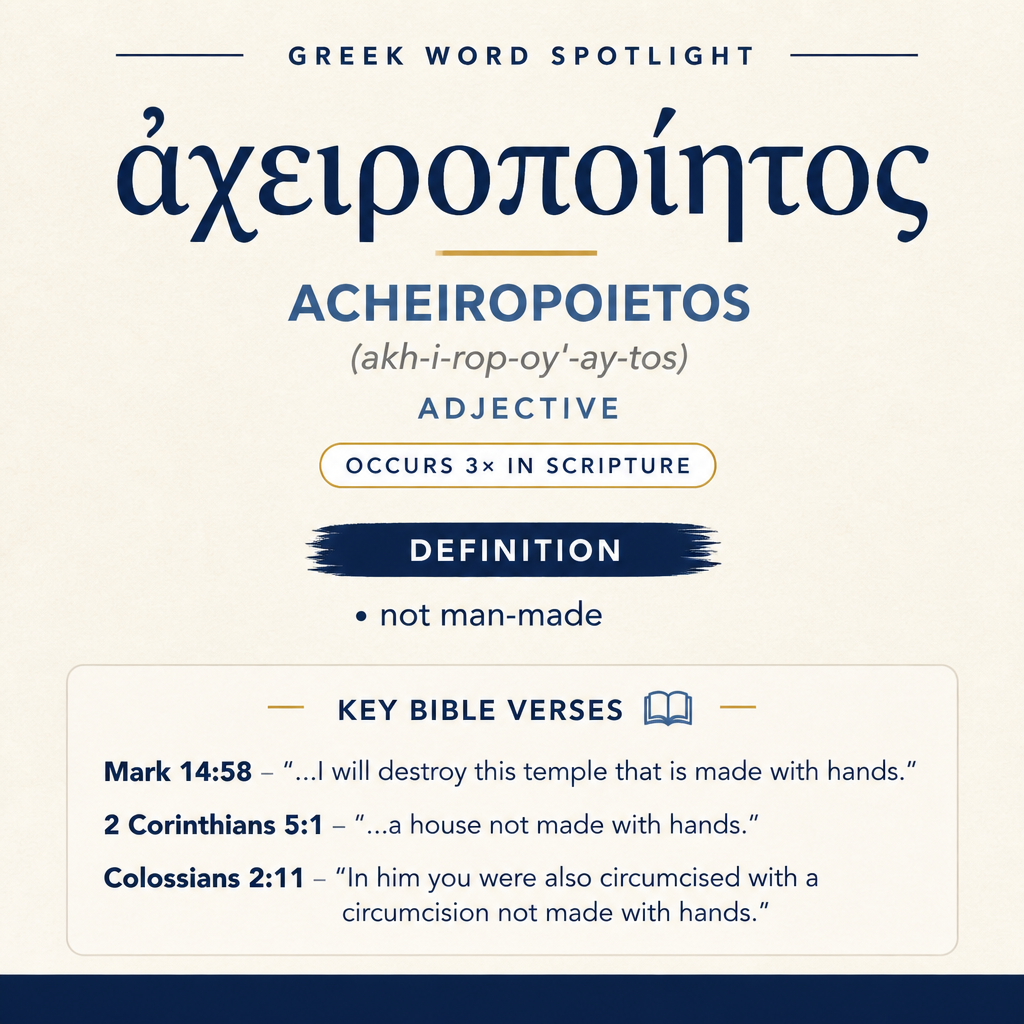
ἀχειροποίητος means “not man-made” and appears three times in Scripture: Mark 14:58; 2 Corinthians 5:1; Colossians 2:11.
Core Meaning
ἀχειροποίητος means “not man-made.” In these passages it contrasts what is made with hands.
Learn More →Gospel Context
In Mark 14:58 it appears in the statement about a temple “made with hands” and another “made without hands.” The contrast highlights two kinds of temples.
Learn More →Pauline Usage
In 2 Corinthians 5:1 it describes “a house not made with hands,” a building from God. In Colossians 2:11 it describes “a circumcision not made with hands.”
Learn More →ἀχειροποίητος describes something “not man-made,” and it appears in three New Testament contexts: a temple contrasted with one built “without hands,” a “house” from God contrasted with an “earthly” tent, and a circumcision described as “not made with hands.” Across these scenes, the word marks a sharp boundary between what humans produce and what is presented as belonging to God’s own action.
Root and Related Words
ἀχειροποίητος is built from the related adjective cheiropoietos (χειροποίητος), “hand-made” (Strong’s G5499), with an alpha element A (α, Ἀλφα), “Alpha” (Strong’s G1), noted as part of its derivation.

Occurrences
“We heard him say, ‘I will destroy this temple that is made with hands, and in three days I will build another made without hands.’ ” (Mark 14:58)
Here the term is placed in direct contrast with “this temple that is made with hands.” The accusation turns on a two-temple comparison: one characterized by human construction (“made with hands”) and another characterized by the opposite (“made without hands”). In the quotation’s logic, what is “made without hands” is not simply a replacement building; it is a different kind of temple, defined by its lack of human manufacture. The word therefore functions as a boundary marker: it identifies the second temple by negating the ordinary way temples come into being—through human work—so that the new structure is framed as beyond human making.
For we know that if the earthly house of our tent is dissolved, we have a building from God, a house not made with hands, eternal, in the heavens. (2 Corinthians 5:1)
In this passage, ἀχειροποίητος qualifies “a house,” which is also called “a building from God.” The sentence stacks contrasts: “earthly” versus “in the heavens,” the dissolving “house of our tent” versus a “building from God,” and what can be “dissolved” versus what is “eternal.” Within that series, “not made with hands” highlights the nature of the heavenly house as fundamentally unlike the earthly tent. The phrase works together with “from God” to describe the house as not arising from human construction or human maintenance. It also strengthens the permanence claim (“eternal”) by separating this house from the fragile, temporary, and dissolvable condition of the “earthly” tent.
In him you were also circumcised with a circumcision not made with hands, in the putting off of the body of the sins of the flesh, in the circumcision of Christ, (Colossians 2:11)
Colossians applies ἀχειροποίητος to “a circumcision,” describing it as “not made with hands.” The surrounding explanation interprets this circumcision in terms of an inward change: it is connected to “the putting off of the body of the sins of the flesh,” and it is further specified as “the circumcision of Christ.” In this setting, the adjective separates this circumcision from anything performed by human hands and embeds it in a transformation described in moral and bodily terms (“putting off”). The word thus supports the passage’s portrayal of an act associated with Christ that affects the person at the level described, rather than being defined by a manual procedure.
Sense and Usage
Across these three texts, “not man-made” operates as a defining descriptor that reclassifies an object or act by excluding human manufacture as its source. The adjective is consistently attached to nouns that typically have strong associations with tangible, humanly performed work: a temple, a house/building, and a circumcision. In each case, the phrase does more than deny human craftsmanship; it establishes a contrastive identity.
In Mark, the contrast is explicit and immediate—“made with hands” versus “made without hands”—so the word functions as a pivot point in a claim about destruction and rebuilding. The temple that is “made without hands” is set over against the existing, visible temple precisely at the point where “hands” would normally be assumed: construction. The description makes the second temple’s origin the crucial issue, and it does so through negation rather than by providing a positive account of how it is made.
In 2 Corinthians, the adjective is woven into an argument about mortality and permanence. The “earthly house of our tent” belongs to a realm where dissolution is possible; the “house not made with hands” belongs to the realm described as “eternal” and “in the heavens.” The term fits naturally with “from God,” not as a mere synonym but as a clarifier: the house’s God-given character is reinforced by stating that it does not come from human making. In this way, the word helps construct the passage’s picture of two modes of habitation—one temporary and dissolvable, one enduring and heavenly—distinguished in part by whether “hands” are involved in their origin.
In Colossians, the usage shifts from buildings to a religious rite, yet the same semantic pressure remains: what is “not made with hands” is cast as belonging to a different order than what humans do with their hands. The explanatory phrases that follow (“putting off…,” “circumcision of Christ”) situate the circumcision in an effect described as moral and bodily transformation. The adjective therefore serves to detach the circumcision described from human performance and to locate it within Christ’s sphere of action.
Taken together, these uses show a consistent pattern: ἀχειροποίητος marks a thing as outside the category of human production and therefore able to be contrasted with what is earthly, dissolvable, or manually performed. It is not used as a general abstract label, but as a sharply targeted qualifier that reorients how the reader is to think about a temple, a dwelling, or a circumcision—each becomes defined, at least in part, by being “not man-made.”
Imagery
The word’s imagery is concrete even when its referent is not. “Hands” evoke building, crafting, and performing—activities that shape temples, houses, and rites. By describing something as “not made with hands,” these passages invite the reader to picture the familiar work of human hands and then to set it aside: a temple contrasted with one built differently (Mark 14:58), a house contrasted with a dissolving tent (2 Corinthians 5:1), and a circumcision contrasted with a hand-performed act and instead linked to “the putting off of the body of the sins of the flesh” (Colossians 2:11).
Sources: Lexical data from Strong’s Exhaustive Concordance and the Translators Brief Lexicon of Extended Strongs for Greek (STEPBible, CC BY). Occurrence data from the Translators Amalgamated Greek New Testament (STEPBible, CC BY). Scripture quotations from the World English Bible (public domain).