Exploring the Meaning of Aphros in Greek
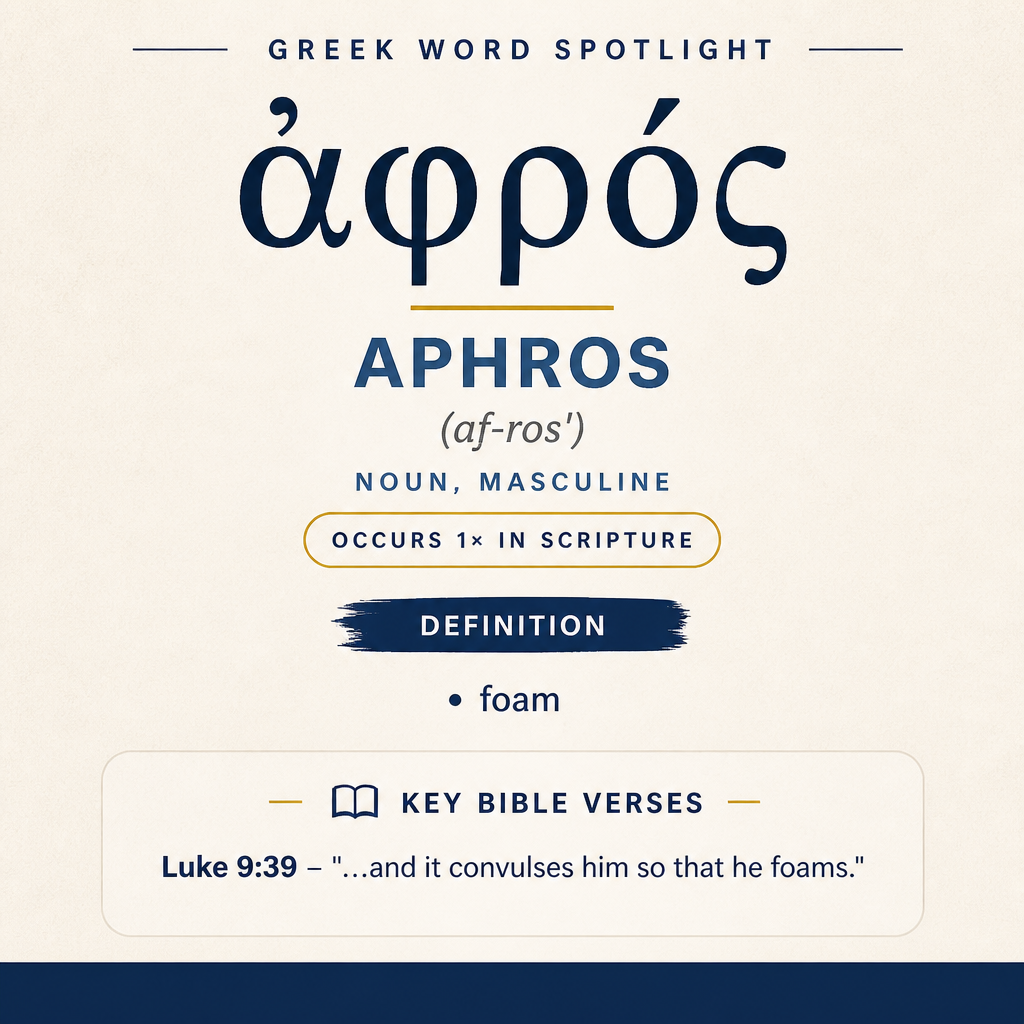
ἀφρός means “foam” and appears once in Scripture, in Luke 9:39.
Context in Luke
In Luke 9:39, the afflicted person is described as foaming during a convulsion.
Learn More →ἀφρός refers to “foam” and appears in a single New Testament scene where a boy’s affliction is described in vivid physical terms. In that account, the word helps portray the violence and severity of the episode in the moment it occurs.
Occurrences
“Behold, a spirit takes him, he suddenly cries out, and it convulses him so that he foams, and it hardly departs from him, bruising him severely.” (Luke 9:39)
Here ἀφρός is embedded in a tightly packed description of an acute seizure-like event: the child is taken, cries out suddenly, is convulsed, and as a result “foams.” The word contributes a concrete, visible sign accompanying the convulsions. Within the sentence, the foaming is not an isolated detail but part of a chain of escalating bodily effects—crying out, convulsing, foaming, lingering oppression, and severe bruising. The sequence makes the foaming function as one of the outward manifestations by which the onlookers recognize the episode’s intensity.

The immediate context also places the foaming between “it convulses him” and “it hardly departs from him,” linking the physical symptom to both the force of the convulsion and the persistent nature of the affliction. The report is framed as an eyewitness plea (“Behold”), and the foaming is one of the observable elements that renders the plea concrete rather than abstract. In the narrative logic of the line, ἀφρός does not stand for the underlying cause; it depicts the bodily condition produced during the attack, helping the speaker communicate urgency and distress with sensory specificity.

Sense and Usage
The sense of ἀφρός in this passage is straightforwardly physical: foam as a substance produced and seen in the act of “foaming.” Because it occurs as the result of convulsions, it is presented as a symptom that accompanies a moment of bodily crisis. The wording does not treat foam as a metaphor or as a descriptive flourish detached from events; instead it serves as a clinical-sounding observation within a personal report of suffering. The description is compressed and kinetic—multiple verbs in rapid succession—so the reference to foam functions as a vivid marker of the episode’s severity, something that can be recognized by sight as it happens.
Luke 9:39 also shows how the term can be used as part of a verbal expression (“he foams”) rather than as a stand-alone noun naming foam in general. Even in that verbal setting, the idea remains concrete: foam is not merely mentioned; it is depicted as appearing on the person during the convulsion. The construction ties the appearance of foam to the action of the affliction (“it convulses him so that he foams”), presenting it as a consequence rather than a separate event. This makes ἀφρός an element within a cause-and-effect portrayal of bodily trauma, supporting the account’s realism and immediacy.
Within the single attested context, the word’s contribution is therefore primarily sensory and evidentiary. It supplies one of the observable facts that validates the speaker’s claim of how grievous and uncontrollable the experience is. The boy’s condition is described in ways that imply both sudden onset (“he suddenly cries out”) and continuing harm (“it hardly departs from him, bruising him severely”). In that framework, foaming is one sign among several that the affliction is not mild or fleeting. The mention of foam helps the reader picture the episode as physically overwhelming, marked by involuntary bodily effects.
Imagery
The imagery carried by ἀφρός in Luke 9:39 is starkly bodily: foam appears as a visible product of an extreme convulsion. Because it is paired with bruising and persistence, the image does not invite contemplation so much as it confronts the reader with the concrete reality of suffering and the urgency of the plea being made. The single word adds a sharp, immediate detail that anchors the description in what can be seen during the crisis itself.
Sources: Lexical data from Strong’s Exhaustive Concordance and the Translators Brief Lexicon of Extended Strongs for Greek (STEPBible, CC BY). Occurrence data from the Translators Amalgamated Greek New Testament (STEPBible, CC BY). Scripture quotations from the World English Bible (public domain).