
Exploring the Meaning of Aphrizo in Greek
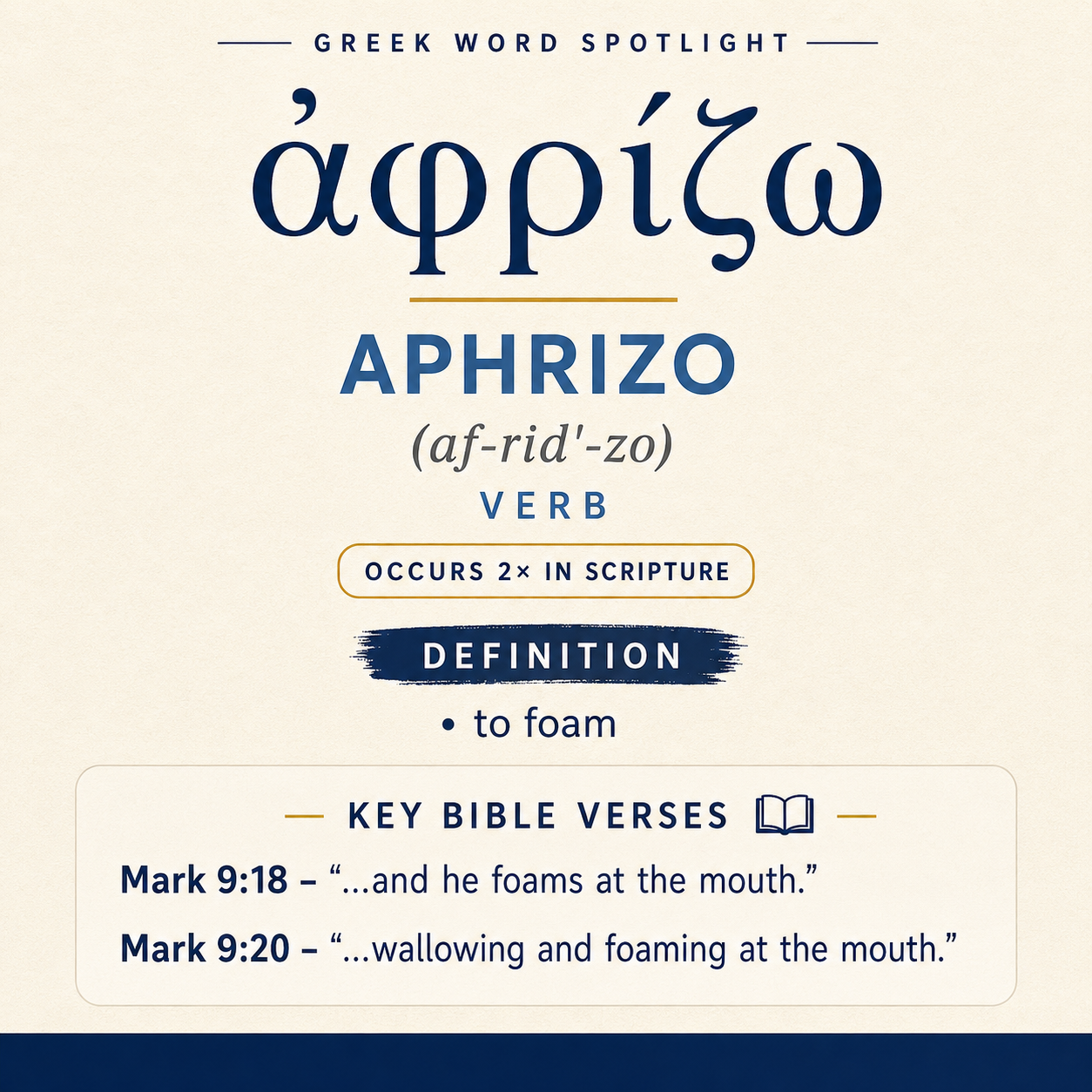
ἀφρίζω means “to foam” and appears twice in Scripture, both in Mark 9:18 and Mark 9:20.
Mark 9 Context
In Mark 9:18 it describes a boy foaming at the mouth when seized and thrown down. In Mark 9:20 he falls to the ground, wallowing.
Learn More →Scripture Occurrences
This verb occurs 2 times in Scripture. Both occurrences are in Mark 9.
Learn More →ἀφρίζω expresses the bodily action of foaming, and it appears in Mark’s account of a boy’s violent seizure during an attempted exorcism. In both places it depicts a visible symptom that accompanies the spirit’s assault and the child’s collapse to the ground.
Root and Related Words
ἀφρίζω (Aphrizo) is derived from ἀφρός (aphros), “foam” (Strong’s G876). The verb form puts the noun’s substance into action, describing the production or presence of foam in a moment that can be seen by onlookers.

Occurrences
“and wherever it seizes him, it throws him down, and he foams at the mouth, and grinds his teeth, and wastes away. I asked your disciples to cast it out, and they weren’t able.” (Mark 9:18)
Here ἀφρίζω is part of a father’s summary of what happens “wherever it seizes him.” The foaming is presented as one symptom within a chain of physical effects: the seizure “throws him down,” then he “foams at the mouth,” “grinds his teeth,” and “wastes away.” In this description, the verb contributes a concrete, outward sign that the attack is not merely internal; it is manifested at “the mouth,” a detail that highlights the intensity and visible distress of the episode. Because the father is explaining why help is needed (“I asked your disciples to cast it out, and they weren’t able”), the foaming functions as part of the evidence of the problem’s severity and persistence.

“They brought him to him, and when he saw him, immediately the spirit convulsed him, and he fell on the ground, wallowing and foaming at the mouth.” (Mark 9:20)
In this scene ἀφρίζω is narrated as an immediate consequence of the boy encountering Jesus: “when he saw him, immediately the spirit convulsed him.” The verb stands in parallel with “wallowing,” portraying what the crowd can observe once he “fell on the ground.” The foaming is again specified as “at the mouth,” keeping the action tied to a precise bodily location and reinforcing its role as an externally visible symptom. The rapid sequence—seeing, convulsing, falling, wallowing, foaming—frames the action as sudden and uncontrolled, with ἀφρίζω marking the disturbing physical output that accompanies the convulsion.
Sense and Usage
Across its two Markan uses, ἀφρίζω consistently names the production of foam during an extreme seizure. It is not presented as a voluntary action or a neutral physical condition, but as something that happens to the boy when the spirit “seizes” or “convulsed” him. The repeated phrase “at the mouth” anchors the verb in a concrete bodily manifestation: the symptom is not inferred, but seen. This makes the action rhetorically powerful within each context: in Mark 9:18 the father’s report piles up observable effects to convey the crushing toll of repeated attacks, while in Mark 9:20 the narrator places foaming in the immediate aftermath of the convulsion to show the violence of the episode as it unfolds in real time.
Because ἀφρίζω appears alongside other vivid physical verbs (“throws him down,” “convulsed,” “fell,” “wallowing,” “grinds his teeth”), it functions as one element in a composite picture of bodily breakdown. The word does not stand alone as a diagnosis; it is one sign within a larger pattern of incapacitation. Its specificity—foam at the mouth—adds a clinical sharpness to the description without turning the narrative into a medical report. Mark uses the verb to keep the reader’s attention on what witnesses could actually observe during the seizure, strengthening the portrayal of the boy’s helplessness and the spirit’s oppressive force.
The fact that ἀφρίζω is used both in the father’s retrospective account (what happens “wherever” the seizure occurs) and in the narrator’s present-tense depiction (what happens “immediately” when the spirit acts) gives the word a dual narrative role. It serves as part of a general pattern of recurring episodes and as part of a single, sharply defined incident. In both roles, it marks the same kind of outward symptom, reinforcing the continuity between the father’s testimony and what is then witnessed.
Imagery
The imagery carried by ἀφρίζω in these verses is starkly physical: a child on the ground, overtaken by convulsions, with foam at the mouth. In Mark 9:18 the verb contributes to the father’s portrayal of a life repeatedly interrupted and diminished by violent seizures, while in Mark 9:20 it punctuates the immediacy of the spirit’s reaction—an eruption of bodily distress that can be seen as the boy “fell on the ground, wallowing.” In both, the word places the reader among the witnesses, confronting the tangible signs of suffering that prompt the plea for deliverance.
Sources: Lexical data from Strong’s Exhaustive Concordance and the Translators Brief Lexicon of Extended Strongs for Greek (STEPBible, CC BY). Occurrence data from the Translators Amalgamated Greek New Testament (STEPBible, CC BY). Scripture quotations from the World English Bible (public domain).





