
Exploring the Meaning of Aphanismos in Greek
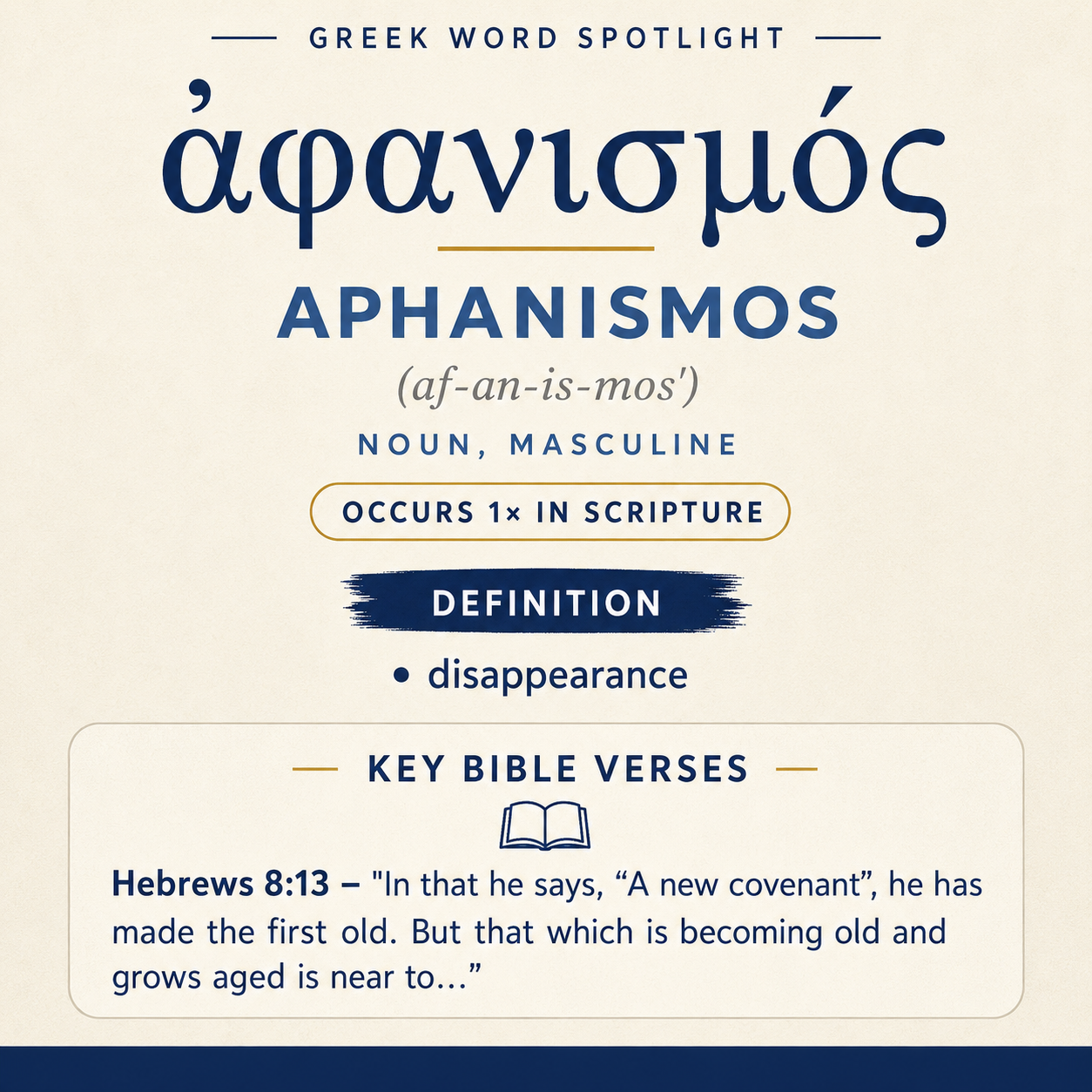
ἀφανισμός (Aphanismos) means “disappearance” and appears once in Scripture, in Hebrews 8:13.
Verse Context
In Hebrews 8:13, it appears in the statement that what is becoming old and growing aged is near to disappearance.
Learn More →ἀφανισμός expresses “disappearance,” and it appears once in the New Testament, in a concluding statement about what happens to something that has become “old” and “grows aged.” In its lone occurrence, it helps describe an approaching endpoint rather than a static condition.
Root and Related Words
ἀφανισμός is related to the verb aphanizō (ἀφανίζω), “to destroy” (Strong’s G853). The relationship links the noun’s idea of something no longer being present with a verbal form that speaks of bringing about such an outcome.

Occurrences
“In that he says, “A new covenant”, he has made the first old. But that which is becoming old and grows aged is near to vanishing away.” (Hebrews 8:13)
In Hebrews 8:13, ἀφανισμός stands behind the closing expression “near to vanishing away,” functioning as the endpoint of a chain of descriptions. The verse begins by contrasting “A new covenant” with “the first,” and the act of calling something “new” is said to have “made the first old.” The noun belongs to the concluding assessment of what “old” entails: what is “becoming old” and “grows aged” is not merely marked by time, but characterized as approaching “disappearance.”
The movement of the sentence is important for how ἀφανισμός works here. The verse does not portray disappearance as already completed; it portrays it as imminent (“near”). The term therefore contributes a forward-looking horizon: the “first” is pictured as in a process (“becoming old,” “grows aged”) that tends toward an approaching removal from view. In this argument, ἀφανισμός does not stand alone as an abstract concept; it is the final descriptive note that matches the logic of replacement implied by “new.” If the “new covenant” stands, the earlier one is framed as nearing a state where it no longer appears as the governing, visible arrangement.
Within the immediate wording, “vanishing away” is the most concrete statement about the fate of what is old. “Old” and “aged” describe condition; ἀφανισμός supplies outcome. The term thus clarifies that the author is not merely labeling the first covenant as obsolete in sentiment, but depicting it as approaching “disappearance” in the unfolding situation being described.
Sense and Usage
The sense “disappearance” in this usage is shaped by two features of Hebrews 8:13: (1) the comparative framework of “new” versus “first,” and (2) the temporal framing “becoming… grows… near.” First, because the verse is explicitly comparing two covenantal realities—“A new covenant” and “the first”—ἀφανισμός functions as a term of transition. The noun serves the rhetorical aim of marking the old as something on its way out of effective presence in light of the new. The word’s force lies in what it does to the reader’s sense of continuity: the first is not presented as coexisting indefinitely with the new, but as headed toward disappearance.
Second, the verse uses a sequence of time-inflected descriptors: “becoming old,” “grows aged,” “near.” ἀφανισμός fits naturally into this sequence as the anticipated terminus. “Disappearance” is not introduced as a sudden event in this line of thought, but as the nearing result of an aging process. By locating the word at the end of a progression, the author portrays disappearance as the appropriate completion of becoming old. The term therefore participates in a process-oriented description: the “first” is depicted as moving toward non-appearance.
Because the verse expresses nearness rather than completion, ἀφανισμός carries an anticipatory quality. It suggests a state about to be realized: the old is not merely less prominent, and not simply superseded in name, but approaching the point where it no longer appears as the operative covenantal framework. In this way the noun supports the verse’s argument by giving the “first” a directional fate aligned with the announcement of “new.”
The related verb aphanizō (ἀφανίζω), “to destroy,” helps frame the noun’s usage in Hebrews 8:13 as more than a passive fading. Even though Hebrews 8:13 itself speaks in terms of a state (“near to vanishing away”), the connection with a verb of active causing highlights that disappearance can be conceived as the outcome of decisive change. In the logic of the sentence, the decisive change is the declaration of “A new covenant,” which is said to have “made the first old.” The noun’s placement underscores that this change has consequences that reach the level of presence itself: what has become old is described as nearing disappearance.
Imagery
Hebrews 8:13 pairs the imagery of aging (“becoming old,” “grows aged”) with the imagery of loss of presence (“vanishing away”). ἀφανισμός contributes the picture of something once visible and current now approaching the point where it no longer appears, matching the verse’s contrast between what is “new” and what is “the first.”
Sources: Lexical data from Strong’s Exhaustive Concordance and the Translators Brief Lexicon of Extended Strongs for Greek (STEPBible, CC BY). Occurrence data from the Translators Amalgamated Greek New Testament (STEPBible, CC BY). Scripture quotations from the World English Bible (public domain).





