
Exploring the Meaning of Autocheir in Greek
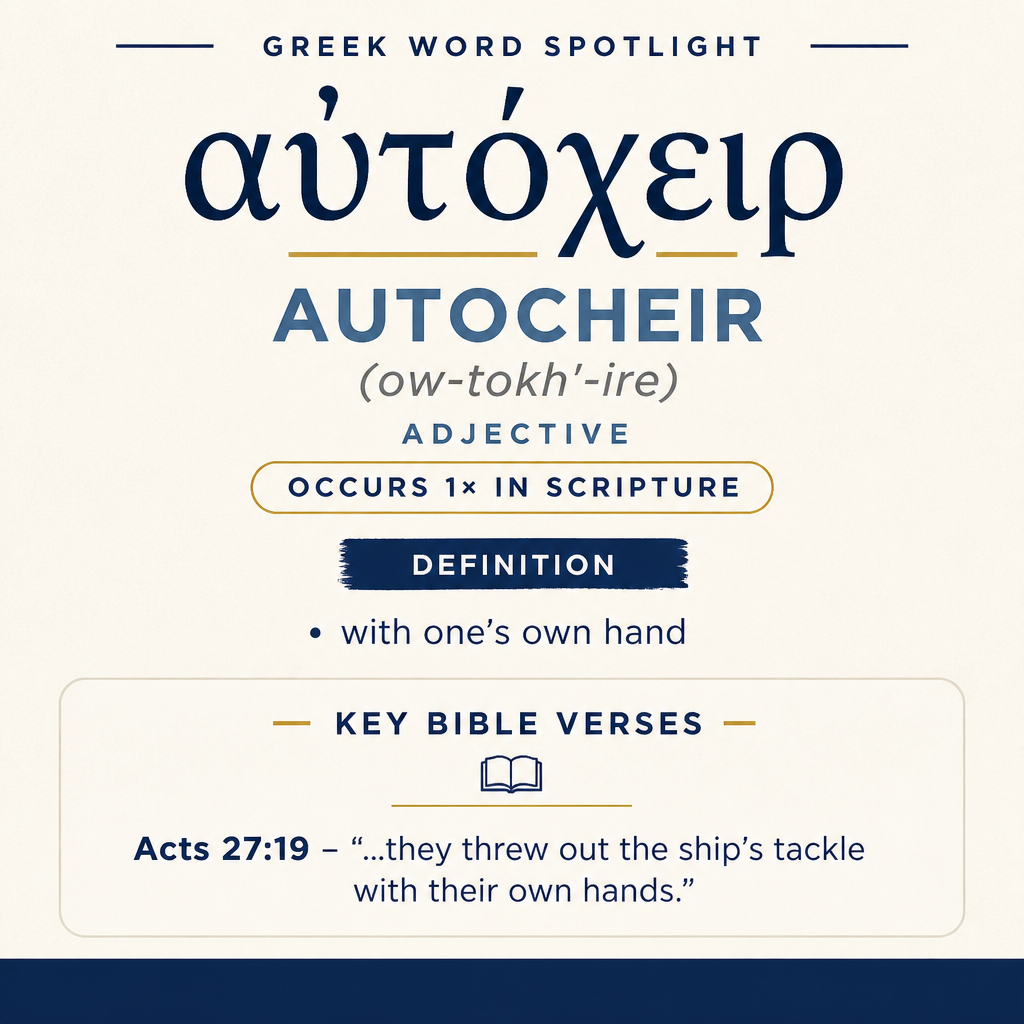
αὐτόχειρ means “with one’s own hand” and appears once in Scripture, in Acts 27:19.
Context in Acts
In Acts 27:19, it describes throwing out the ship’s tackle with their own hands.
Learn More →αὐτόχειρ expresses action done “with one’s own hand.” It appears once, in the shipwreck narrative of Acts 27:19, describing what the sailors themselves did in the emergency.
Root and Related Words
αὐτόχειρ is formed from autos (αὐτός), “it/s/he,” and cheir (χείρ), “hand.” The compound brings the reflexive idea of the subject together with the concrete instrument of manual action.

Occurrences
“On the third day, they threw out the ship’s tackle with their own hands.” (Acts 27:19)
Here αὐτόχειρ specifies the manner in which the crew responds to escalating danger at sea: the action is not merely that cargo or equipment is lost, but that “they” actively do it, manually. The verse places this act on “the third day,” in a sequence of increasingly costly measures. In that setting, αὐτόχειρ sharpens the picture of urgency: in the middle of a storm situation, the sailors do not delegate the task or treat it as routine handling; they themselves take hold of the “ship’s tackle” and jettison it. The word anchors the scene in physical effort—hands on gear—so the reader feels the immediacy and labor of survival decisions made under pressure.
Because the object is “the ship’s tackle,” the phrase “with their own hands” also conveys that what is thrown overboard is not incidental debris but working equipment—items normally used to manage the ship. αὐτόχειρ, set alongside this costly loss, underscores that the decision is deliberate and enacted directly by the group named in the sentence (“they”). The wording emphasizes personal involvement: the same people whose safety depends on the ship are the ones physically stripping it of resources in the attempt to stay afloat.
Sense and Usage
The force of αὐτόχειρ lies in its combination of agency and instrument. “Hand” is concrete, but the expression does more than mention body parts: it marks the action as performed personally, not at a distance. In Acts 27:19, the narrative could have reported that the tackle was discarded; αὐτόχειρ instead highlights that the crew carried out the dumping themselves. This directs attention to the subjects as active agents in the crisis rather than passive victims of circumstance.
In this single attestation, the phrase functions adverbially in sense, describing how the throwing out was done. The “own” element strengthens the linkage between the actors (“they”) and the deed: the hands that act belong to the same group that faces the peril. The word therefore contributes a nuance of direct participation—an emphasis that what happens to the ship happens through the crew’s immediate, tactile work.
The setting in Acts 27:19 also shows how the expression can heighten narrative intensity. The step of discarding “the ship’s tackle” is a measure taken when conditions are severe enough to justify sacrificing equipment. By stating that this was done “with their own hands,” the text draws the reader into the physicality of the moment: grasping, hauling, and casting overboard. αὐτόχειρ thus supports the realism of the account, coupling a critical decision with the image of strenuous manual execution.
Within the verse, αὐτόχειρ also subtly reinforces the communal nature of the action. The pronoun “they” governs the scene, and the mention of hands fits group labor: many hands acting together, each person contributing directly. The expression does not merely state that the group consented; it presents them as collectively engaged in the work that the emergency requires.
Imagery
Acts 27:19 frames αὐτόχειρ with maritime peril and urgent improvisation. The phrase evokes the sight of sailors, close to the deck and the gear, physically stripping the ship of what it normally relies on. By focusing on “their own hands,” the verse leaves a tactile impression: the crisis is handled at arm’s length, through immediate, bodily effort rather than through distant command.
Sources: Lexical data from Strong’s Exhaustive Concordance and the Translators Brief Lexicon of Extended Strongs for Greek (STEPBible, CC BY). Occurrence data from the Translators Amalgamated Greek New Testament (STEPBible, CC BY). Scripture quotations from the World English Bible (public domain).




