
Exploring the Meaning of Autou in Greek
αὐτοῦ (Autou) means “there” and appears in Matthew 26:36, Luke 9:27, Acts 18:19, and Acts 21:4.
Scripture Occurrences
It occurs 5 times in Scripture. Listed examples include Matthew 26:36, Luke 9:27, Acts 18:19, and Acts 21:4.
Learn More →Context Examples
In Matthew 26:36, Jesus says, “Sit here, while I go there and pray.” In Acts 21:4, the disciples “stayed there seven days.”}],
Learn More →αὐτοῦ expresses location with the sense “there,” marking where someone goes, remains, or is left within a narrative scene. In the passages where it appears, it anchors action to a specific place already present in the immediate context.

Root and Related Words
αὐτοῦ is related to autos (αὐτός), “it/s/he” (Strong’s G846).

Occurrences
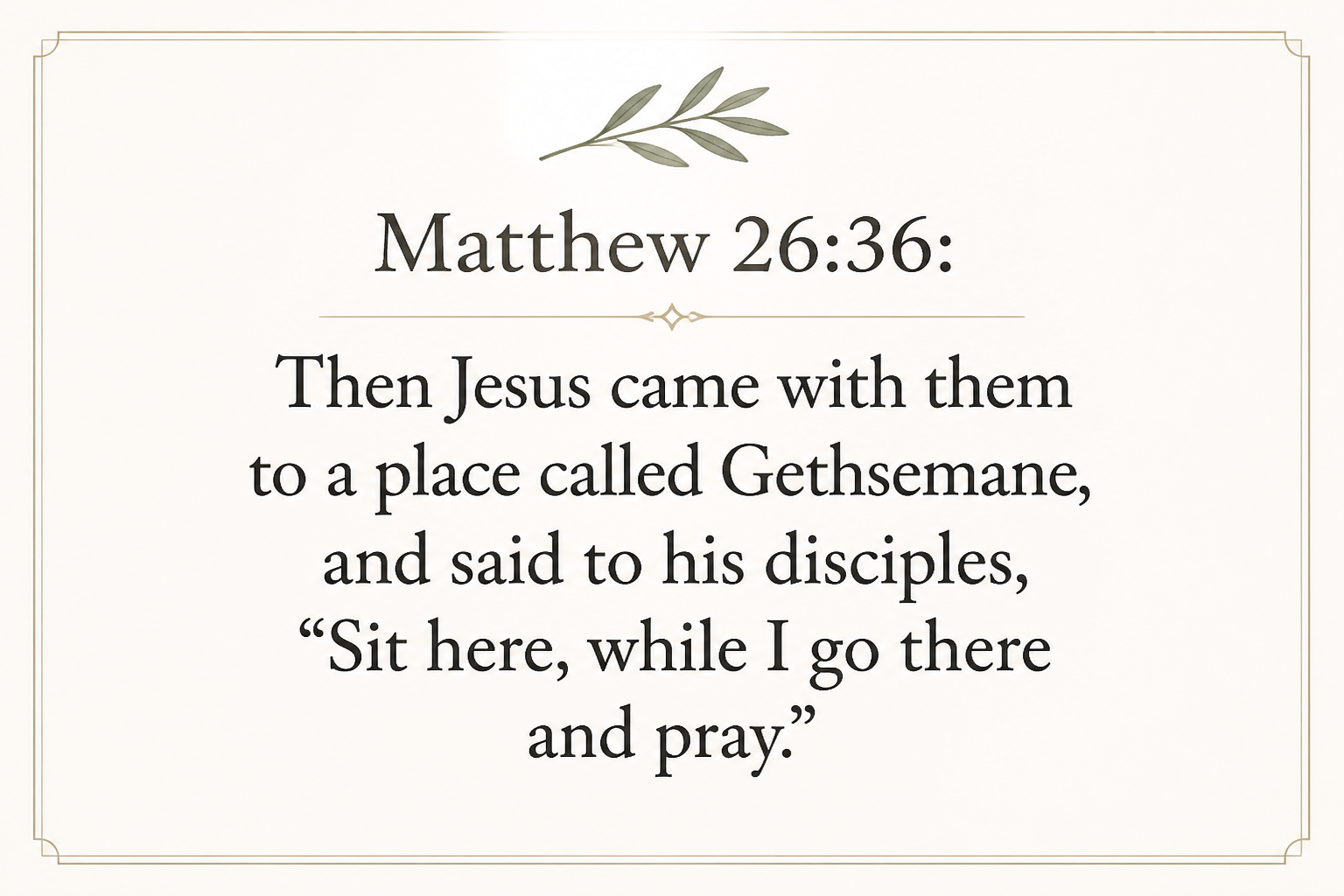
Matthew 26:36: Then Jesus came with them to a place called Gethsemane, and said to his disciples, “Sit here, while I go there and pray.”
Here αὐτοῦ functions as a directional pointer within Jesus’ spoken instruction. The scene is already grounded geographically: they arrive at “a place called Gethsemane,” and Jesus differentiates positions—“Sit here” versus “I go there.” The word highlights a separation of locations inside the same setting: the disciples are to remain where they are, while Jesus moves to another spot in order to pray. Because the command contrasts “here” and “there,” αὐτοῦ carries the force of a concrete, near-context location rather than an abstract idea; it indicates a place that can be reached by going, and one that is distinct from where the disciples will sit.
Luke 9:27: But I tell you the truth: There are some of those who stand here who will in no way taste of death until they see God’s Kingdom.”
In this saying, αὐτοῦ identifies a location connected to the immediate audience: “those who stand here.” The contrast is not between two places within the same scene (as in Gethsemane) but between present standing and future seeing. The word places the listeners in a shared “there” that is effectively the speaker’s and hearers’ current setting, the point from which the promise is made. Within the sentence, αὐτοῦ functions as the locative anchor that makes the statement concrete: the claim concerns identifiable people located in the present place, not a vague or hypothetical group.
Acts 18:19: He came to Ephesus, and he left them there; but he himself entered into the synagogue, and reasoned with the Jews.
In this narrative movement, αὐτοῦ marks the place where companions are left behind. The verse begins with arrival—“He came to Ephesus”—and then immediately uses “there” to tie the action of leaving to that arrival. The word does more than repeat the city name; it links the act (“he left them”) to the location already established, keeping the story’s motion clear: arrival at Ephesus results in a separation of parties within that same locale. The following clause, “but he himself entered into the synagogue,” keeps the location implicit while shifting the focus to the subject’s next action. αὐτοῦ helps the reader track where the others remain even as the main actor moves on to reason in the synagogue.
Acts 21:4: Having found disciples, we stayed there seven days. These said to Paul through the Spirit that he should not go up to Jerusalem.
Here αὐτοῦ sets the stage for duration and interaction. The narrative first notes the discovery of a community—“Having found disciples”—and then establishes the group’s continued presence in a location: “we stayed there seven days.” The word provides the spatial frame for the week-long stay, which in turn becomes the setting for the ensuing speech directed to Paul. By locating the seven days “there,” αὐτοῦ functions as a narrative hinge: it keeps the reader oriented while the account shifts from travel and finding disciples to the content of their warning “through the Spirit.” The place is not described further in the verse, so “there” bears the weight of holding the scene together as the focus turns from lodging to counsel about going “up to Jerusalem.”
Sense and Usage
Across these contexts, αὐτοῦ operates as a compact locator that relies on immediate context for its reference. In direct speech (Matthew 26:36), it points to a distinct spot within a known place, creating a clear spatial contrast with “here.” In a public saying (Luke 9:27), it fixes the audience in the present setting, making the statement about “some of those” tangible by attaching them to where they are standing. In travel narrative (Acts 18:19), it links a new location (“Ephesus”) to subsequent actions, clarifying that the leaving happens in that arrived-at place. In an account of extended stay (Acts 21:4), it frames time (“seven days”) within a settled location, enabling the narrative to develop what is said and decided in that setting.
In each passage, “there” is not a distant, undefined elsewhere but a place made specific by the sentence itself: a spot to which one can “go,” a setting where people “stand,” a city where companions can be “left,” and a locale in which travelers can “stay” for a measured time. The word’s contribution is therefore largely structural: it keeps spatial reference tight and avoids repetitious place-naming while still preserving clarity about where the action occurs.
Imagery
The imagery attached to αὐτοῦ in these verses is practical and scene-setting: a point of departure for prayer (“I go there and pray”), a gathered audience standing in one place, companions left behind after arrival in a city, and a week-long stay among disciples in the same locale. In each case, “there” invites the reader to picture the immediate surroundings as the backdrop for instruction, promise, movement, and counsel.
Sources: Lexical data from Strong’s Exhaustive Concordance and the Translators Brief Lexicon of Extended Strongs for Greek (STEPBible, CC BY). Occurrence data from the Translators Amalgamated Greek New Testament (STEPBible, CC BY). Scripture quotations from the World English Bible (public domain).





