
Exploring the Meaning of Autoptes in Greek
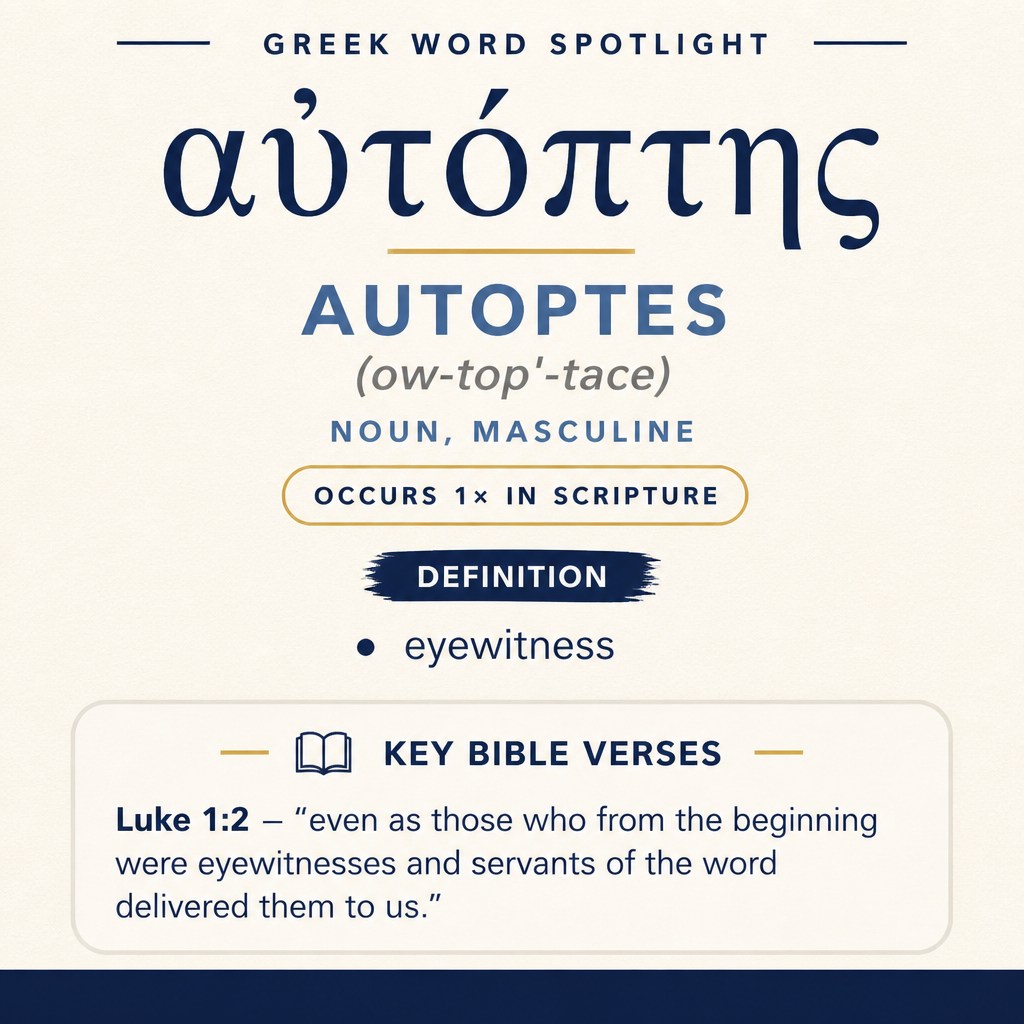
αὐτόπτης (Autoptes) means “eyewitness” and appears once in Scripture, in Luke 1:2.
Scripture Occurrence
This word occurs 1 time in Scripture. Its sole reference is Luke 1:2.
Learn More →Verse Context
In Luke 1:2 it refers to those who from the beginning were eyewitnesses and servants of the word. They delivered these accounts to others.
Learn More →αὐτόπτης means “eyewitness” and appears in the New Testament in Luke 1:2. In that opening sentence of Luke’s Gospel, the term helps describe the kind of sources that transmitted the earliest account.
Root and Related Words
αὐτόπτης (Autoptes) is connected with two elements named in its related words list: the verb ὀπτάνομαι (optanomai), “to appear” (Strong’s G3700), and αὐτός (autos), “it/s/he” (Strong’s G846). Together these related terms frame the word in a vocabulary of personal presence and sight—language suited to describing first-hand observation rather than distant report.

Occurrences
“even as those who from the beginning were eyewitnesses and servants of the word delivered them to us,” (Luke 1:2)
In Luke 1:2, αὐτόπτης stands inside a chain of transmission: what is delivered “to us” comes through “those who from the beginning were eyewitnesses and servants of the word.” The term marks a category of persons distinguished by direct seeing. Luke’s wording sets these “eyewitnesses” at the starting point (“from the beginning”) of the tradition he is describing, placing their testimony at the earliest stage of how the message moved from events to narration.
The verse joins “eyewitnesses” with “servants of the word,” presenting two linked descriptions of the same people. Within the sentence, αὐτόπτης contributes the observational dimension: they are people whose service is paired with having been present to see what occurred. The combination also clarifies that the delivery is not merely the passing along of opinions; it is associated with those whose role included both witness and service in relation to “the word.”
Sense and Usage
As used in Luke 1:2, “eyewitness” functions as a credibility-bearing descriptor within a literary preface. Luke is speaking about how accounts were “delivered,” and αὐτόπτης specifies that the originators in that chain include individuals characterized by direct visual witness. The term therefore works relationally: it defines the people by their proximity to what is being spoken about and by their capacity to hand on what they have seen.
The placement of αὐτόπτης alongside “from the beginning” gives the word a temporal contour in this context. It is not simply that they saw something at some point; they are described as belonging to the earliest phase of the story Luke is about to tell. The effect is to tighten the link between beginnings, seeing, and subsequent delivery of the report. In Luke’s sentence, the concept of an eyewitness is not isolated; it is embedded in a process of remembering, serving, and transmitting.
Luke also couples αὐτόπτης with a second identifier, “servants of the word.” That pairing suggests that their witness is not framed as detached observation. In this line, the eyewitnesses are also participants in the communicative life of “the word,” so that their seeing and their service together shape how the message is delivered. The term “eyewitness” thus contributes to Luke’s portrait of responsible transmission: persons grounded in first-hand sight and marked by a role of service are the ones through whom the tradition comes.
Imagery
The single occurrence carries the plain imagery of seeing with one’s own eyes at the beginning of events and then passing on what was seen. In Luke 1:2, αὐτόπτης evokes the scene of first-hand observers standing at the start of the story and functioning as the initial human link in a chain of delivery to later recipients.
Sources: Lexical data from Strong’s Exhaustive Concordance and the Translators Brief Lexicon of Extended Strongs for Greek (STEPBible, CC BY). Occurrence data from the Translators Amalgamated Greek New Testament (STEPBible, CC BY). Scripture quotations from the World English Bible (public domain).




