
Exploring the Meaning of Autokatakritos in Greek
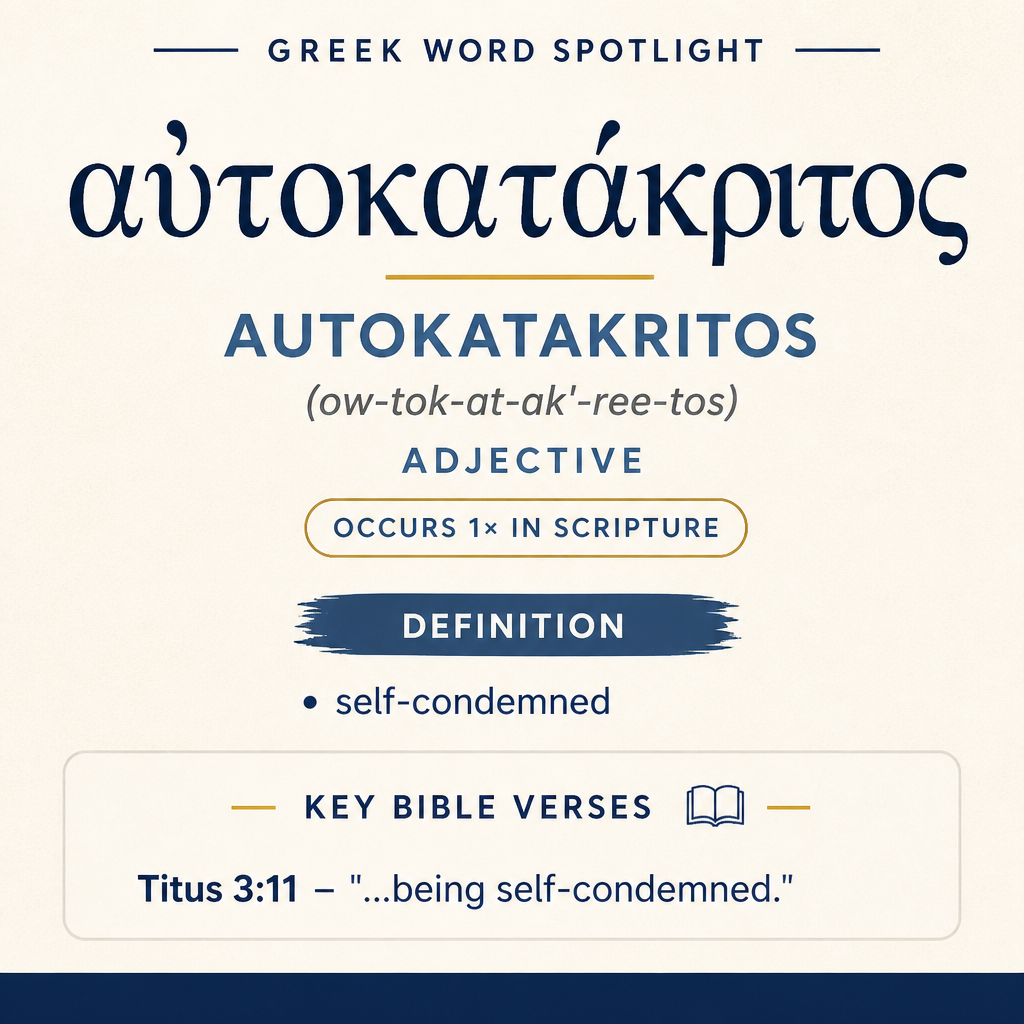
αὐτοκατάκριτος means “self-condemned” and appears once in Scripture, in Titus 3:11.
Verse Context
In Titus 3:11, it describes one who is perverted and sins, being self-condemned.
Learn More →αὐτοκατάκριτος means “self-condemned” and appears in the New Testament in Paul’s instruction to Titus about responding to a certain kind of disruptive person within the community.
Root and Related Words
αὐτοκατάκριτος is related to the verb katakrino (κατακρίνω), “to condemn” (Strong’s G2632), and to autos (αὐτός), “it/s/he” (Strong’s G846). The shape of the adjective reflects the joining of autos (“self”) with the idea of condemnation expressed by katakrino.

Occurrences
Titus 3:11 — “knowing that such a one is perverted and sins, being self-condemned.”
In Titus 3:11, αὐτοκατάκριτος functions as a final descriptor in a tight chain: “perverted,” “sins,” and then “being self-condemned.” The word contributes the idea that the person’s own stance, behavior, or pattern of action leaves him under condemnation that is in some sense his own doing; the condemnation is attached to him as something he carries, not merely something imposed from outside in the moment. Within the verse, the term does not stand alone as an abstract label but appears as the closing assessment that rounds off what is “known” about “such a one.” That placement makes it sound like the culminating recognition that follows from the preceding realities: the person is distorted in character (“perverted”) and continues in wrongdoing (“sins”), and therefore he stands as “self-condemned.”

The grammar of the verse frames this as a settled understanding: “knowing that such a one…” introduces a conclusion Titus and the community are to treat as recognized fact. αὐτοκατάκριτος, as part of that knowledge, marks the person as already bearing condemnation tied to his own case. The verse’s language suggests an internal consistency: the person’s conduct is not a one-off failure but a trajectory that openly contradicts what is expected, so that his own actions speak against him. The adjective thus strengthens the rationale implied by “knowing”: the community is not acting on guesswork or mere suspicion; the person’s ongoing behavior has made his situation plain.
Sense and Usage
Because αὐτοκατάκριτος occurs only in this setting, its force is concentrated and specific: it characterizes a person whose condemnation is connected to himself. The definition “self-condemned” highlights that the decisive feature is not simply that condemnation exists, but that it is in some way self-attaching—bound up with the person’s own course. In Titus 3:11 this is not presented as an inner feeling of guilt described in psychological terms; rather, it is a moral assessment stated alongside visible traits (“perverted”) and observable action (“sins”). The word therefore sits in the realm of evaluative description: it labels the person’s state in light of his conduct.
The immediate context in the verse shows αὐτοκατάκριτος operating as a kind of climactic summary. “Perverted” indicates that something has gone wrong at the level of direction or orientation; “sins” indicates the concrete outworking; “self-condemned” names the resulting standing of the person in terms of condemnation. In this sequence, the term helps explain why the community can “know” what they are dealing with: the pattern is sufficiently clear that the person’s own behavior has effectively rendered a verdict on his case. The adjective’s emphasis on “self” also gives the description a particular sharpness: condemnation is not portrayed as an arbitrary decision by others, but as something that follows the person as a consequence of what he is and does in the terms of the verse.
As an adjective, αὐτοκατάκριτος describes the person directly (“such a one… being self-condemned”), not merely the person’s actions. That matters for its nuance in this context: the verse portrays the situation as more than isolated acts; the person is “being” in this state. The form “being self-condemned” reads as a characterization of condition or standing that accompanies the ongoing sinning. In other words, the condemnation is not treated as a distant future possibility; it is bound to the present reality of the person as he persists in the behavior named in the verse.
The two related words help clarify how the adjective carries its sense. autos (αὐτός) supplies the “self” element, focusing attention on the subject as the one implicated. katakrino (κατακρίνω) supplies the condemnation idea, giving the term its evaluative weight. Put together in this adjective, the result is a compact description: the person is marked out as one whose condemnation is connected to himself rather than being merely a label placed upon him from the outside. Within Titus 3:11, that connection is grounded in the stated facts that he is “perverted” and “sins.”
Imagery
Titus 3:11 carries a courtroom-like flavor without narrating an actual trial: “knowing” introduces a settled conclusion, and “self-condemned” suggests a verdict that, in effect, has been reached by the person’s own case. The imagery is that of a life that testifies against itself—where the evidence is not a hidden detail but the person’s continuing pattern (“sins”) flowing from a distorted condition (“perverted”), ending in the stark assessment that he stands “self-condemned.”
Sources: Lexical data from Strong’s Exhaustive Concordance and the Translators Brief Lexicon of Extended Strongs for Greek (STEPBible, CC BY). Occurrence data from the Translators Amalgamated Greek New Testament (STEPBible, CC BY). Scripture quotations from the World English Bible (public domain).




