Exploring the Meaning of Auxesis in Greek
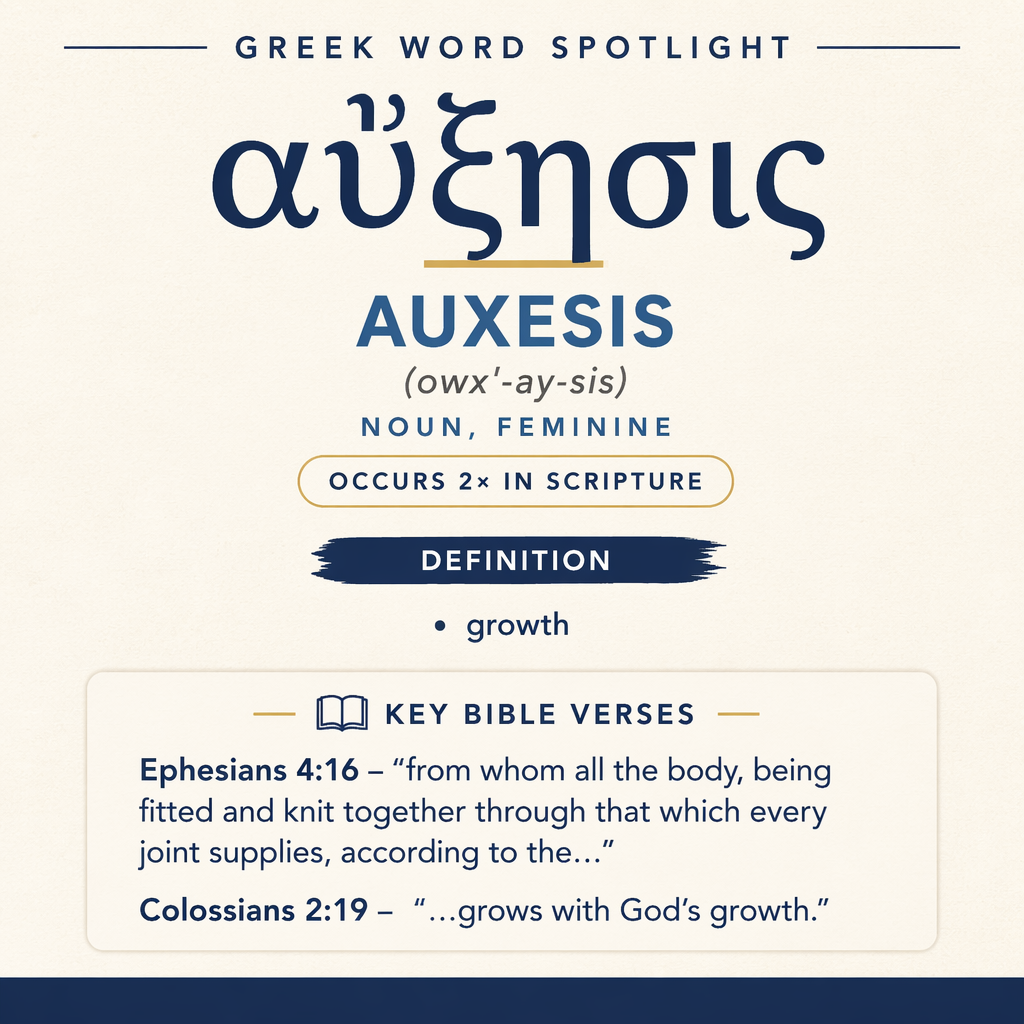
αὔξησις (Auxesis) means “growth” and appears twice in Scripture: Ephesians 4:16 and Colossians 2:19.
Scripture Occurrences
This word occurs 2 times in Scripture. Its references are Ephesians 4:16 and Colossians 2:19.
Learn More →Context Snapshot
In both listed verses, it appears within descriptions of the body being supplied and knit together. The texts speak of joints and ligaments working together.
Learn More →αὔξησις expresses “growth” in two Pauline descriptions of how Christ’s people develop as a living body. In both passages the term belongs to the imagery of a body whose coordinated parts produce an increase that is directed toward spiritual maturity.
Root and Related Words
αὔξησις is related to the verb auxano (αὐξάνω), “to grow” (Strong’s G837). The noun presents growth as a named reality—something that can be spoken of as an identifiable increase rather than only as an action.

Occurrences
Ephesians 4:16: “from whom all the body, being fitted and knit together through that which every joint supplies, according to the working in measure of each individual part, makes the body increase to the building up of itself in love.”
Here αὔξησις appears in a carefully layered description of communal life under Christ (“from whom”). The image is not of isolated individuals improving privately, but of “all the body” as a single organism. The verse stacks phrases that emphasize cohesion and interdependence: the body is “fitted and knit together,” and this unity is mediated “through that which every joint supplies.” Within that framework, αὔξησις names the result that emerges when each element functions properly: “according to the working in measure of each individual part, makes the body increase.” Growth is thus portrayed as something produced by coordinated activity—each “part” contributing in its proper “measure.”
The verse also defines the direction and purpose of this increase: it is “to the building up of itself in love.” Growth is not presented as mere expansion for its own sake; it is oriented toward constructive strengthening (“building up”) and occurs within the relational sphere of “love.” In this setting αὔξησις belongs to the logic of edification: the body’s increase serves its own maturation as a unified whole under its source (“from whom”).
Colossians 2:19: “and not holding firmly to the Head, from whom all the body, being supplied and knit together through the joints and ligaments, grows with God’s growth.”
In Colossians, αὔξησις stands at the climax of a contrast. The verse begins with a failure of relationship—“not holding firmly to the Head”—and then immediately identifies the true source of the body’s life and development: “from whom all the body” receives what it needs. The body is “supplied and knit together through the joints and ligaments,” language that parallels Ephesians in its emphasis on connectedness and provision. Within this anatomy-based picture, αὔξησις is the kind of growth that belongs to God: the body “grows with God’s growth.”

The phrase “God’s growth” frames the noun by assigning ownership and character to the increase. Growth is not treated as a self-originating process driven by the body’s internal resources; it comes “from” the Head and bears the mark of God. The relational tie to the Head is therefore essential to the body’s growth: the verse sets “not holding firmly” against the reality that all supply and coordination are “from whom,” leading to growth that is described as God’s own kind of increase.
Sense and Usage
Across these two occurrences, αὔξησις functions within a consistent metaphor: the community is a “body,” and growth is the increase that follows when the body is properly connected, supplied, and coordinated. The term is used neither for biological development in general nor for numerical increase in the abstract, but for the kind of increase that fits an organism whose parts are joined together and whose life depends on a central source (“the Head”). This makes αὔξησις a word for growth conceived as an integrated outcome—an increase that has a shape and direction because it arises from an ordered, connected whole.
Both texts also place growth within a chain of means and results. In Ephesians, the movement runs from Christ as source (“from whom”), to cohesion (“fitted and knit together”), to mutual contribution (“every joint supplies”), to proportionate effectiveness (“working in measure of each individual part”), and then to the named outcome (“makes the body increase”). αὔξησις is the endpoint of that chain, the observable increase that occurs when each element performs its role in the whole. The verse then extends the line of thought one step further: this increase aims “to the building up of itself in love.” Growth therefore belongs to a constructive process; it is the kind of increase that results in edification rather than fragmentation.
In Colossians, the chain is tightened around the relationship to the Head. The initial negative (“not holding firmly to the Head”) makes the following affirmations stand out: supply and unity are “from whom,” and the body is “supplied and knit together through the joints and ligaments.” Here αὔξησις is expressed as “God’s growth,” a phrase that places the increase within God’s sphere and under God’s agency. The body grows, but its growth is not self-defined; it is characterized as belonging to God. In that way the noun conveys growth as something received and sustained—an increase that depends on continuing attachment to the Head who provides what the body needs.
The two passages together also show how αὔξησις can carry both a corporate and a directional nuance without changing its core idea. The subject of growth is “all the body,” not a single limb. Yet the body’s increase is not depicted as chaotic; it is coordinated by joints, ligaments, and measured working, suggesting ordered development. Ephesians highlights the internal dynamics—each part’s measured working and each joint’s supply—while Colossians highlights the external dependency of the body upon the Head from whom supply and unity come. In both, αὔξησις names growth as the result of a living connection that brings coherence, provision, and constructive strengthening.
Imagery
αὔξησις carries the imagery of an organism becoming more fully itself: a body whose parts are joined, supplied, and active, producing an increase that builds up the whole. Ephesians pictures that increase unfolding “in love,” while Colossians frames it as “God’s growth,” keeping the body’s development tethered to the Head “from whom” it receives life and cohesion.
Sources: Lexical data from Strong’s Exhaustive Concordance and the Translators Brief Lexicon of Extended Strongs for Greek (STEPBible, CC BY). Occurrence data from the Translators Amalgamated Greek New Testament (STEPBible, CC BY). Scripture quotations from the World English Bible (public domain).