
Exploring the Meaning of Aulizomai in Greek
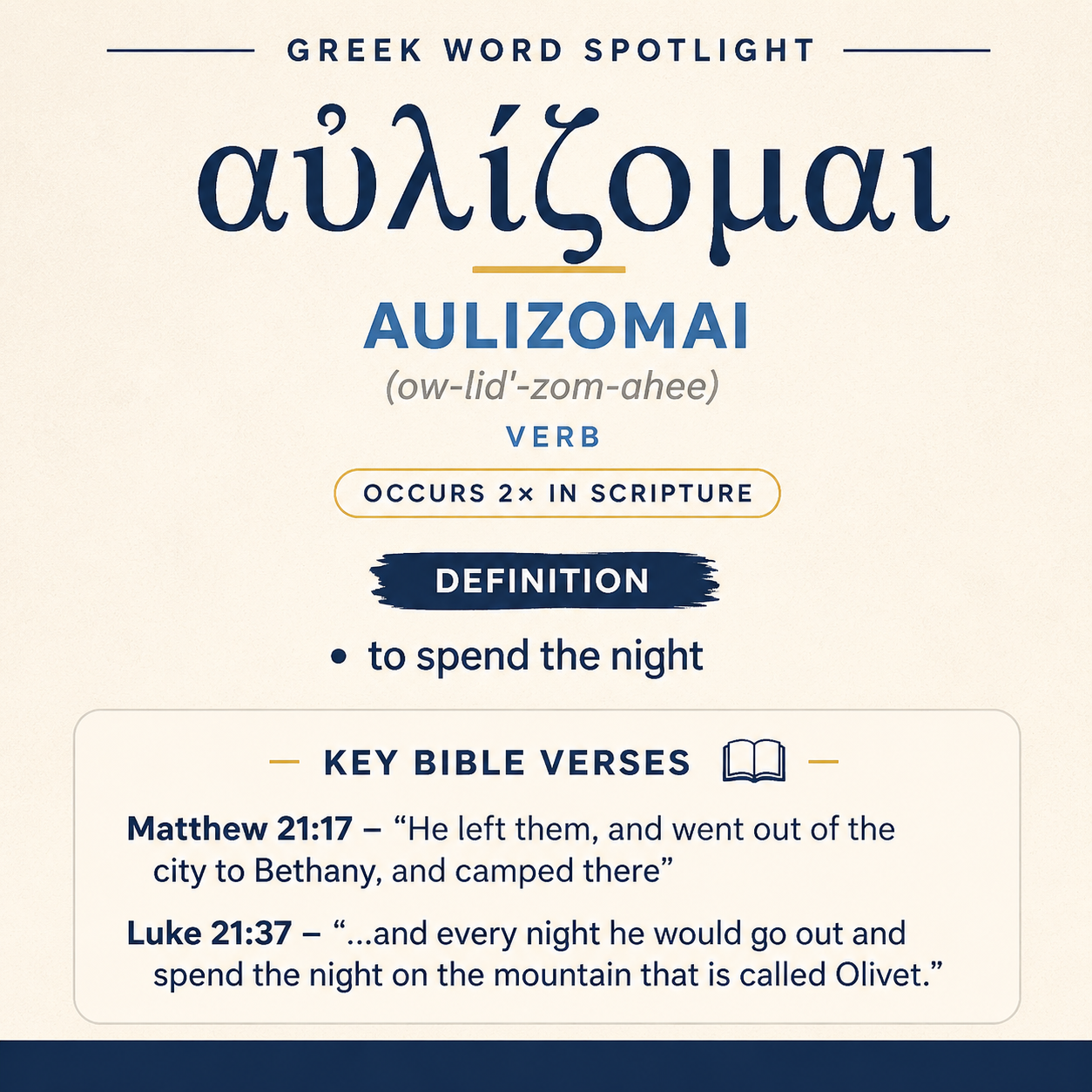
αὐλίζομαι means “to spend the night” and appears twice in Scripture: Matthew 21:17 and Luke 21:37.
Gospel Occurrences
It occurs two times in Scripture, in Matthew 21:17 and Luke 21:37.
Learn More →Context in Verses
In Matthew 21:17, Jesus went to Bethany and camped there. In Luke 21:37, after teaching daily in the temple, he went out nightly to spend the night on the mountain.
Learn More →αὐλίζομαι describes spending the night, marking where someone remains when the day’s activity has ended. It appears in the accounts of Jesus leaving the city after public engagement and passing the night elsewhere (Matthew 21:17; Luke 21:37).
Root and Related Words
αὐλίζομαι is related to the noun aulē (αὐλή), “palace/courtyard” (Strong’s G833). The relationship links the verb to the sphere of lodging or staying in a place connected with a residence or its precincts.

Occurrences
“He left them, and went out of the city to Bethany, and camped there.” (Matthew 21:17)
Here αὐλίζομαι anchors a clear transition: Jesus disengages from an immediate public setting (“He left them”), moves from the urban center (“went out of the city”) to a specific nearby location (“to Bethany”), and then settles there for the night (“camped there”). The verb gathers up the day’s movement into a final resting-place, presenting the night as an interval in which travel and confrontation stop and a stable location is taken. Within the sentence’s sequence of actions, the word functions like a narrative full stop: the day’s interactions end, and the scene closes with where he remains until morning.
The phrasing also places emphasis on geography and separation. Jesus does not merely pause somewhere along the way; he goes “out of the city” and “to Bethany.” αὐλίζομαι, in this context, highlights the significance of that destination by presenting it as the chosen overnight stay. The effect is to show that the night is spent outside the city’s space, suggesting a rhythm of coming and going that frames his ministry movements in terms of day and night.
“Every day Jesus was teaching in the temple, and every night he would go out and spend the night on the mountain that is called Olivet.” (Luke 21:37)
In Luke’s sentence, αὐλίζομαι sits inside a carefully balanced pattern: “Every day” is matched by “every night.” The day is defined by a steady public activity (“teaching in the temple”), while the night is defined by a repeated action of departure and overnight staying (“he would go out and spend the night”). The verb gives the nightly half of the pattern its concrete endpoint: not merely leaving, but actually remaining somewhere through the night.
Luke also specifies the location with unusual clarity: “on the mountain that is called Olivet.” αὐλίζομαι therefore does more than mark the passage of time; it attaches Jesus’ nighttime to a distinct setting outside the temple precincts. The phrase “he would go out” indicates movement away from the center of daily teaching, and αὐλίζομαι completes that motion by portraying the mountain as the place where the night is actually passed. The verb, placed after the going out, underscores that this is not a brief visit but a sustained overnight stay that closes each day’s cycle.
Taken as a whole, the verse presents two spheres: the temple as the daytime sphere of instruction, and Olivet as the nighttime sphere of staying. αὐλίζομαι is the key term that turns “night” from an abstract time period into a lived routine—night is where he stays, repeatedly, in a particular place.
Sense and Usage
Across these two occurrences, αὐλίζομαι functions as a narrative marker of where a person remains after the day’s engagements. In Matthew, the emphasis falls on a single evening’s relocation: leaving a group, exiting the city, arriving at Bethany, and then staying there through the night. In Luke, the emphasis falls on repeated practice: teaching daily in the temple and then consistently going out to stay overnight on Olivet. In both cases, the verb is paired with movement language (“went out,” “go out”), so that the overnight stay is presented as the completion of a deliberate departure.
The word also carries a practical, situational force: it signals a real interval of time spent in a place, not merely a moment of stopping. That interval matters to the storytelling. In Matthew 21:17 it closes a scene with a specific locale, anchoring the next day’s narrative in the fact that Jesus has spent the night away from the city. In Luke 21:37 it characterizes an established rhythm of ministry life, portraying day and night as distinct phases with distinct locations. αὐλίζομαι thus helps the reader sense not only where Jesus is, but how his days are structured—public instruction in one setting, overnight staying in another.
Though the two references name different places (Bethany; the mountain called Olivet), they share the same directional contrast: outward from the city/temple center to a place outside it. The verb contributes to that contrast by tying the “outside” location to the full duration of the night. The resulting picture is not simply that Jesus departs at evening, but that his night is spent elsewhere, implying a consistent boundary between the public center of activity and the place where the night is passed.
The related noun aulē (αὐλή), “palace/courtyard,” sits in the background of the verb’s lodging idea and helps explain why αὐλίζομαι readily fits both a settled village setting (Bethany) and a specified outdoor location (Olivet). In these narratives, the exact character of the lodging is not elaborated; instead, the verb’s role is to indicate the act of staying overnight as the conclusion of a day’s movement. This makes αὐλίζομαι especially useful for describing patterns of itinerary: it can close a travel sequence (“went out… to Bethany”) or complete a habitual cycle (“Every day… every night…”).
Imagery
The imagery carried by αὐλίζομαι in these passages is the quiet settling that follows public intensity. Matthew paints an evening departure from the city to Bethany, ending with the simple fact of camping there; Luke paints a repeated rhythm in which teaching in the temple yields to nights spent on the mountain called Olivet. In both, αὐλίζομαι evokes the shift from the public, crowded places of the day to a nighttime location where the hours are passed until morning.
Sources: Lexical data from Strong’s Exhaustive Concordance and the Translators Brief Lexicon of Extended Strongs for Greek (STEPBible, CC BY). Occurrence data from the Translators Amalgamated Greek New Testament (STEPBible, CC BY). Scripture quotations from the World English Bible (public domain).





