Exploring the Meaning of Arotron in Greek
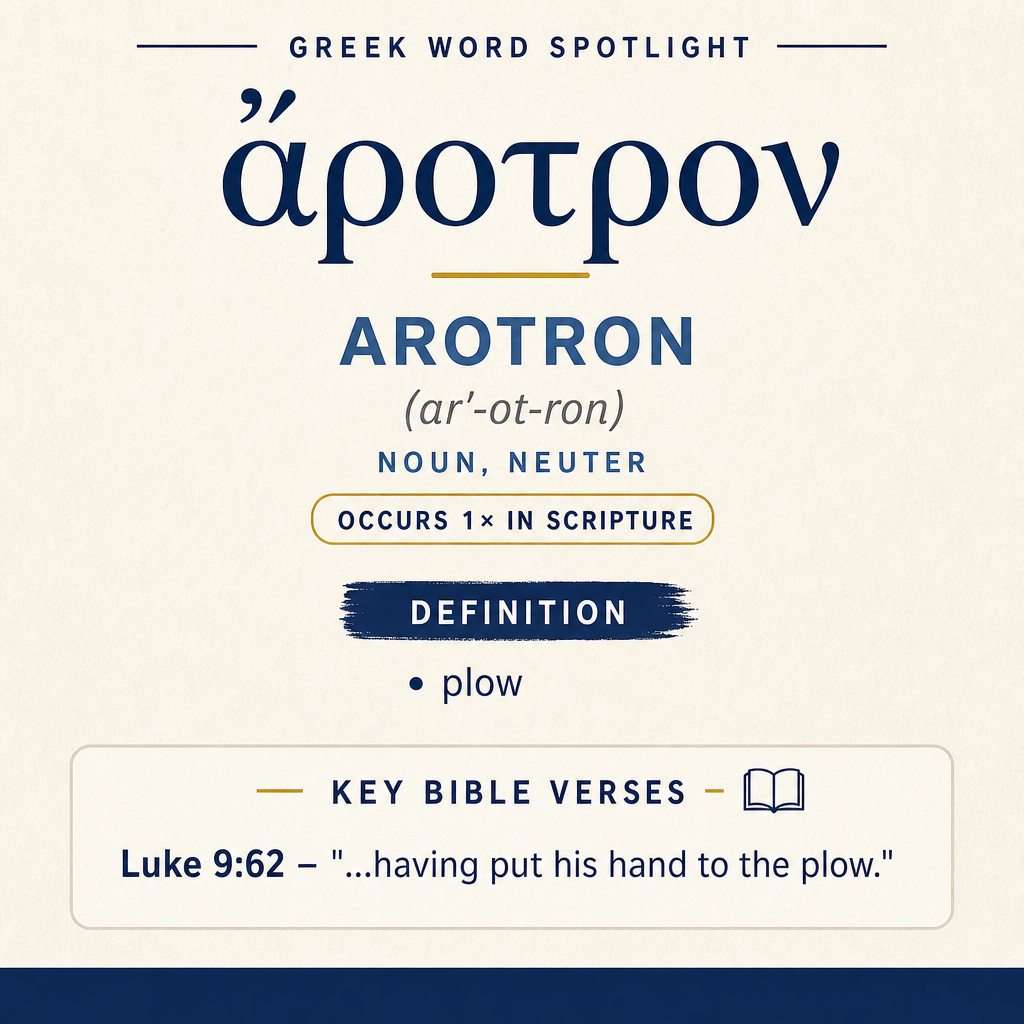
ἄροτρον (Arotron) means “plow” and appears once in Scripture, in Luke 9:62.
Verse Context
In Luke 9:62, Jesus speaks of someone putting his hand to the plow and looking back. He says such a person is not fit for God’s Kingdom.
Learn More →ἄροτρον refers to a “plow” and appears in a single Gospel saying where Jesus uses agricultural imagery to describe single-minded fitness for God’s Kingdom. The word functions as a concrete object in view, anchoring the statement in the ordinary work of field cultivation.
Occurrences
“But Jesus said to him, “No one, having put his hand to the plow, and looking back, is fit for God’s Kingdom.”” (Luke 9:62)
In Luke 9:62, ἄροτρον supplies the physical point of contact for Jesus’ image: a person has already “put his hand to the plow.” The scene presumes the start of labor, not merely an intention to work. The hand on the plow frames the moment as one of committed engagement—work begun with an implement designed to cut and turn soil. Within the wording of the saying, the plow is the stable reference point that makes “looking back” intelligible as a conflicting action: the worker’s posture and attention are divided between the tool in hand and whatever lies behind. Jesus’ conclusion—“is fit for God’s Kingdom”—treats the plow-image as an analogy for suitability, where the decisive issue is not possession of the tool but the posture of a person who has taken hold of it and then turns his gaze elsewhere.
The verse also places the plow in a particular syntactic role: it appears in a prepositional phrase (“to the plow”) that marks direction or orientation. The tool is not named as a distant object in the field but as something immediately present and engaged, close enough to be grasped. That closeness strengthens the force of the statement: this is not a warning about never starting, but about the inconsistency of starting and then being drawn backward in attention. The plow therefore carries the weight of an irreversible beginning—once the hand is on it, the work has, in the logic of the image, already been taken up.

Sense and Usage
Because ἄροτρον denotes a plow, its meaning is straightforwardly concrete, yet in this saying it functions as a vivid, workaday object that makes an interior reality visible. A plow is associated with the beginning and continuation of fieldwork: it is an implement that must be handled, guided, and kept in view while it is being used. Luke 9:62 assumes that the essential act is not merely touching the implement but taking up the task that the implement represents. This makes the plow an effective image for a course of action that has been undertaken and that calls for sustained attention.
The structure of the saying hinges on two participial ideas placed side by side: “having put his hand to the plow” and “looking back.” The plow, in that pairing, serves as the forward-facing task-marker. It is the object that signals commitment to what lies ahead—cultivation, progress, movement into the field. “Looking back” is then presented as a contradiction of the orientation implied by the plow. Without needing to assign extra meanings to the implement, the plow naturally implies forward direction in the work: it is the tool at the leading edge of what the worker is doing, the instrument by which the field is being opened. The tension in the line depends on that practical association: a person engaged with a plow is expected to attend to the work in front of him rather than shifting focus behind.
In terms of imagery, the plow is also an object that invites the language of readiness and capability. Jesus’ concluding assessment, “is fit for God’s Kingdom,” draws the tool-image into a judgment about suitability. The point is not that the Kingdom is agricultural, but that the demands of the Kingdom can be expressed through the demands of a real task. The plow makes the abstract criterion (“fit”) concrete: fitness is pictured as a steadiness of purpose while one’s hand is already committed to an implement of labor.
The saying also uses ἄροτρον to mark a threshold between two states: before taking hold of the plow, a person might still be deciding; after taking hold, a person is engaged. Luke 9:62 speaks from the latter side of that threshold: the person has already acted (“having put his hand”). The plow therefore belongs to the moment of responsibility that follows initiation. In that way, the implement is not decorative detail; it is the hinge that makes the warning concrete. It locates the admonition at the point where one’s choice has already begun to take shape in action.
Even in a single occurrence, the word’s ordinary referent keeps the saying grounded. The plow is not a rare or mystical object; it belongs to familiar labor and clear outcomes. That familiarity helps the statement land as a plain assessment rather than an obscure riddle. The image assumes that listeners can picture the physical act: a hand placed on an implement, the body aligned toward the work, and the disruption that comes when attention turns backward. The plow thus serves as a common, tangible anchor for the force of the saying.
Imagery
Luke 9:62 leaves the reader with a stark visual: a worker poised at the start of a furrow, hand on the plow, yet eyes turned behind. The plow stands at the center of the picture as the tool that binds the worker to the work, so that the simple movement of “looking back” becomes a test of whether one’s forward commitment is whole or divided.
Sources: Lexical data from Strong’s Exhaustive Concordance and the Translators Brief Lexicon of Extended Strongs for Greek (STEPBible, CC BY). Occurrence data from the Translators Amalgamated Greek New Testament (STEPBible, CC BY). Scripture quotations from the World English Bible (public domain).