Exploring the Meaning of Aren in Greek
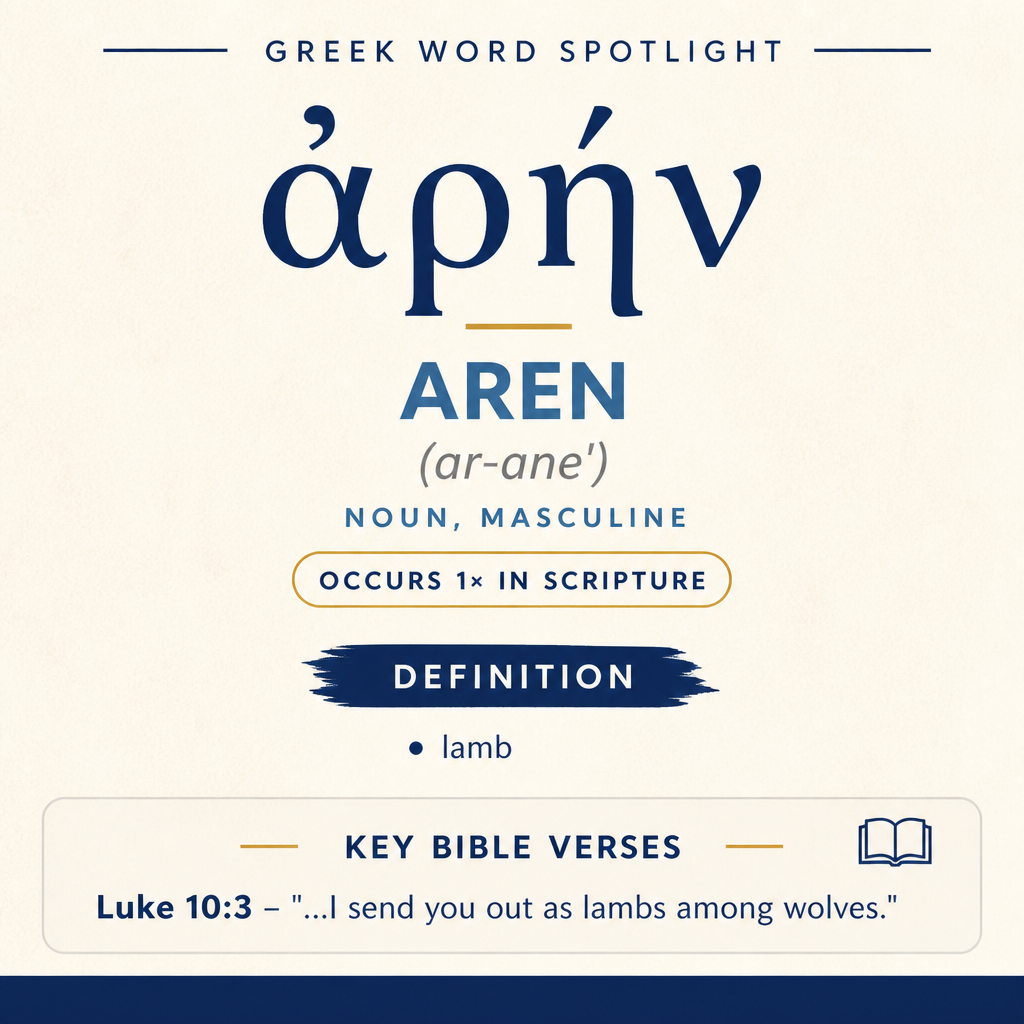
ἀρήν means “lamb” and appears once in Scripture, in Luke 10:3.
Scripture Occurrence
It occurs one time in Scripture. The occurrence is in Luke 10:3.
Learn More →ἀρήν means “lamb” and appears in a single New Testament saying that frames a mission in stark, animal imagery. In Luke 10:3 it functions as the vulnerable counterpart to “wolves,” sharpening the picture of exposure and risk.
Root and Related Words
ἀρήν (Aren) derives from ἄρρην / ἄρσην (arrhēn / arsēn), “male” (Strong’s G730). This relationship ties the noun to a broader Greek word family concerned with male identity.

Occurrences
“Go your ways. Behold, I send you out as lambs among wolves.” (Luke 10:3)
Here ἀρήν appears in a direct comparison (“as lambs”) that defines the posture of those being sent: they are portrayed as lambs placed “among wolves.” The contrast is immediate and deliberate. The sentence begins with an imperative—“Go your ways”—and then grounds the command in a vivid scene: the sender dispatches the group into an environment where the surrounding creatures are predatory. Within that picture, “lambs” supplies the sense of being comparatively small and exposed in the presence of danger. The word does not stand alone; its force comes from the paired term “wolves,” which makes “lambs” function as the emblem of the weaker party in an unequal setting.

The phrasing “I send you out” places agency on the sender, not on the lambs themselves. In that frame, ἀρήν contributes to the portrayal of the sent ones as recipients of a commission that includes vulnerability. The lamb imagery makes the peril feel concrete rather than theoretical: the audience is asked to imagine a living creature that, when surrounded by wolves, is outmatched. The effect is to communicate that the mission described is not merely a trip or assignment but an entry into a hostile context where the normal advantages of strength are absent.
Sense and Usage
Within Luke 10:3, “lamb” is used figuratively, yet the meaning remains the ordinary, literal animal. The sentence relies on the listener’s familiarity with how lambs relate to wolves in a natural setting: the lamb is the prey animal, the wolf the predator. Because the verse supplies no additional qualifiers (such as age, condition, or setting beyond “among wolves”), the word’s contribution is concentrated: it marks the sent ones as those who do not dominate their environment and who must carry out their commission without the protections normally associated with strength or aggressiveness.
The plural form in English (“lambs”) indicates that the comparison is applied to a group rather than an individual. That group identity shapes the image: the mission is communal, but the communal nature does not remove the asymmetry embedded in “lambs among wolves.” Even together, the lambs are still lambs; the metaphor does not shift toward a different animal or a different balance of power. In this way, ἀρήν helps establish the emotional and practical tone for the sending: the sent ones should expect exposure, and the environment should be expected to contain opposition.
Because this is the only attested occurrence here, the semantic range on display is focused: “lamb” functions as a relational term, defined by what surrounds it. Luke 10:3 does not describe lambs in a pastoral field or under shepherding care; it places them “among wolves.” The sense therefore plays out as a marker of vulnerability in proximity to threat. The image is not abstract; it depends on a tangible, recognizable creature to convey the character of the situation.
Imagery
Luke 10:3 employs the lamb image to set expectations before any details of travel, reception, or response appear in the quoted line itself. By choosing “lambs among wolves,” the saying compresses the experience of danger into a single picture: a gentle animal positioned within the space of predators. ἀρήν thus carries a stark visual weight in the verse—one that makes the command “Go your ways” sound less like a routine departure and more like an intentional entry into risk under the sender’s direction.
Sources: Lexical data from Strong’s Exhaustive Concordance and the Translators Brief Lexicon of Extended Strongs for Greek (STEPBible, CC BY). Occurrence data from the Translators Amalgamated Greek New Testament (STEPBible, CC BY). Scripture quotations from the World English Bible (public domain).