Tithely Review (2026)
We dug through Tithely’s giving tools, its Breeze-powered management software, and 1,800+ user reviews to find out who it actually fits — and who should keep looking.
Every church tech decision eventually runs into the same wall: giving has to move online, the member spreadsheet has become unmanageable, and you’re paying four vendors for things that should live in one place. Tithely — used by more than 53,000 churches and now trading under the tagline “Simply Serve” — pitches itself as the one platform that ends the juggling.
We wanted to know whether that pitch holds up when you actually run a church on it. So we did two things: we set up and used the product ourselves, and we sat down with a couple of thousand real reviews to see where praise and frustration actually land. What follows is the honest picture, including the parts Tithely would rather you skim past.
Independence: Tithely didn’t pay for, preview, or approve this review, and no vendor can buy a higher score. We don’t accept payment for rankings.
What Tithely actually is
And the Breeze detail that changes how you should read it.
Tithely started in 2015 as a cheaper, simpler way for churches to take donations online. It has since grown into a full suite: giving, church management, custom mobile apps, websites, worship planning, messaging, and check-in — the “run your whole church here” bundle.
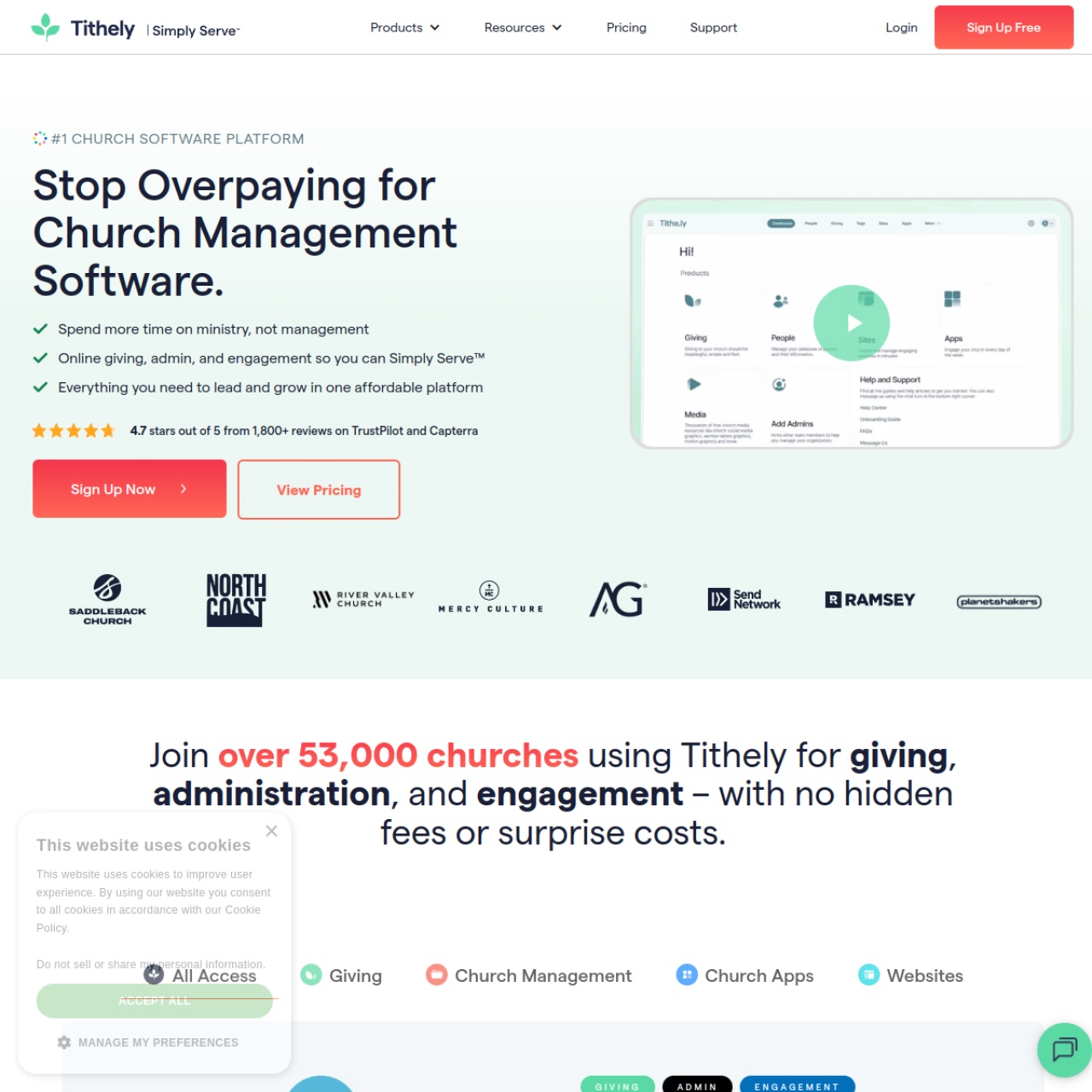
One thing surprised us while researching this, and it matters more than any feature list. The church management side of Tithely is Breeze — the small-church favorite Tithely acquired back in 2021, when Breeze served around 9,000 churches on its own. For a few years Breeze kept running as its own friendly, standalone product. That era is ending: as of the 2025 “Simply Serve” relaunch, Breeze has been folded fully into the platform and rebranded “Tithely Church Management.”
That’s genuinely good news for integration — one login, one bill, shared data. But it’s worth naming the trade: the thing longtime Breeze users loved was a small, focused, unhurried tool. What you’re buying now is Breeze inside a much larger platform, with that platform’s priorities and release cadence. If you’re choosing Tithely partly because someone told you “it’s basically Breeze,” know that the standalone Breeze you may remember is on its way out.
How Tithely scores, category by category
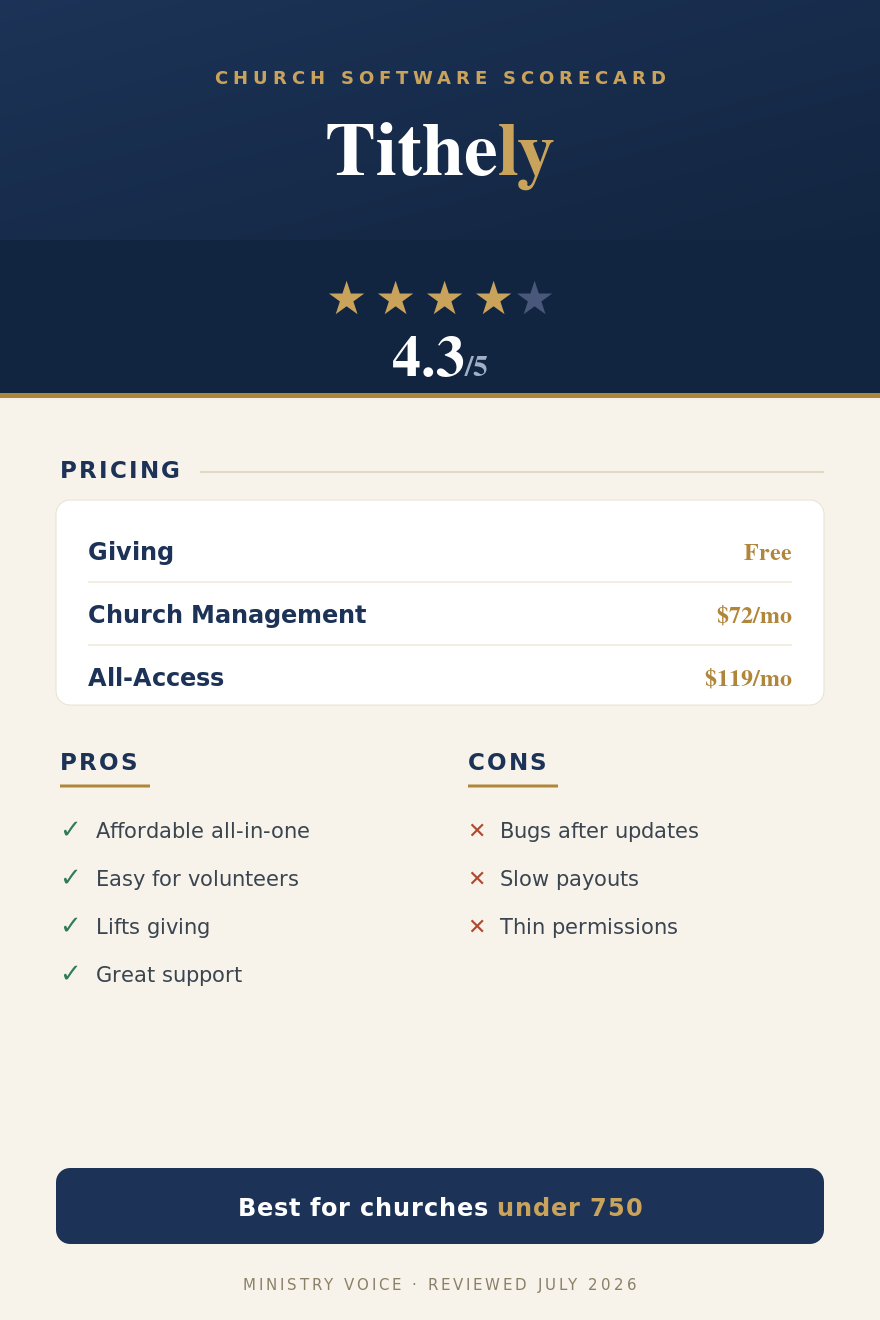
Our overall 4.3/5 isn’t one gut-feel number. Here’s where it comes from.
| What we scored | Score | Why |
|---|---|---|
| Online giving | 4.6 | Fast, clean donor experience; Apple/Google Pay, recurring, text-to-give. Its oldest, most polished piece. |
| Ease of use | 4.6 | Volunteers get productive without training. Capterra scores it 4.9/5 for value and rates usability highly. |
| Pricing transparency | 4.5 | Flat, published rates and no setup fee — rare in a category built on demo calls. |
| Church management (Breeze) | 4.1 | Friendly and capable; the mid-transition from standalone Breeze and shallow permissions cost it here. |
| Website & app builders | 3.9 | Competent and quick to launch, but limited customization versus dedicated tools. |
| Support | 3.7 | Praised at small scale (especially Breeze’s team), but there’s no phone line and complex tickets crawl. |
| Reporting & permissions | 3.4 | The weakest area: coarse role controls and boxed-in reporting/exports. More on this below. |
| Payout speed | 3.4 | The single most common financial complaint in real reviews. Bank deposits can lag badly. |
How we weight it: scores are out of 5 and weighted toward what a typical church actually leans on day to day — giving and ease of use carry the most weight, niche modules the least. The 4.3 overall is that weighted average, not a round-up.
Pricing, and what you’ll actually pay
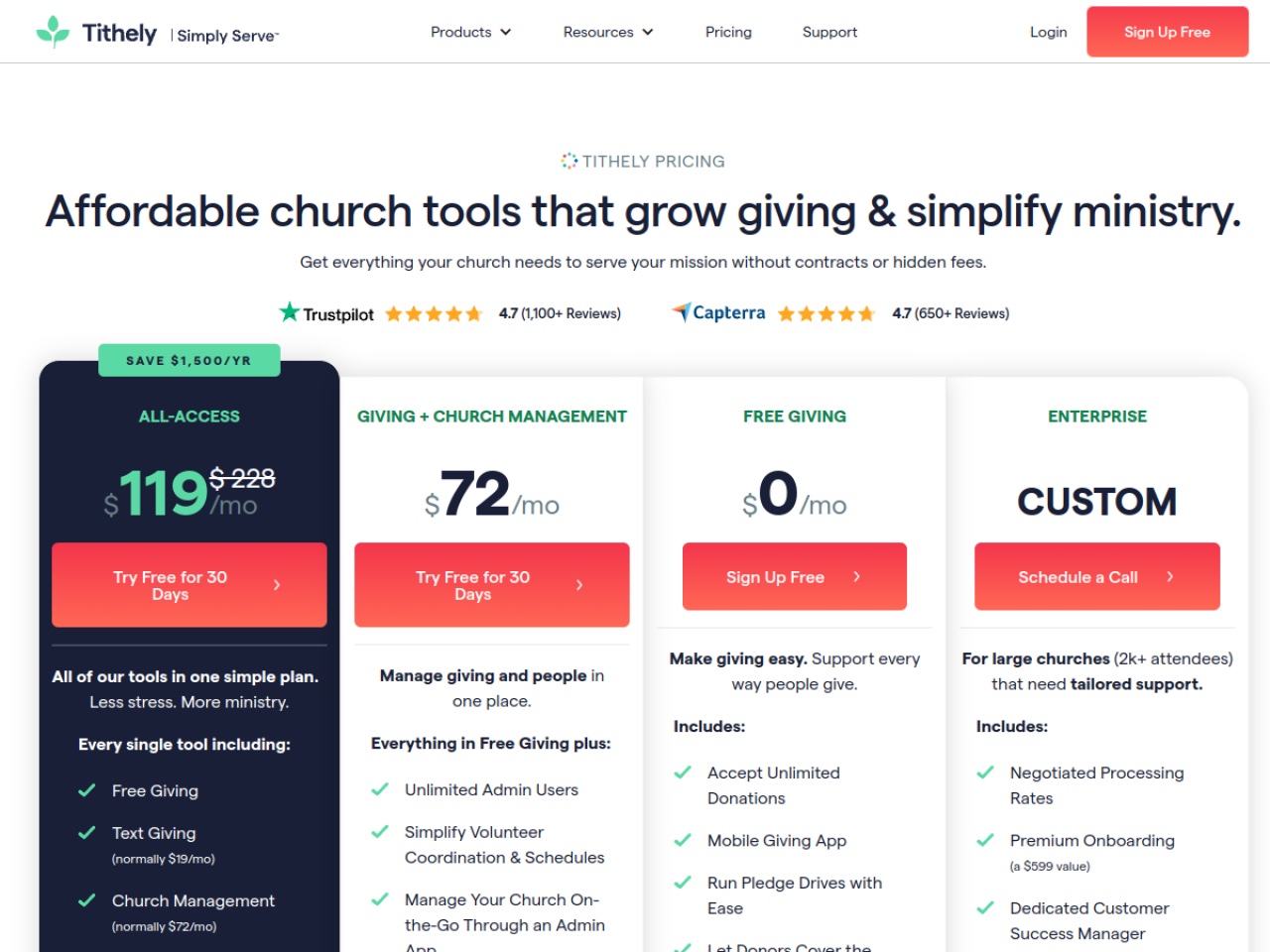
Verified on Tithely’s pricing page, July 2026.
Most church platforms hide pricing behind “request a demo.” Tithely publishes flat monthly rates with no setup fee, which is a real advantage when you’re budgeting.
| Plan | Price | What you get |
|---|---|---|
| Giving | $0/mo | Online, mobile, text & kiosk giving; recurring gifts; tax statements. You pay only transaction fees. |
| Church Management | $72/mo | Giving + the former Breeze: people database, groups, check-in, messaging, service planning. |
| All Access | $119/mo | Everything above plus custom app, website, and worship tools. Regularly $228 — their headline value. |
| Enterprise | Custom | Larger churches: negotiated rates, a dedicated success manager, premium onboarding. |
Two things the pricing page buries that are worth knowing: full data migration and one-on-one onboarding is a $599 add-on, and several “extras” are billed separately if you buy them à la carte — Text Giving ($19/mo), Worship Planning ($29/mo), a Custom App ($89/mo), a Custom Website ($19/mo). On All Access they’re bundled; standalone, they add up fast.
But the number that actually decides your budget isn’t the monthly fee — it’s the giving fees, because that’s what most churches pay:
| Method | Fee per gift |
|---|---|
| Credit / debit card | 2.9% + $0.30 |
| ACH / bank transfer | 1% + $0.30 |
| American Express | 3.5% + $0.30 |
Those card rates are standard (essentially Stripe’s). ACH is refreshingly cheap, and that gap is where the real money is. We ran the math at three giving levels so you can see it:
| Monthly giving | If all by card (2.9%) | If all by ACH (1%) | Yearly difference |
|---|---|---|---|
| $5,000 | ~$1,740/yr | ~$600/yr | ~$1,140 |
| $15,000 | ~$5,220/yr | ~$1,800/yr | ~$3,420 |
| $30,000 | ~$10,440/yr | ~$3,600/yr | ~$6,840 |
Percentage portion only; add $0.30 per gift. Real churches land in between, but the lesson holds.
Nudge donors toward ACH, or let them cover the fee. A church taking $15,000/month mostly on cards is handing roughly $5,000 a year to processing. Tithely does let donors optionally cover fees, and many do — turning that on is the highest-leverage setting in the whole product.
The products, one by one
What each piece does well, and where it thins out.
A note on getting started, because it colored our whole impression: setup was easier than we expected. We had online giving and a basic church website live quickly and with little hand-holding — the onboarding videos genuinely helped, and the learning curve was low enough that a volunteer without a technical background could keep up.
Giving
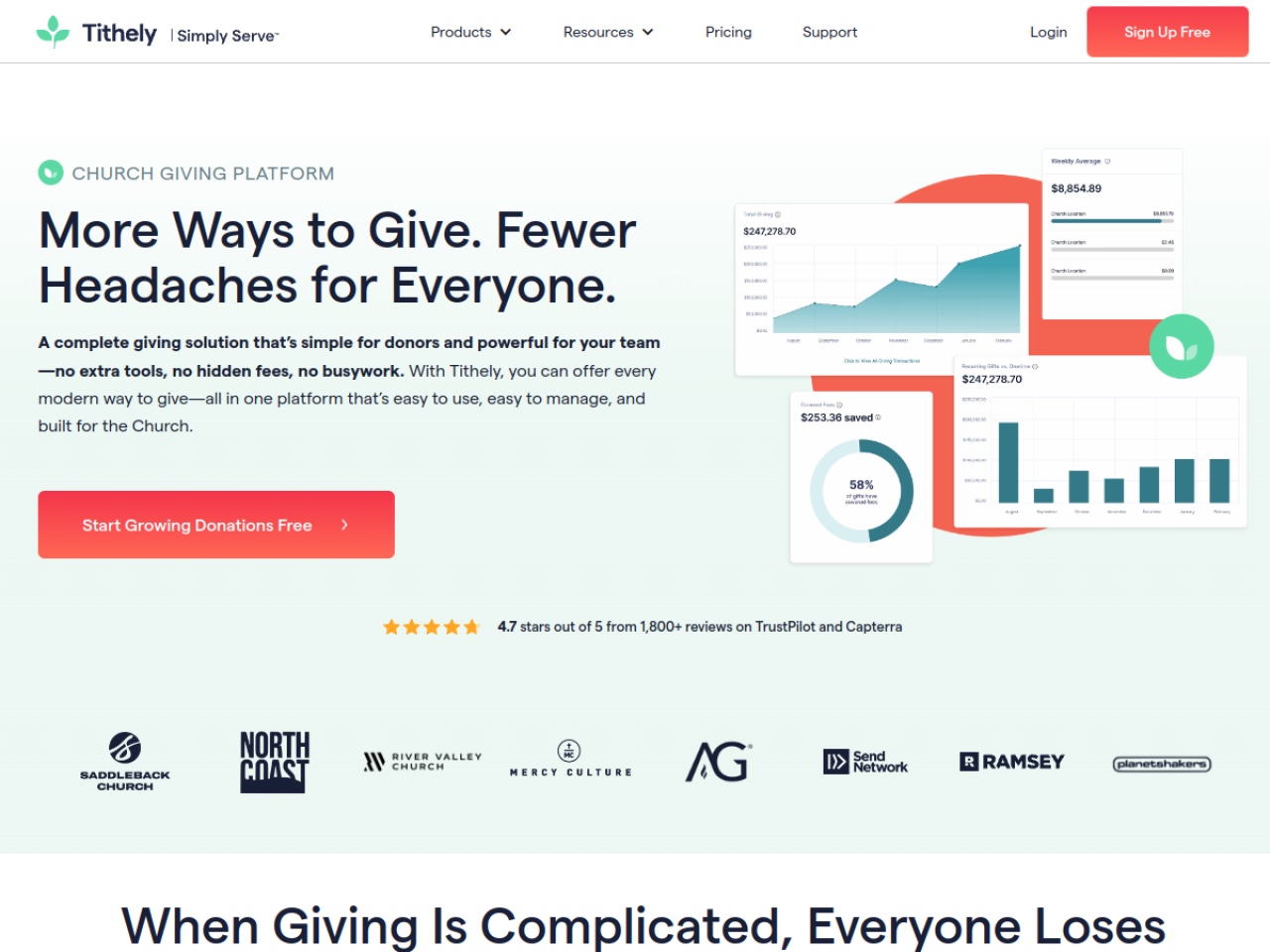
This is Tithely’s heart, and you can feel it. Setting up a giving page took minutes; the donor flow is clean on mobile, recurring gifts are painless, and Apple Pay and Google Pay are there without fuss. Text-to-give and kiosk cover the Sunday-morning crowd. In our own testing the thing that stood out wasn’t a feature so much as a feeling: members who aren’t comfortable with technology gave without a hitch, and the simplicity of recurring gifts for them was a genuine reason we’d lean toward Tithely. One honest caveat — recurring giving ran reliably once it was set up, but editing or canceling a recurring gift was fiddlier than it should be. If all you needed was to raise online giving, Tithely would be an easy yes — and churches say switching to it lifted their giving, which is a recurring, specific theme in real reviews rather than marketing spin.
Church Management (the former Breeze)
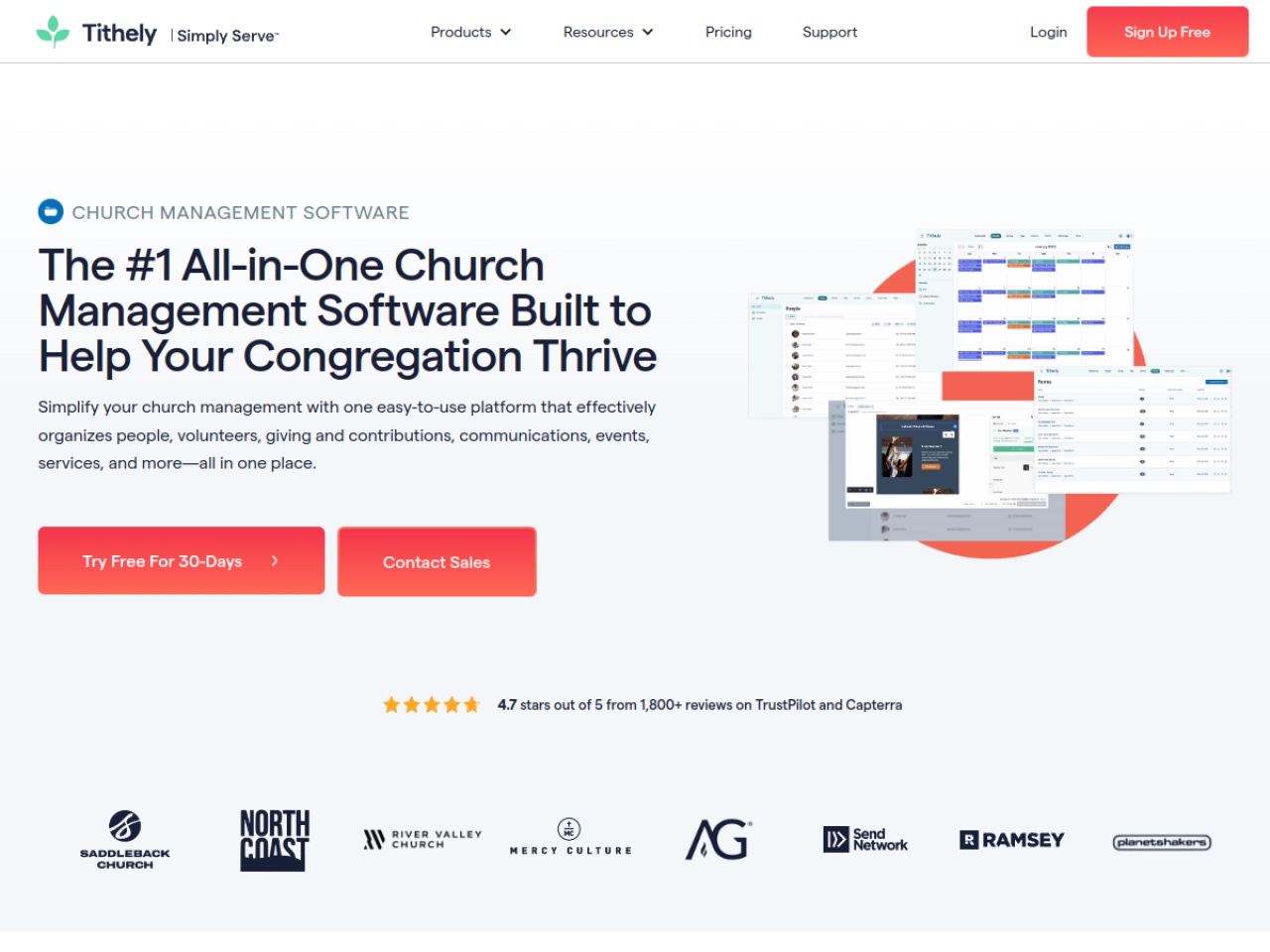
Importing a sample member list was quick, and the day-to-day — profiles, groups, attendance, check-in, messaging — is approachable enough that a volunteer can run it. Breeze earned its reputation the hard way, and that friendliness survived the acquisition. The Breeze integration was, honestly, one of our favorite parts of the platform. Two things left us cooler: accounting integrations felt narrower and less robust than we wanted, and there’s a navigation seam we kept snagging on between the giving/donor side and the church-management side — finding certain admin features took longer than it should, and crossing between the two halves isn’t as seamless as “one platform” suggests. Where it wobbles is deeper down: the permission model and reporting weren’t built for a church with a finance director, a children’s ministry lead, and multiple campus admins who each need different access. We’ll come back to that, because it’s the review’s real sticking point.
Apps & websites
The app and website builders get a church a modern presence without a developer. They’re not the most flexible tools on the market — you’ll hit customization ceilings — but for a congregation that needs a clean, functional site and a branded app, they clear the bar. It’s worth separating the app from the website, though: the mobile giving app was a real positive for us — giving, announcements, messaging, and engagement all worked well — but the website builder’s mobile output was the weak link, with a few pages we built not rendering cleanly on phones.
The extras
Worship planning, kids and event check-in, and background checks round out All Access. None of these individually beats a dedicated best-in-class tool. Bundled at $119/month, though, they add up to real value — as long as you were going to use them.
Where the complaints actually cluster
We read the critical reviews so you don’t have to. They aren’t random.
Tithely’s overall ratings are high — 4.7 on both Capterra and Trustpilot. But averages hide the story. When we sorted the recent one- and two-star reviews, the frustration wasn’t spread evenly; it fell into four buckets, and they’re not equally serious.
Ranked by how loud (and how fixable) they are
- 1. Payout timing — the loudest financial complaint. Bank deposits routinely lag. One Trustpilot user documented a recurring gift made around 4 a.m. on June 5 that still hadn’t landed by mid-afternoon on June 16 — nearly twelve days. Others report a week or more. If your church lives close to its cash flow, read this one twice. In our own use the larger gifts seemed to lag the most, which is precisely when a slow deposit strains operations.
- 2. Instability after big updates. The rollout of “Tithely 2.0” is a recurring sore spot — reviewers described being unable to print or export PDF giving statements afterward, alongside assorted bugs. Platform-wide updates seem to be where things break.
- 3. Support you can’t call. There’s no phone line. Support runs through chat, an AI assistant, and tickets, and reviewers say it’s fine for simple questions but slow when something is genuinely wrong — which is exactly when you don’t want a queue. That squared with our experience — knowledgeable and friendly on routine questions, but slow chat waits and no real phone option when an urgent payment issue came up.
- 4. Fees and customization gripes. A minority feel the processing fees run high versus alternatives, and others want more control over reporting and email. Real, but quieter than the first three.
- 5. Billing and cancellation snags. A quieter one we ran into ourselves: unexpected subscription renewals and billing issues after canceling. It’s the processing fees and renewal surprises that grate, not the sticker price — watch your renewal dates.
Notice what’s not on that list: the church management software itself. Breeze-based features draw far more praise than criticism. The pain is concentrated in money movement and support, not in the day-to-day tools — a useful distinction if you’re weighing whether the complaints apply to how your church would use it.
The permissions problem, up close
The thing most reviews mention in passing and we think deserves a full look.
Here’s the scenario that exposes it. Say you want to give a children’s-ministry volunteer access to check kids in on Sunday — and nothing else. No giving totals, no member financials, no admin settings. In an enterprise-grade church system you’d toggle that at the module level. In Tithely we found the role controls coarser than that: you’re working with broad access buckets more than granular, per-module switches.
For a 150-person church where the same three people run everything, this is a non-issue — you probably want everyone to see everything. But flip it around. A multi-site church with a finance director who should see giving, a kids’ director who shouldn’t, and campus admins who each need their own slice? That’s where the model starts to pinch, and it’s the clearest reason a larger, more structured church might outgrow Tithely faster than the price tag suggests. Reporting has the same shape of limitation: fine for standard needs, frustrating the moment you want to slice data your own way. That mirrored our experience: basic financial reports were easy to pull, but advanced reporting and — the one we’d flag hardest — tax-statement generation were genuinely cumbersome. If your treasurer lives in tax statements, test that exact workflow before you commit.
So who is Tithely actually for?
Skip the “best for everyone” hedge. Here’s a straight test.
Run your church through these five questions:
2. Do you have a finance director who needs tightly scoped, per-role permissions?
3. Will staff live in custom reports and exports?
4. Would payouts taking up to a week genuinely hurt your cash flow?
5. Do you need to pick up a phone when money is on the line?
Answer “yes” to two or more, and we’d test alternatives hard before committing. You may simply outgrow what Tithely does well. Answer “no” to most of them — which describes the small-to-mid church with a handful of admins who value simplicity over deep configuration — and Tithely’s All Access plan is one of the best values in the category, full stop. That’s not a hedge; it’s the actual dividing line.
How it stacks up
The same church, four different bets.
| Platform | Starts at | Best at | Weakest at |
|---|---|---|---|
| Tithely | $0 giving / $119 all-in | Affordable all-in-one, transparent pricing | Payout speed, deep permissions/reporting |
| Planning Center | Modular, free tiers | Depth, flexibility, serious teams | Cost and complexity add up; less “one bill” |
| Subsplash | Quote-based | Polished apps & media/streaming | Pricing opacity; pricier |
| Pushpay | Quote-based | Large / multi-site scale & engagement | Expensive; overkill for small churches |
| ChurchTrac | Low, flat tiers | Rock-bottom price, simple ChMS | Less polished app/website |
| Givebutter / Zeffy | $0 (fee-covered) | Lowest cost on giving alone | No real church back office |
Read it this way: against Planning Center, Tithely is simpler and cheaper but less configurable. Against Subsplash, far more affordable but less slick on apps and media. Against giving-only tools, Tithely costs a bit more per gift but hands you the whole back office in return. Nobody wins every column — which is rather the point.
Our verdict
Tithely delivers on its core promise better than most: it’s an affordable, genuinely all-in-one platform that lets a small or mid-sized church stop stitching tools together and get back to ministry. Folding in Breeze shored up its historically weakest link, and publishing flat pricing in a category built on sales calls is a small act of respect that its competitors should copy.
We went in expecting the Breeze acquisition to be the whole story, and it isn’t. Breeze itself is well liked; the friction that shows up in real reviews sits somewhere else entirely — in payout timing, in post-update stability, in support you can’t call, and in permissions that don’t bend far enough for a complex org. Those aren’t the same problem, and only some of them will be your problem. For us specifically, the recurring headaches were delayed deposits and slow support when money was on the line; the rest we could design around.
So here’s where we land, without the hedge: if you’re under about 500 people and tired of demo calls, just buy it — turn on donor-covered fees and don’t look back. If you’re larger, more structured, or you’d feel a week-long payout delay in your bones, put Tithely in a real bake-off before you sign. It’s an easy platform to recommend and a hard one to beat on value — for the churches it actually fits.
Frequently Asked Questions
Is Tithely really free?
The Giving tier has no monthly fee — you pay only transaction fees (2.9% + 30¢ on cards, 1% + 30¢ on ACH). Management, app, and website features start at $72/month for Church Management or $119/month for All Access.
Is Tithely the same as Breeze?
Tithely acquired Breeze ChMS in 2021, and as of the 2025 “Simply Serve” relaunch, Breeze has been fully integrated and rebranded as Tithely Church Management. So the church management you get is Breeze’s lineage — now living inside the larger Tithely platform rather than as a standalone product.
How long do Tithely payouts take?
Officially a few business days, but delayed bank deposits are the most common complaint in real reviews — some users report a week or more, and one documented case ran nearly twelve days. If timing is critical, test it with a small gift before you commit.
Who should not use Tithely?
Large or multi-site churches with complex permission needs and staff who push reporting hard may outgrow it. And if giving is all you need, weigh the fees against no-cost-to-church platforms before defaulting to Tithely.
Sources & how we keep this current
We check the facts in this review against primary sources and re-verify pricing quarterly. Last updated July 2026.
- Tithely official pricing — tiers and transaction fees
- Tithe.ly reviews on Capterra — 4.7/5 across 681 reviews
- Tithe.ly reviews on Trustpilot — ~1,165 reviews, and the payout complaints we cite
- Breeze is now Tithely Church Management — the 2025 integration, in Tithely’s words
- Religion News Service — the “Simply Serve” relaunch