
Understanding the Significance of Apostasia in Greek
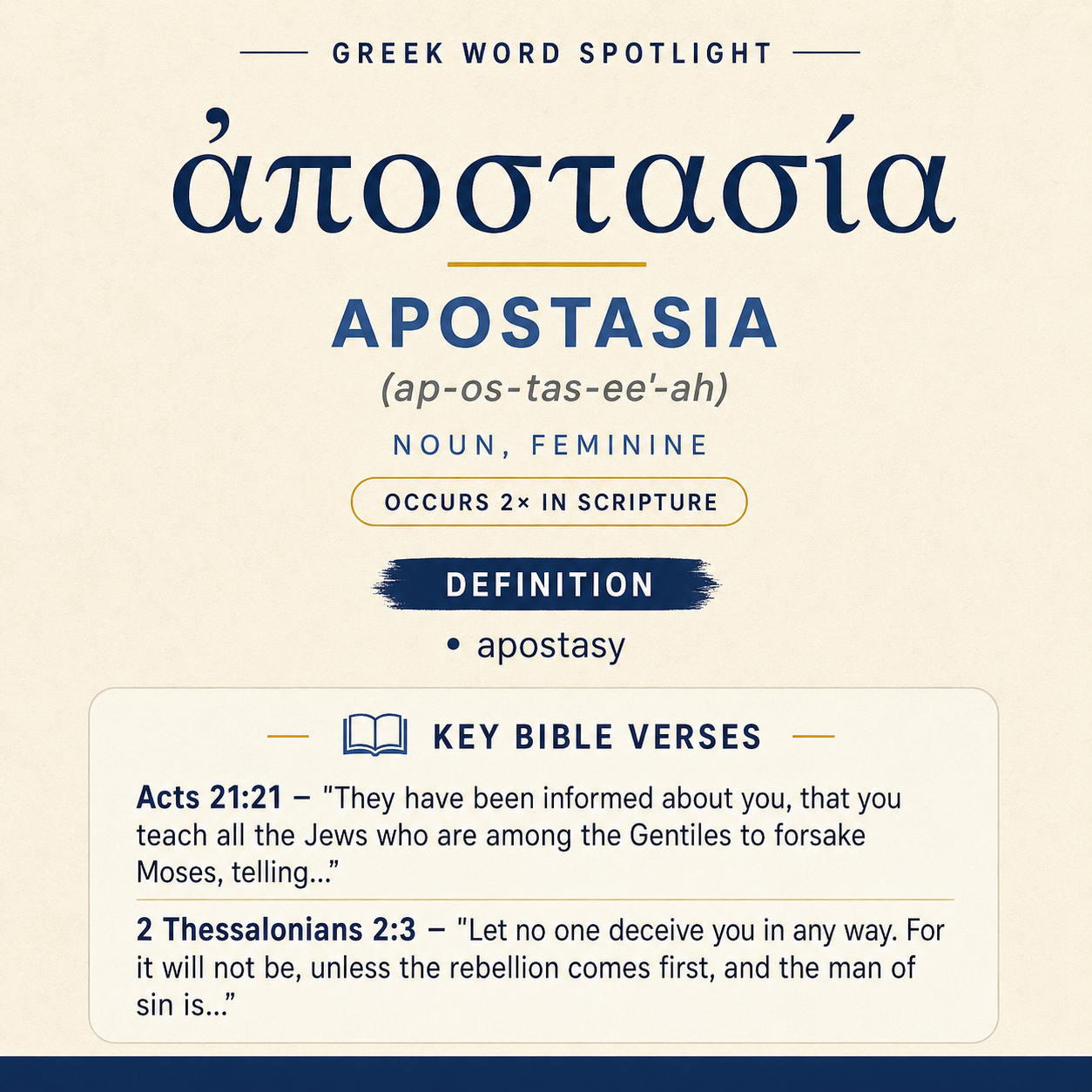
ἀποστασία (Apostasia) means apostasy and occurs twice in Scripture, in Acts 21:21 and 2 Thessalonians 2:3.
Scripture Occurrences
It appears 2 times in Scripture: Acts 21:21 and 2 Thessalonians 2:3.
Learn More →Context Snapshots
In Acts 21:21 it is linked with being taught to forsake Moses. In 2 Thessalonians 2:3 it is rendered “the rebellion.”
Learn More →ἀποστασία refers to apostasy. It appears in Acts 21:21 in a report about what Paul is alleged to teach, and in 2 Thessalonians 2:3 in an eschatological warning about what must come first.
Root and Related Words
A related term is apostasion (ἀποστάσιον), “divorce” (Strong’s G647).

Occurrences
“They have been informed about you, that you teach all the Jews who are among the Gentiles to forsake Moses, telling them not to circumcise their children and not to walk after the customs.” (Acts 21:21)
Here ἀποστασία is framed as a charge: others “have been informed” that Paul teaches Jewish believers living “among the Gentiles” “to forsake Moses.” The verse itself unpacks what that alleged forsaking looks like in practice: “not to circumcise their children” and “not to walk after the customs.” In this setting, the term sits inside a contested description of Paul’s instruction and its implications for Jewish identity markers. The word’s force comes from the way the accusation ties together a break with Moses and concrete behaviors—circumcision and customary practice—so that “forsake” is not left vague but is anchored in recognizable communal actions.
The scene also places the issue in a cross-cultural environment (“among the Gentiles”), where pressure to redefine boundaries can be keenly felt. Within the single sentence, ἀποστασία functions as a label that gathers multiple alleged teachings into one interpretive claim: that Paul’s message amounts to apostasy in relation to Moses. The word therefore operates rhetorically; it is not a detached dictionary category but a contested evaluation attached to what Paul is accused of promoting.
“Let no one deceive you in any way. For it will not be, unless the rebellion comes first, and the man of sin is revealed, the son of destruction,” (2 Thessalonians 2:3)
In 2 Thessalonians 2:3, ἀποστασία stands in a sequence of events that are presented as prerequisites: “it will not be, unless the rebellion comes first, and the man of sin is revealed.” The admonition begins with a protective imperative—“Let no one deceive you in any way”—which makes the term part of a strategy meant to guard the community against misinformation. ἀποστασία here is not an accusation about a particular teacher’s present conduct; it is a named development that “comes first,” occupying a defined place in the unfolding scenario.
The verse pairs this “rebellion” with the unveiling of a figure described as “the man of sin… the son of destruction.” That coupling gives ἀποστασία a weighty narrative context: it is associated with a time of disclosure and crisis, and it helps mark off what the readers should expect before whatever “it” refers to occurs. The word thus contributes a sense of temporal ordering (“comes first”) and communal vigilance (“Let no one deceive you”), shaping how the audience is to interpret claims about timing and signs.
Sense and Usage
Across these two passages, ἀποστασία functions as a public, socially legible departure—something that can be alleged, reported, anticipated, and used to interpret behavior or events. In Acts 21:21, apostasy is articulated through specific practices (circumcision and “the customs”), so that the charge is not merely that someone holds a different opinion, but that instruction is thought to lead to recognizable non-observance. The verse’s phrasing also shows how the term can be employed polemically: it is mediated through hearsay (“They have been informed about you”) and presented as a summary judgment (“to forsake Moses”) supported by illustrative claims. Apostasy, in this frame, is a category that others apply to Paul’s teaching in order to characterize its direction and consequences.
In 2 Thessalonians 2:3, apostasy is generalized and projected: it is “the rebellion” that “comes first.” The community is warned against deception, suggesting that confusion about what must precede the climactic moment is a live danger. Here ἀποστασία serves less as an interpretation of a known set of actions and more as a signpost within an expected sequence. The verse does not define it by listing behaviors, but it places it alongside the “revealed” appearance of “the man of sin,” which gives it a role in identifying a broader period characterized by opposition and disclosure.
Read together, these uses show how ἀποστασία can operate on two levels without changing its basic reference: (1) as a label applied to alleged teaching that results in concrete departures from established practice, and (2) as a named phenomenon that is expected to arrive and that functions as a marker within an end-times timetable. In both cases, the word has a communal and interpretive dimension. It is not merely an inner disposition; it is something that can be communicated (“They have been informed”), warned about (“Let no one deceive you”), and treated as a decisive lens for assessing what is happening among a people.
Imagery
The imagery carried by ἀποστασία in these texts is the imagery of separation and turning: in Acts, the alleged turning away is narrated as leaving established practices behind (“not to circumcise… and not to walk after the customs”); in 2 Thessalonians, the turning is cast on a larger stage as a “rebellion” that arrives before the revealing of a destructive figure. Both passages portray apostasy as something observable in its effects—either in identifiable communal conduct or in a public moment that reshapes expectations and demands discernment.
Sources: Lexical data from Strong’s Exhaustive Concordance and the Translators Brief Lexicon of Extended Strongs for Greek (STEPBible, CC BY). Occurrence data from the Translators Amalgamated Greek New Testament (STEPBible, CC BY). Scripture quotations from the World English Bible (public domain).





