
Understanding the Significance of Apokleio in Greek
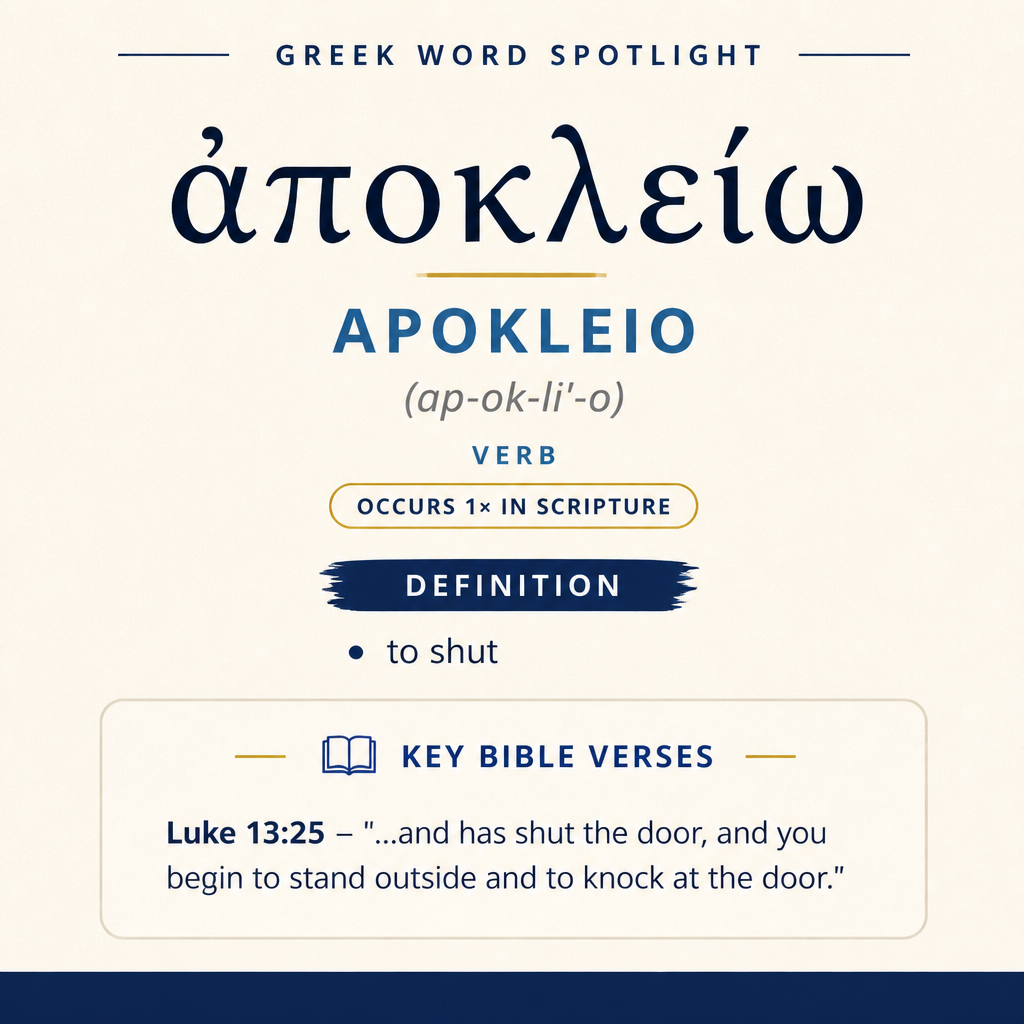
ἀποκλείω means “to shut” and appears once in Scripture, in Luke 13:25.
Scripture Occurrence
It occurs 1 time in Scripture. Its only reference is Luke 13:25.
Learn More →Context in Luke
In Luke 13:25, it describes the master of the house shutting the door.
Learn More →ἀποκλείω means “to shut.” It appears once, in Jesus’ picture of a householder who closes the door, leaving would-be entrants outside.
Root and Related Words
ἀποκλείω (Apokleio) is formed from ἀπό (apo), “away from” (Strong’s G575), and κλείω (kleio), “to shut” (Strong’s G2808). The combined form expresses shutting in a way that leaves someone away from what is closed.
Occurrences
“When once the master of the house has risen up, and has shut the door, and you begin to stand outside and to knock at the door, saying, ‘Lord, Lord, open to us!’ then he will answer and tell you, ‘I don’t know you or where you come from.’” (Luke 13:25)
Here ἀποκλείω names a decisive action taken by “the master of the house”: he “has risen up” and “has shut the door.” The sequence matters. The shutting is presented as the moment after which the situation reverses for the latecomers: they “begin to stand outside” and to “knock,” now addressing the one inside with urgent appeal—“Lord, Lord, open to us!” The verb therefore carries more than the physical movement of a door; it marks the change from an open opportunity to a closed one, a boundary that reorders everyone’s position (“outside” versus inside) and sets the conditions for what follows.
The scene also shows that shutting introduces a new kind of interaction: not entry, but appeal from the outside and answer from within. The “master” responds verbally—“I don’t know you or where you come from”—but that answer occurs after the door has been shut, within the created divide. ἀποκλείω thus helps frame the dialogue: it is the act that makes knocking necessary and makes the request “open to us” a plea rather than a normal entrance. The door’s closure becomes the visible sign that access is no longer assumed, and the speaker inside is not obliged to recognize those outside as belonging to the household.
Sense and Usage
In Luke 13:25, “to shut” functions as an act of exclusion in a household setting. The verb is applied to a door, so the shutting is concrete and spatial: one party remains within, another is left without. Yet the narrative ties that physical closure to relational and verbal consequences. Those outside address the master with a form of recognition (“Lord, Lord”), and their request presumes that the door can be reopened by the person who shut it. The master’s reply, however, is not framed as a discussion about the door or timing, but about recognition—“I don’t know you or where you come from.” In this way, the shutting becomes the turning point that brings questions of belonging to the surface, even though the verb itself simply names the act of closing.
The prepositional element in the word’s formation (apo, “away from”) fits the scene’s depicted effect: shutting establishes distance. The text highlights that distance with repeated spatial language: “outside,” “at the door,” and the posture of knocking. Once the door has been shut, the latecomers can still speak and knock, but they cannot cross the boundary on their own; their only remaining action is to appeal to the one who controls the boundary. The verb therefore serves as a narrative hinge: before it, there is movement toward the house; after it, there is only standing outside, knocking, and receiving an answer that refuses recognition.
Because the occurrence is in a brief, vivid picture, ἀποκλείω also carries an implied finality within the story’s logic. The master “has shut the door,” and the others “begin” their outside stance and knocking only after that completed act. The verb’s force is not in describing an ongoing process but in describing a completed closure that sets a new state of affairs. That state is stable enough to allow an exchange of cries and replies across the threshold, and it is strong enough that the hope of entry is reduced to a request for reopening—“open to us”—rather than any attempt to enter directly.
Imagery
The imagery of ἀποκλείω in Luke 13:25 is domestic and ordinary: a master rises and shuts a door. Yet the ordinary image is sharpened by contrast—inside versus outside—and by sound—knocking and calling. The closed door becomes a plain object that embodies separation: those outside can approach it, touch it, and speak through it, but the shut door visibly maintains the distance that the master’s answer confirms.
Sources: Lexical data from Strong’s Exhaustive Concordance and the Translators Brief Lexicon of Extended Strongs for Greek (STEPBible, CC BY). Occurrence data from the Translators Amalgamated Greek New Testament (STEPBible, CC BY). Scripture quotations from the World English Bible (public domain).





