Exploring the Meaning of Anupokritos in Greek
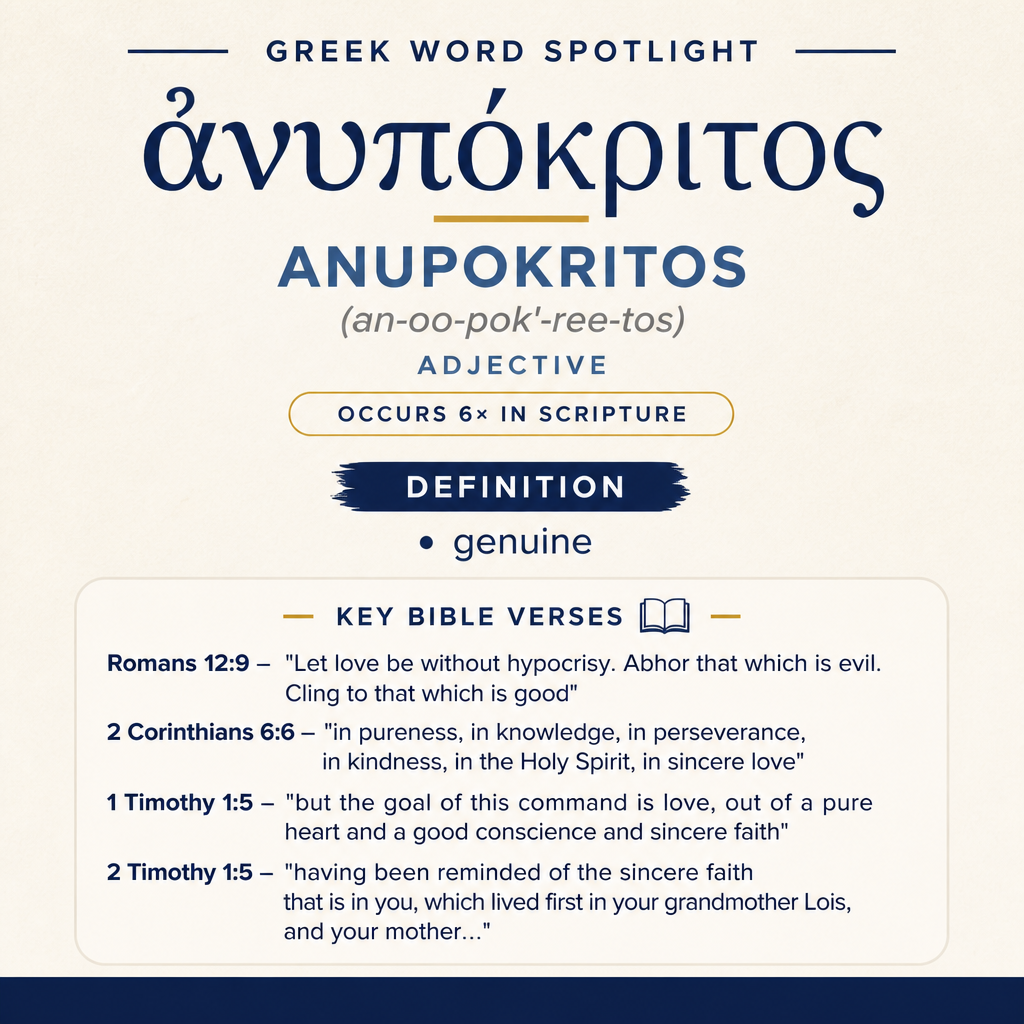
ἀνυπόκριτος means “genuine” and appears 6 times in Scripture: Romans 12:9; 2 Corinthians 6:6; 1 Timothy 1:5; 2 Timothy 1:5; James 3:17; 1 Peter 1:22.
Core Meaning
ἀνυπόκριτος is defined as “genuine.” It describes love, faith, wisdom, and brotherly affection in these passages.
Learn More →Where It Appears
It occurs in Romans 12:9; 2 Corinthians 6:6; 1 Timothy 1:5; 2 Timothy 1:5; James 3:17; and 1 Peter 1:22.
Learn More →Textual Contexts
Romans 12:9 pairs it with love “without hypocrisy,” and 2 Corinthians 6:6 speaks of “sincere love.” It also modifies faith (1 Tim 1:5; 2 Tim 1:5), wisdom (Jas 3:17), and brotherly affection (1 Pet 1:22).
Learn More →ἀνυπόκριτος describes what is genuine, especially in the sphere of love, faith, and wisdom. It appears in a cluster of New Testament exhortations that contrast inward reality with the kind of outward show that can accompany moral and religious language.
Root and Related Words
ἀνυπόκριτος is connected with ὑποκρίνω (hypokrinomai), “to pretend” (Strong’s G5271). It also draws on α (A), “Alpha” (Strong’s G1), as part of its formation.

Occurrences
“Let love be without hypocrisy. Abhor that which is evil. Cling to that which is good.” (Romans 12:9)
Here ἀνυπόκριτος qualifies love as something that must match reality: love is to be expressed in a way that is not a performance. The surrounding commands press the point that genuine love is morally discerning: it does not merely speak warmly, but “Abhor[s] that which is evil” and “Cling[s] to that which is good.” In this setting, ἀνυπόκριτος functions as a guardrail against a kind of love that could be verbally smooth yet ethically detached.

“in pureness, in knowledge, in perseverance, in kindness, in the Holy Spirit, in sincere love,” (2 Corinthians 6:6)
In a list of virtues and realities, ἀνυπόκριτος describes love as one quality among others such as “pureness,” “knowledge,” and “kindness.” The placement of “in the Holy Spirit” immediately before “in sincere love” links this genuineness to the sphere of spiritual life, not simply to natural temperament. Within the rhythm of repeated “in … in …,” the word marks love as something that belongs in the same register as integrity-related qualities: it is not an accessory to religious work but part of its moral texture.
“but the goal of this command is love, out of a pure heart and a good conscience and sincere faith,” (1 Timothy 1:5)
This occurrence pairs ἀνυπόκριτος with “faith,” and it appears in a purpose statement: “the goal of this command is love.” The verse then traces love’s sources: “a pure heart,” “a good conscience,” and “sincere faith.” In that chain, genuine faith is not presented as an isolated inner attitude; it stands in relationship to conscience and heart, and it serves the larger end of love. ἀνυπόκριτος highlights that the faith feeding love is meant to be the real thing—consistent with purity of heart and a conscience that can be called “good.”
“having been reminded of the sincere faith that is in you, which lived first in your grandmother Lois, and your mother Eunice, and, I am persuaded, in you also.” (2 Timothy 1:5)
Again describing “faith,” ἀνυπόκριτος is tied to personal history and recognizable continuity: faith “lived first” in two older family members and is now present “in you also.” The word supports the idea that this faith is more than inherited vocabulary or family identity; it is a living reality within the person addressed. The verse’s emphasis on remembrance and persuasion (“having been reminded…,” “I am persuaded…”) suggests that the genuineness of this faith is evidenced in a way that can be recalled and affirmed.
“But the wisdom that is from above is first pure, then peaceful, gentle, reasonable, full of mercy and good fruits, without partiality, and without hypocrisy.” (James 3:17)
In this description of “the wisdom that is from above,” ἀνυπόκριτος appears as one feature in a sequence of qualities. The verse builds a portrait: purity leading into peace, gentleness, reasonableness, and a life “full of mercy and good fruits.” The closing pair—“without partiality, and without hypocrisy”—frames genuineness as a hallmark of this wisdom’s social and moral expression. In a list that already includes visible outcomes (“good fruits”), ἀνυπόκριτος signals that such wisdom does not need a mask; it aligns what it is with how it acts.
“Seeing you have purified your souls in your obedience to the truth through the Spirit in sincere brotherly affection, love one another from the heart fervently,” (1 Peter 1:22)
Here ἀνυπόκριτος modifies “brotherly affection,” set within a larger description of purification and obedience: “you have purified your souls in your obedience to the truth through the Spirit.” Genuine affection is presented as the relational fruit that coheres with that purification. The command that follows—“love one another from the heart fervently”—echoes the same inward/outward unity: the love is to arise “from the heart” and to be earnest in its intensity. ἀνυπόκριτος strengthens the connection between spiritual obedience and interpersonal reality, so that affection is not reduced to polite convention.
Sense and Usage
Across these passages, ἀνυπόκριτος consistently serves to test the alignment between inner reality and outward expression. The word attaches to major virtues—love (Romans 12:9; 2 Corinthians 6:6), faith (1 Timothy 1:5; 2 Timothy 1:5), wisdom (James 3:17), and brotherly affection (1 Peter 1:22)—as if to insist that the most valued Christian qualities are vulnerable to imitation and therefore must be specified as genuine.
In Romans and Peter, the stress falls on relational life: love and affection must not be hollow. Romans 12:9 sets genuineness at the head of practical moral directives, showing that genuine love does not float above good and evil but responds to them: it “Abhor[s]” evil and “Cling[s]” to good. First Peter 1:22 deepens the same concern by placing genuine affection within spiritual purification and obedience “through the Spirit,” then immediately pressing for fervent, heart-sourced love. In both, ἀνυπόκριτος is not a vague compliment; it is a demand that love be the kind of love that can bear moral weight and heartfelt intensity.
In the Pastoral Epistles, ἀνυπόκριτος strengthens the integrity of faith as a formative source. In 1 Timothy 1:5, genuine faith is part of a triad that yields love: heart, conscience, and faith converge toward the goal. In 2 Timothy 1:5, the word frames faith as something that can be recognized across generations and within an individual: it “lived” in others and now is “in you also.” The emphasis is not on novelty but on authenticity—faith that is real enough to be remembered and to be seen as continuing life.
James 3:17 broadens the word’s reach beyond specific virtues to an overall moral character called “wisdom that is from above.” Here ἀνυπόκριτος is not primarily about warmth or sincerity in speech; it belongs to a catalog that includes mercy and “good fruits.” In that setting, genuineness contributes to a picture of wisdom as whole and consistent—peaceful and productive, impartial and unmasked.
In 2 Corinthians 6:6, ἀνυπόκριτος functions like a qualifying adjective that safeguards “love” amid other qualities associated with mature conduct: purity, knowledge, perseverance, kindness, and life “in the Holy Spirit.” The word’s force is to keep love from being reduced to a mere professional posture. Love belongs in a list of realities that are meant to be lived, not staged.
Imagery
The passages that use ἀνυπόκριτος repeatedly picture the inner life showing itself without disguise: love that clings to good (Romans 12:9), faith that “lived” and is “in you” (2 Timothy 1:5), wisdom bearing “good fruits” (James 3:17), and affection arising “from the heart” (1 Peter 1:22). The word gathers these images into a single moral insistence: what is named as virtue must be real enough to govern choices, endure, and produce recognizable fruit.
Sources: Lexical data from Strong’s Exhaustive Concordance and the Translators Brief Lexicon of Extended Strongs for Greek (STEPBible, CC BY). Occurrence data from the Translators Amalgamated Greek New Testament (STEPBible, CC BY). Scripture quotations from the World English Bible (public domain).