Exploring the Meaning of Aneuthetos in Greek
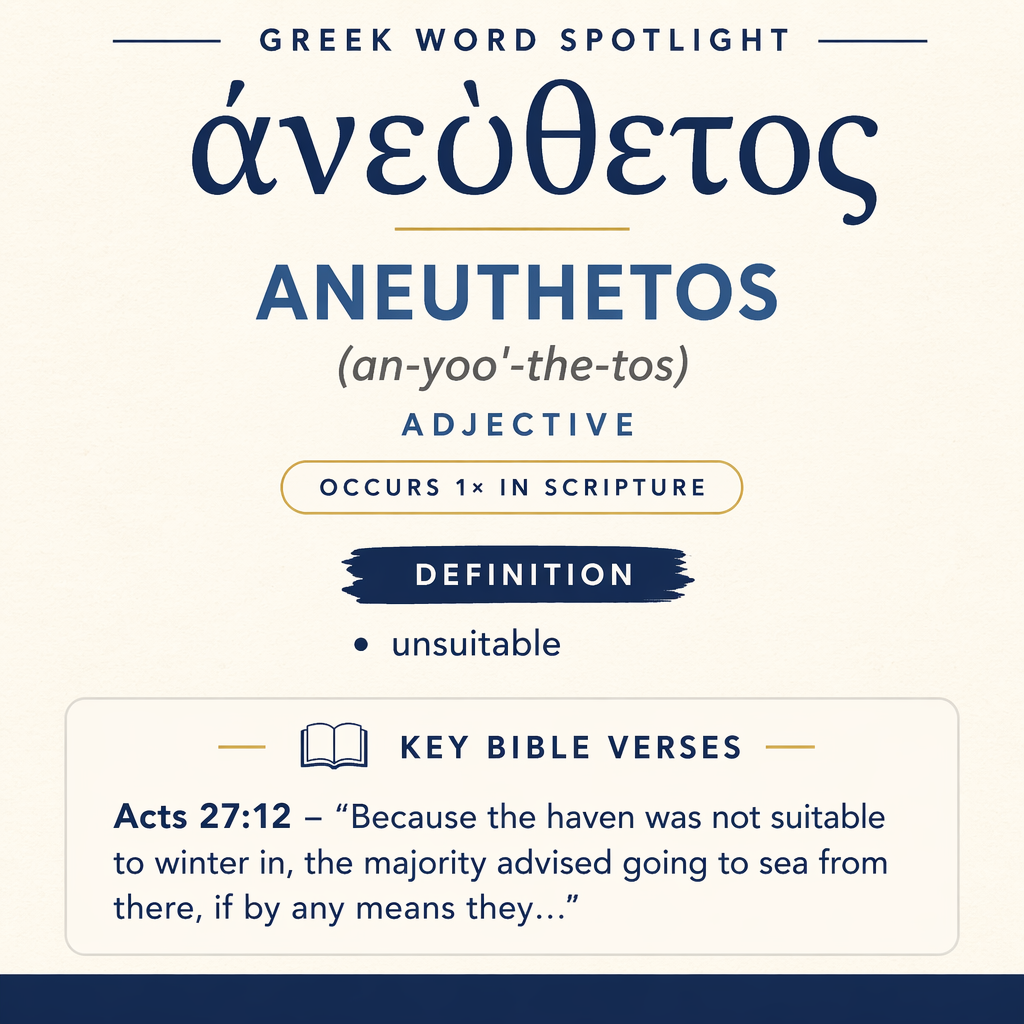
ἀνεύθετος means “unsuitable” and appears once in Scripture, in Acts 27:12.
Acts Context
In Acts 27:12, it describes a haven as not suitable to winter in. This assessment led the majority to advise going to sea from there.
Learn More →ἀνεύθετος expresses the idea of something being “unsuitable,” and it appears in the narrative of a sea voyage in Acts. In its lone New Testament use, it evaluates whether a particular harbor can serve as a safe place to remain through the winter.
Root and Related Words
ἀνεύθετος (Aneuthetos) is related to εὔθετος (euthetos), “suitable” (Strong’s G2111). Strong’s also connects it to α (Alpha), “Alpha” (Strong’s G1).

Occurrences
“Because the haven was not suitable to winter in, the majority advised going to sea from there, if by any means they could reach Phoenix, and winter there, which is a port of Crete, looking southwest and northwest.” (Acts 27:12)
Here ἀνεύθετος functions as a practical assessment within a group decision: “the haven” is judged “not suitable to winter in.” The sentence links that evaluation directly to a change of plan—“the majority advised going to sea from there”—so the word provides the stated reason for leaving. The setting is not abstract but concrete and time-bound: the question is where to “winter,” and the suitability in view concerns enduring an entire season rather than merely stopping briefly. The result is a collective recommendation to attempt a different destination, “Phoenix,” described specifically as “a port of Crete,” with its orientation “looking southwest and northwest.” In this context, “unsuitable” does the work of marking one harbor as a poor choice for seasonal shelter and establishing the rationale for risking another leg of travel “if by any means they could reach” the alternative port.
Sense and Usage
The sense “unsuitable” in Acts 27:12 is applied to a location and measured against a clear purpose: “to winter in.” The word therefore frames suitability as fitness for a particular task and timeframe. Within the verse, the evaluation is not presented as a private preference but as a conclusion that shapes communal counsel (“the majority advised”), showing that the term can stand as a decisive criterion in deliberation.
The verse also places “unsuitable” within the language of maritime planning. The haven’s inadequacy prompts a proposal “going to sea from there,” and the alternative is another harbor named and described in terms of its geographic orientation. Even without additional occurrences, this single use demonstrates how ἀνεύθετος can mark a mismatch between a setting and a need: a place may be a “haven,” yet still fail the demands of a coming season. In that way, the word highlights that the label or general function of something does not guarantee its adequacy for every circumstance; the immediate situation (“to winter in”) sets the standard by which suitability is judged.
Imagery
Acts 27:12 attaches ἀνεύθετος to the image of a harbor facing the oncoming winter: a haven that cannot reliably serve as seasonal shelter and therefore becomes the point from which sailors consider setting out again. The word contributes the stark contrast between staying in place and venturing onward, with “unsuitable” as the hinge that turns the group from remaining where they are to attempting to reach a better-protected port.
Sources: Lexical data from Strong’s Exhaustive Concordance and the Translators Brief Lexicon of Extended Strongs for Greek (STEPBible, CC BY). Occurrence data from the Translators Amalgamated Greek New Testament (STEPBible, CC BY). Scripture quotations from the World English Bible (public domain).