
Exploring the Meaning of Amunomai in Greek
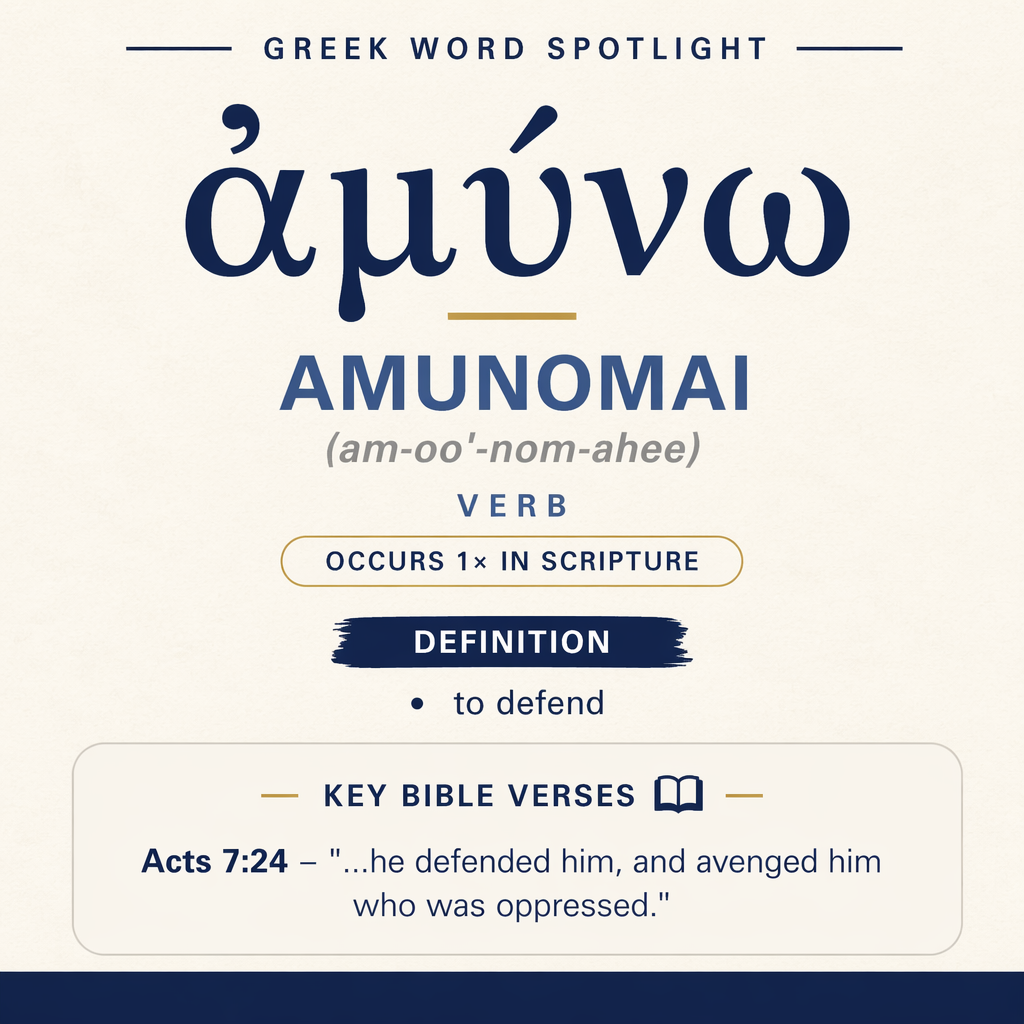
ἀμύνω means “to defend” and appears once in Scripture in Acts 7:24.
Acts Context
In Acts 7:24, it describes defending someone who suffered wrong, followed by avenging the oppressed by striking the Egyptian.
Learn More →ἀμύνω means “to defend” and appears once in the New Testament, in Stephen’s speech as he recounts Moses’ intervention on behalf of an Israelite in Egypt. In its single attestation it describes a decisive act performed in response to visible injustice.
Occurrences
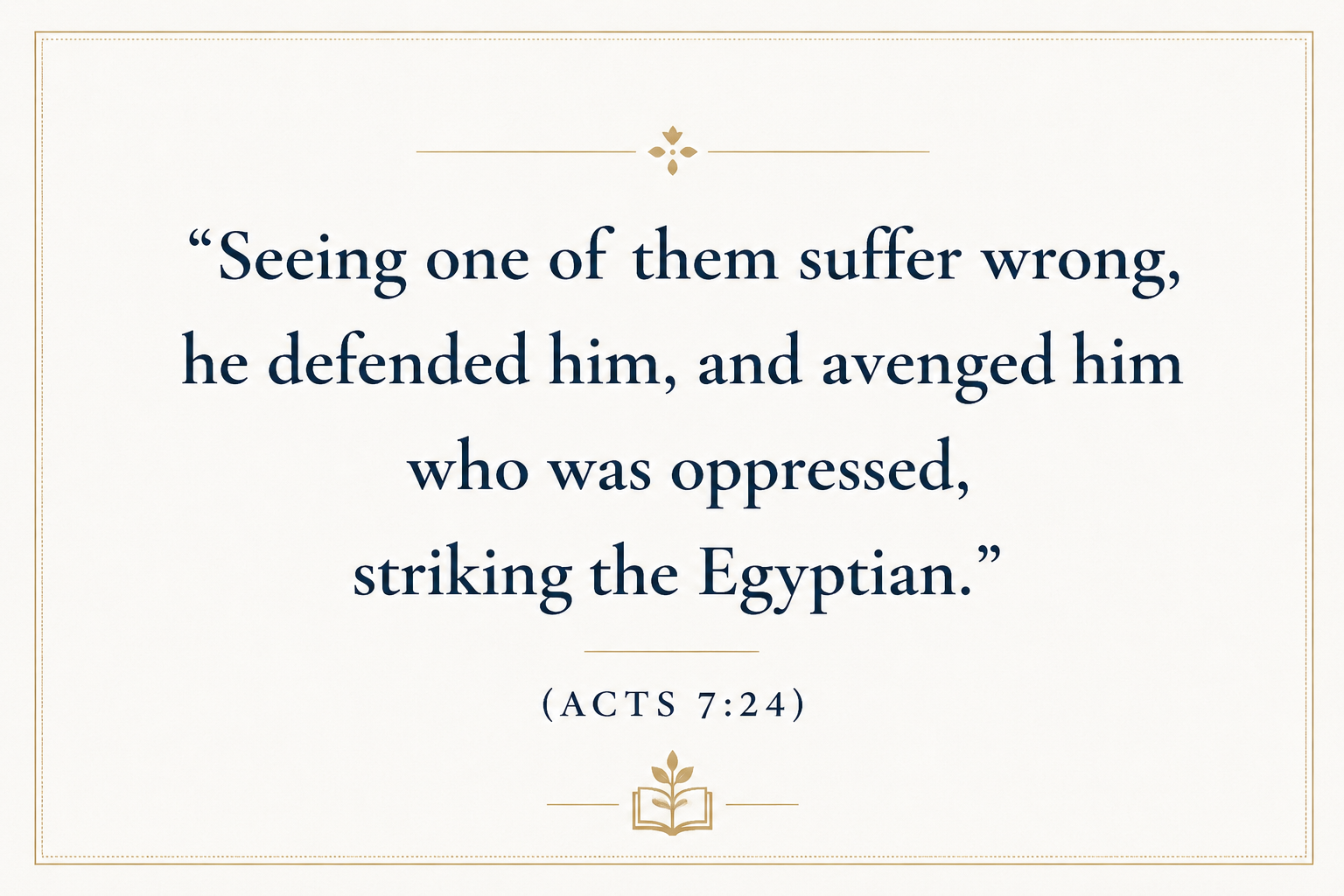
“Seeing one of them suffer wrong, he defended him, and avenged him who was oppressed, striking the Egyptian.” (Acts 7:24)
In this scene the verb marks Moses’ response to an instance of harm in progress: he sees “one of them suffer wrong,” and that perception immediately frames the action that follows. ἀμύνω places Moses’ intervention on the side of the injured party; it is not mere observation or sympathy but a move to stand for the one “oppressed.” The sentence pairs “he defended him” with “and avenged him who was oppressed,” presenting defense as an active taking-up of another’s cause in a situation where power is uneven. The final phrase, “striking the Egyptian,” supplies the concrete means by which the defense is carried out in this narrative moment; the verb for defending is thus embedded in a description of bodily, forceful intervention, not in an abstract or verbal protest. Within Stephen’s retelling, ἀμύνω functions to characterize Moses’ action as protective and aligned with the victimized Israelite.

Sense and Usage
The single use of ἀμύνω shows “to defend” operating in a tightly defined relational frame: a defender, a person suffering wrong, and an oppressor. The wording of Acts 7:24 highlights the trigger for the act—Moses “seeing” wrongdoing—and the object of the defense—“one of them” who is being harmed. This gives the verb a clear social direction: it is exercised for someone else, not for the actor’s own safety or advantage.
In the same clause the narrative places defense alongside the idea of setting matters right for someone “oppressed.” Because “he defended him” is immediately joined to “and avenged him,” the defense described here is not presented as passive shielding but as intervention that answers an injury with counteraction. The oppression is not hypothetical; it is already occurring (“suffer wrong”), and ἀμύνω participates in a sequence of response: perception of injustice, protective action, and a decisive outcome (“striking the Egyptian”).
This context also gives the verb an unmistakably public and concrete profile. The defense takes place in the open setting of conflict between persons, not in a courtroom scene or a private dispute. The verse does not describe deliberation, negotiation, or persuasion; it describes a swift protective move that directly confronts the oppressor. In Acts 7:24, therefore, “to defend” is depicted as standing with the harmed person in such a way that the oppression is opposed, not merely acknowledged.
Imagery
Acts 7:24 attaches ἀμύνω to a vivid picture: a wrong being done, an oppressed person, and a defender stepping into the moment with decisive force. The verb carries the imagery of protection enacted at close range, where defense is not an idea but a concrete intervention on behalf of someone who is being overpowered.
Sources: Lexical data from Strong’s Exhaustive Concordance and the Translators Brief Lexicon of Extended Strongs for Greek (STEPBible, CC BY). Occurrence data from the Translators Amalgamated Greek New Testament (STEPBible, CC BY). Scripture quotations from the World English Bible (public domain).





