
Unlocking the Meaning of ‘Adonay in Hebrew
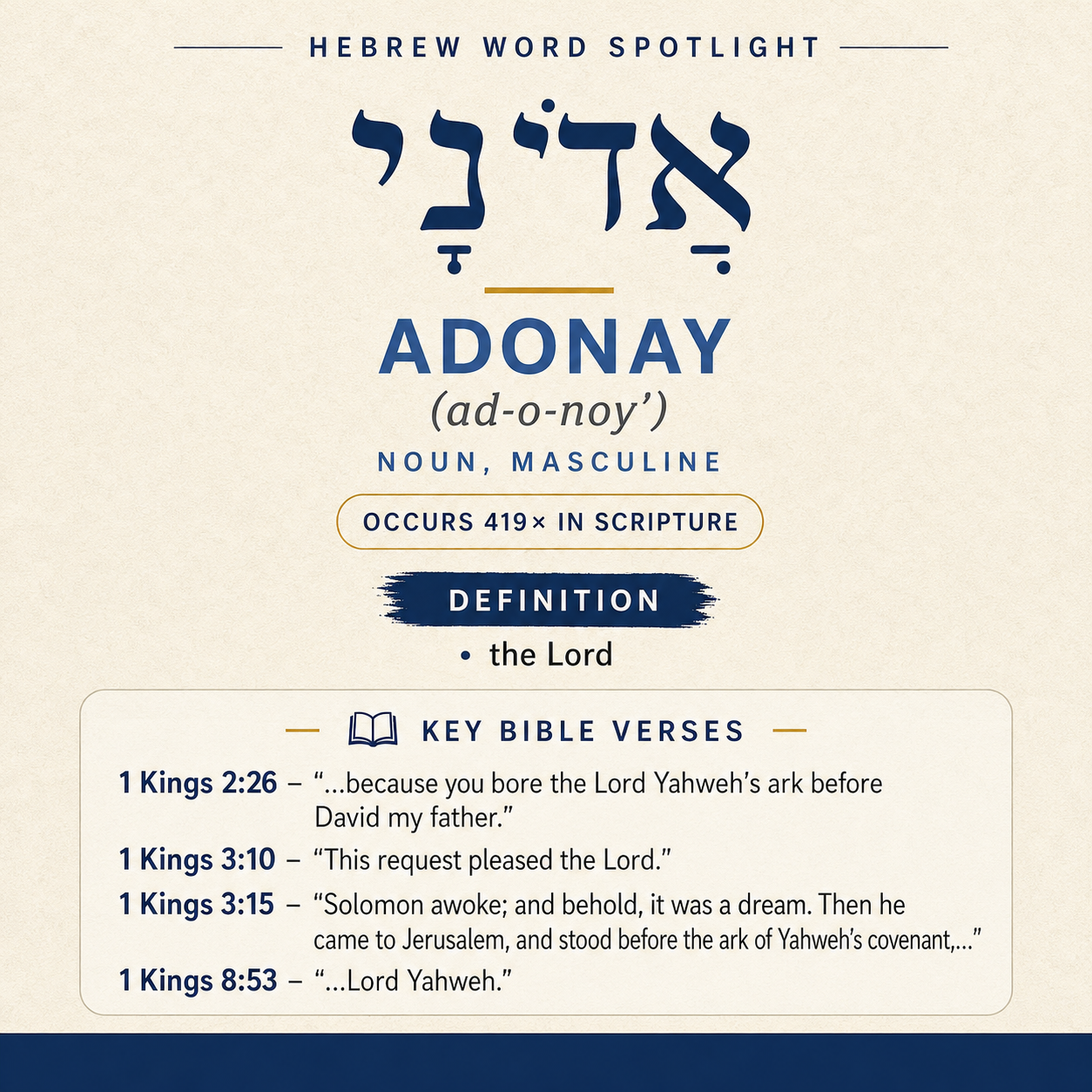
אֲדֹנָי (Adonay) means “the Lord” and occurs 419 times in Scripture, including 1 Kings 3:10 and 2 Samuel 7:18.
Scripture Frequency
This word occurs 419 times in Scripture. It appears in passages such as 1 Kings and 2 Kings.
Learn More →Sample Occurrences
Examples include 1 Kings 3:10 and 2 Kings 7:6. It also occurs in 2 Samuel 7:18.
Learn More →אֲדֹנָי (Adonay) means “the Lord.” In the passages cited here, it functions as a direct form of address and as a subject in narration, marking the Lord as the one who is honored, petitioned, and whose action determines outcomes in Israel’s story.
Occurrences
“To Abiathar the priest the king said, “Go to Anathoth, to your own fields; for you are worthy of death. But I will not at this time put you to death, because you bore the Lord Yahweh’s ark before David my father, and because you were afflicted in all in which my father was afflicted.”” (1 Kings 2:26)
Here “the Lord” is named within a royal verdict. The king’s restraint is grounded in Abiathar’s past service: he “bore the Lord Yahweh’s ark,” linking the Lord to the ark and to David’s hardships. The title frames the ark as belonging to the Lord and makes Abiathar’s role weighty enough to affect life-and-death judgment.
“This request pleased the Lord, that Solomon had asked this thing.” (1 Kings 3:10)
“The Lord” appears as the one who evaluates Solomon’s request. The sentence is terse, but it portrays the Lord’s pleasure as the decisive divine response to what the king “had asked,” setting the request in the moral and relational space of pleasing the Lord.
“Solomon awoke; and behold, it was a dream. Then he came to Jerusalem, and stood before the ark of Yahweh’s covenant, and offered up burnt offerings, offered peace offerings, and made a feast for all his servants.” (1 Kings 3:15)
Though this verse centers on Solomon’s actions, it supplies the immediate cultic setting in which “the Lord” is implicitly the recipient of worship: Solomon “stood before the ark of Yahweh’s covenant” and offered sacrifices. Within this cluster of texts, the Lord is the one to whom offerings and covenant-symbols relate, and Solomon’s response to the dream moves from private experience to public devotion.
“For you separated them from among all the peoples of the earth, to be your inheritance, as you spoke by Moses your servant, when you brought our fathers out of Egypt, Lord Yahweh.” (1 Kings 8:53)
“Lord Yahweh” is invoked at the close of a summary of divine acts: separation of a people “to be your inheritance,” speech “by Moses your servant,” and deliverance “out of Egypt.” The title functions as solemn address within prayer-like language, anchoring Israel’s identity and memory in the Lord’s initiative and speech.
“Then the king of Israel gathered the prophets together, about four hundred men, and said to them, “Should I go against Ramoth Gilead to battle, or should I refrain?” They said, “Go up; for the Lord will deliver it into the hand of the king.”” (1 Kings 22:6)
In this consultation scene, “the Lord” is invoked to guarantee a military outcome: “the Lord will deliver it.” The title lends authority to the prophets’ answer, presenting the Lord as the one who can place victory “into the hand of the king,” and making the proposed battle a matter of divine determination, not merely strategy.
“For the Lord had made the army of the Syrians to hear the sound of chariots, and the sound of horses, even the noise of a great army; and they said to one another, “Behold, the king of Israel has hired against us the kings of the Hittites and the kings of the Egyptians to attack us.”” (2 Kings 7:6)
“The Lord” is the actor behind a decisive misperception: he “had made the army of the Syrians to hear” terrifying sounds. The title marks the Lord as able to influence what an army hears and therefore how it interprets reality, producing fear and retreat through an unseen intervention described in concrete auditory terms.
“By your messengers, you have defied the Lord, and have said, “With the multitude of my chariots, I have come up to the height of the mountains, to the innermost parts of Lebanon, and I will cut down its tall cedars and its choice cypress trees; and I will enter into his farthest lodging place, the forest of his fruitful field.” (2 Kings 19:23)
Here “the Lord” is the one being personally defied. The boast that follows—chariots, mountain heights, Lebanon’s trees, and entry into the “forest of his fruitful field”—is framed as more than political arrogance; it is an offense against the Lord. The title therefore draws a line between human self-exaltation and opposition to the Lord’s honor.
“Then David the king went in, and sat before Yahweh; and he said, “Who am I, Lord Yahweh, and what is my house, that you have brought me this far?” (2 Samuel 7:18)
“Lord Yahweh” appears as intimate address in a posture of humility: David “sat before Yahweh” and asks, “Who am I… and what is my house?” The title carries the weight of reverence while the content highlights the Lord as the one who “brought” David to his present status.
“This was yet a small thing in your eyes, Lord Yahweh; but you have spoken also of your servant’s house for a great while to come; and this among men, Lord Yahweh!” (2 Samuel 7:19)
Repeated address to “Lord Yahweh” frames David’s amazement at divine speech about his “servant’s house.” The title accompanies an acknowledgment that the Lord’s perspective (“in your eyes”) differs from human expectations, and that the Lord’s words reach into the future.
“What more can David say to you? For you know your servant, Lord Yahweh.” (2 Samuel 7:20)
“Lord Yahweh” is addressed as the one who knows the speaker: “you know your servant.” The title sits within a confession of limited human speech before divine knowledge, portraying the Lord as personally aware of David and therefore able to judge and guide beyond what David can articulate.
“Therefore you are great, Yahweh God. For there is no one like you, neither is there any God besides you, according to all that we have heard with our ears.” (2 Samuel 7:22)
Although phrased here as “Yahweh God,” the same reverential naming continues the function of “the Lord” in David’s prayer: declaring greatness and uniqueness. The language places the Lord beyond comparison and ties that confession to communal testimony—“according to all that we have heard with our ears.”
““Now, O Lord Yahweh, you are God, and your words are truth, and you have promised this good thing to your servant.” (2 Samuel 7:28)
“O Lord Yahweh” again marks direct address, now focusing on the Lord’s identity and speech: “you are God,” “your words are truth,” and “you have promised.” The title stands at the head of a statement that binds the Lord’s lordship to dependable speech and committed promise toward “your servant.”

Sense and Usage
Across these occurrences, “the Lord” operates both as a spoken title and as a narrative designation for the one whose authority is ultimate. In royal contexts, the Lord is the one to whom sacred objects belong (“the Lord Yahweh’s ark,” 1 Kings 2:26) and whose evaluation matters (“This request pleased the Lord,” 1 Kings 3:10). In public worship and prayer, addressing the Lord gathers past acts and present dependence into a single speech-act: separation of a people, speaking through Moses, and bringing ancestors out (1 Kings 8:53) are rehearsed not as bare history but as reasons for appeal to the Lord.
In scenes of conflict, “the Lord” becomes the decisive factor in outcomes and the boundary against human pride. Prophetic assurance attributes deliverance to the Lord’s hand (1 Kings 22:6), while narrative explanation assigns a military panic to the Lord’s direct causation of what an army hears (2 Kings 7:6). The boast in 2 Kings 19:23 is labeled defiance not merely of a nation but “the Lord,” turning geographical conquest imagery into a personal affront against the Lord’s majesty.
In David’s prayer (2 Samuel 7:18–20, 28), the title “Lord Yahweh” accompanies humility (“Who am I…?”), awe at divine speech about a household’s future, confidence in divine knowledge (“you know your servant”), and trust in the Lord’s truthful words and promises. The repeated address turns theology into relationship: the Lord is not only confessed as great and incomparable (2 Samuel 7:22) but engaged as the one who brings, speaks, knows, and promises.
Imagery
The passages attach “the Lord” to concrete images that make lordship tangible: an ark borne “before David” (1 Kings 2:26), a king standing “before the ark of Yahweh’s covenant” with offerings (1 Kings 3:15), and the soundscape of war—“the sound of chariots… the noise of a great army”—directed by the Lord (2 Kings 7:6). They also set the Lord against the grandeur of human boasting: cedar and cypress, mountain heights, and forests (2 Kings 19:23) are invoked in a speech that is condemned precisely because it has “defied the Lord.” In prayer, the imagery shifts inward and domestic—“my house,” “your servant’s house”—as David measures his household’s story by what the Lord has done and said (2 Samuel 7:18–19, 28).
Sources: Lexical data from Strong’s Exhaustive Concordance and the Open Scriptures Hebrew Lexicon. Occurrence data from the Westminster Leningrad Codex with STEPBible reference data (CC BY). Scripture quotations from the World English Bible (public domain).





