
Understanding the Meaning of ‘Iggereth in Hebrew
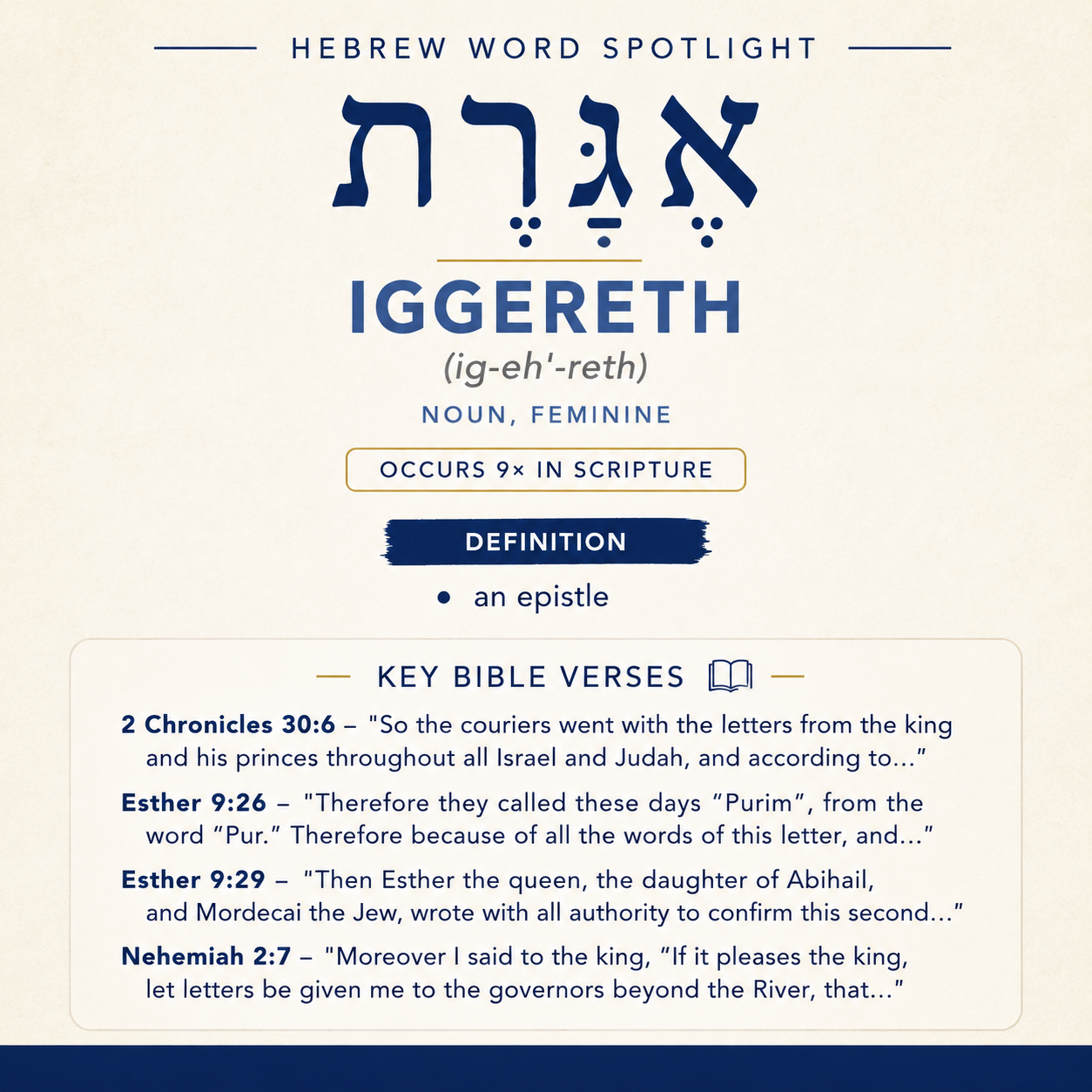
אִגֶּרֶת (iggereth) means “an epistle” and occurs 9 times in Scripture, including in 2 Chronicles, Esther, and Nehemiah.
Core Meaning
אִגֶּרֶת is defined as “an epistle.” It refers to a written letter in the biblical text.
Learn More →Where It Appears
This word occurs 9 times in Scripture. References include 2 Chronicles 30:6; Esther 9:26, 9:29; and Nehemiah 2:7–9; 6:5; 6:17.
Learn More →Narrative Usage
In Nehemiah it is used for the king’s letters and an open letter, and for letters exchanged with Tobiah. In Esther it appears in letters confirming Purim.
Learn More →אִגֶּרֶת (iggereth) means “an epistle” and appears in narrative settings where written communication carries royal or communal authority. Its occurrences cluster around reforms, administration, and political pressure as messages move across regions and between leaders.

Occurrences
“So the couriers went with the letters from the king and his princes throughout all Israel and Judah, and according to the commandment of the king, saying, “You children of Israel, turn again to Yahweh, the God of Abraham, Isaac, and Israel, that he may return to the remnant of you that have escaped out of the hand of the kings of Assyria.” (2 Chronicles 30:6)
Here the “letters” are tied explicitly to “the king and his princes” and travel “throughout all Israel and Judah” by means of “couriers.” The epistle functions as an instrument of summons: it bears a command (“according to the commandment of the king”) and conveys a direct appeal framed in covenantal language (“turn again to Yahweh”). The written form supports wide distribution and uniformity of message, matching the geographic scope named in the verse.
“Therefore they called these days “Purim”, from the word “Pur.” Therefore because of all the words of this letter, and of that which they had seen concerning this matter, and that which had come to them,” (Esther 9:26)
In this setting the epistle is treated as a body of “words” that helps account for an established observance (“these days “Purim””). The verse places the letter alongside lived experience (“that which they had seen… and that which had come to them”), presenting it as part of how the matter is remembered and explained. The epistle contributes documentary weight: it is something whose contents can be pointed to as a reason for communal naming and practice.
“Then Esther the queen, the daughter of Abihail, and Mordecai the Jew, wrote with all authority to confirm this second letter of Purim.” (Esther 9:29)
This occurrence highlights the social force carried by an epistle: it can be written “with all authority” and used “to confirm.” The verse also identifies named senders—“Esther the queen… and Mordecai the Jew”—so the letter’s effectiveness is linked to recognized status and to the act of writing as confirmation. The mention of a “second letter” shows that epistles can be iterative, not merely initial announcements but follow-up communications that reinforce what has been instituted.
“Moreover I said to the king, “If it pleases the king, let letters be given me to the governors beyond the River, that they may let me pass through until I come to Judah;” (Nehemiah 2:7)
Here the epistle is requested as a practical tool for travel and access. The needed audience is specified: “the governors beyond the River.” The purpose is likewise specific: “that they may let me pass through.” In this scene, the letter operates as a credential and authorization, enabling the bearer to move through administrative boundaries under the king’s approval.
“and a letter to Asaph the keeper of the king’s forest, that he may give me timber to make beams for the gates of the citadel by the temple, for the wall of the city, and for the house that I will occupy.” The king granted my requests, because of the good hand of my God on me. (Nehemiah 2:8)
This verse narrows the letter’s function to procurement and logistics. The epistle is addressed “to Asaph the keeper of the king’s forest” so that resources (“timber”) will be released for clearly listed construction aims: “the gates of the citadel by the temple,” “the wall of the city,” and “the house that I will occupy.” The letter thus works as an administrative directive tied to concrete materials and building projects, linking written authorization to the movement of royal assets.
“Then I came to the governors beyond the River, and gave them the king’s letters. Now the king had sent captains of the army and horsemen with me.” (Nehemiah 2:9)
The narrative here shows the letters in use: Nehemiah “gave them the king’s letters” to the governors previously mentioned. The epistles are presented as belonging to the king (“the king’s letters”), emphasizing their source and, by implication, their persuasive power. Their delivery is paired with an escort—“captains of the army and horsemen”—which frames the letters within a wider package of royal backing, both written and physical.
“Then Sanballat sent his servant to me the same way the fifth time with an open letter in his hand,” (Nehemiah 6:5)
In this conflict scene, the epistle appears as a tactic of pressure. The repeated sending (“the fifth time”) highlights persistence, and the detail that it is “an open letter” draws attention to its form and intended effect. The openness suggests a message designed to be seen more broadly than a private note, fitting a strategy where the letter itself—carried “in his hand”—becomes part of the confrontation.
“Moreover in those days the nobles of Judah sent many letters to Tobiah, and Tobiah’s letters came to them.” (Nehemiah 6:17)
This verse depicts epistles as instruments within a network of influence: “the nobles of Judah” and “Tobiah” exchange “many letters.” The two-way traffic (“sent… and… came”) indicates ongoing correspondence rather than a single directive. The emphasis falls on volume and connectivity, showing how letters can sustain alliances or obligations over time through repeated written contact.
“Also they spoke of his good deeds before me, and reported my words to him. Tobiah sent letters to put me in fear.” (Nehemiah 6:19)
The epistle here is explicitly associated with intimidation. The social dynamics are layered: people “spoke of his good deeds before me” and “reported my words to him,” and within that channel Tobiah “sent letters to put me in fear.” The letter becomes a means of psychological pressure, extending opposition beyond spoken reports into deliberate written attempts to influence emotion and decision-making.
Sense and Usage
Across these passages, an epistle is a written communication whose significance lies less in its material form than in its capacity to carry authority, coordinate action, and shape outcomes at a distance. In 2 Chronicles 30:6 the letters travel by couriers and function as a royal summons addressed broadly to “all Israel and Judah,” showing how writing supports a unified message across a large population. In Esther 9:26 and 9:29, letters are bound up with communal memory and confirmation: the “words of this letter” are treated as part of the reasoned basis for naming days, and the act of writing “with all authority” serves to “confirm” a second communication. In Nehemiah 2:7–9, letters operate as official instruments for passage and provisioning; they enable movement through governed regions and access to timber for specified construction tasks, and their delivery underscores their role as royal authorization. In Nehemiah 6:5, 6:17, and 6:19, the same category of written message is shown in contentious settings: letters can be open and repeated, exchanged in quantity within elite circles, or sent to instill fear. The word’s range in these scenes is therefore not about differing definitions but about the different social purposes an epistle can serve—summoning, confirming, authorizing, networking, and pressuring—depending on sender, recipient, and context.
Imagery
The passages give the epistle a strong public and administrative feel: couriers crossing regions with royal communications (2 Chronicles 30:6), authoritative confirmation set down in writing (Esther 9:29), and official letters presented to governors and resource-keepers for travel and building (Nehemiah 2:7–9). At the same time, the same written medium can be weaponized—held as “an open letter” (Nehemiah 6:5) or multiplied and sent “to put me in fear” (Nehemiah 6:19)—so that the image of a letter includes both sanctioned order and contested influence.
Sources: Lexical data from Strong’s Exhaustive Concordance and the Open Scriptures Hebrew Lexicon. Occurrence data from the Westminster Leningrad Codex with STEPBible reference data (CC BY). Scripture quotations from the World English Bible (public domain).





