
Unpacking the Meaning of ‘Ebets in Hebrew
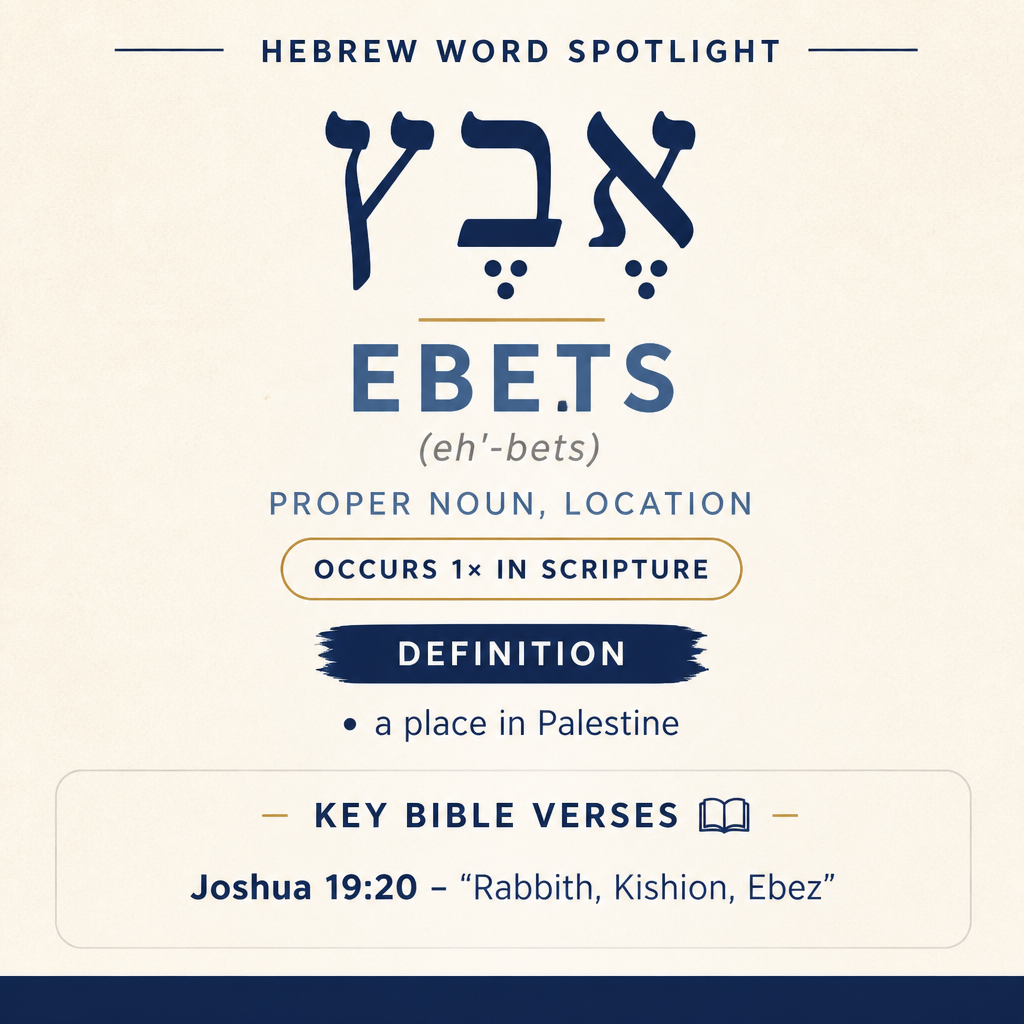
אֶבֶץ (Ebets) is a place in Palestine, appearing in Joshua 19:20 in a list of locations.
Biblical Context
It appears in Joshua 19:20 alongside Rabbith and Kishion in a list of places.
Learn More →Ebez refers to a place in Palestine, named once in Scripture. It appears in a short list of locations within a territorial description.
Occurrences
Joshua 19:20
“Rabbith, Kishion, Ebez,” (Joshua 19:20)
Here Ebez functions as one element in a compact series of place-names: “Rabbith, Kishion, Ebez,”. The line is composed entirely of toponyms, with commas marking distinct sites rather than descriptive phrases. In this setting, Ebez contributes as a fixed point on a map: a named locality that helps fill out a geographical inventory. Nothing in the wording supplies narrative action, population, events, or landscape features; the effect is purely documentary, placing Ebez alongside neighboring or associated places in a chain-like enumeration.
The form of the verse as presented is noteworthy for how it frames the name. Ebez is not introduced with a verb (“they went to…”) or a preposition (“to…” / “at…”), but simply placed in apposition with other names. This style treats Ebez as self-identifying within the list; the name’s role is to mark a location recognized as part of the catalog the verse is building. The commas reinforce that the list is meant to be read item by item, as a set of discrete settlements or sites.

Sense and Usage
As “a place in Palestine,” Ebez belongs to the onomastic layer of biblical language: words that primarily function by naming. In Joshua 19:20, that naming function is foregrounded and unembellished. The verse does not lean on Ebez for metaphor, characterization, or theological emphasis; it leans on Ebez for orientation and record-keeping. The name operates like a label in a boundary-and-allotment context, where the cumulative weight of multiple names is what establishes the completeness and specificity of the description.
Because Ebez appears in a list rather than in a story scene, its contribution is structural. It helps define the scope of a territorial account by adding one more identifiable site to the sequence. The meaning supplied for the word (a place in Palestine) fits the verse’s genre: an inventory of places. In such lists, the primary “sense” is not an abstract concept but the referential value of the name—its ability to point to a real location and to distinguish that location from others named nearby in the same breath.
The brevity of the attestation shapes how the name is used: it stands without explanation. Many biblical place-names, when they appear only in lists, function as anchors for an administrative or geographical framework. Ebez exemplifies that: a toponym that gains its significance from being counted among other toponyms. The verse’s economy also means that the reader encounters Ebez as part of a cluster (“Rabbith, Kishion, Ebez,”), which implies association within a shared territorial setting even though the verse itself does not specify the nature of the association beyond co-listing.
Within the immediate wording, the final position of Ebez in the quoted segment gives it a slight rhetorical emphasis: it closes the triad as presented. In list-style writing, the last item can function as a cadence point, finishing a unit before the list continues or the thought moves on. The name thus serves not only as a referent but also as punctuation in the flow of the enumeration, marking the end of a small grouping of places.
Imagery and Setting
Although Ebez is not described with visual details, its placement among other place-names evokes the imagery of mapped space: distinct sites laid out in relation to one another. Joshua 19:20 presents Ebez not as a backdrop for an episode but as a dot in a surveyed landscape—one identifiable location among several, each named plainly as part of a territorial listing.
Sources: Lexical data from Strong’s Exhaustive Concordance and the Open Scriptures Hebrew Lexicon. Occurrence data from the Westminster Leningrad Codex with STEPBible reference data (CC BY). Scripture quotations from the World English Bible (public domain).





