Understanding the Meaning of ‘Abiyshalowm in Hebrew
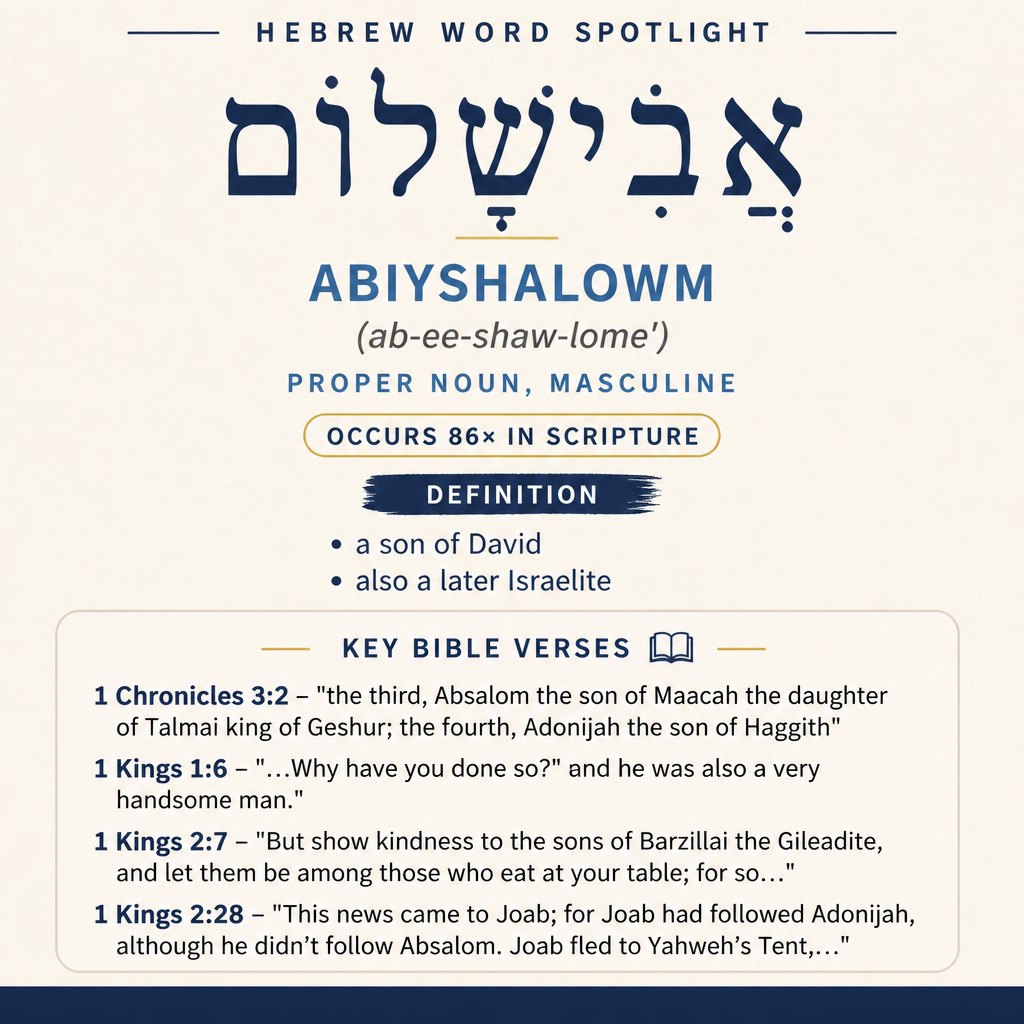
אֲבִישָׁלוֹם (Abiyshalowm) means “a son of David; also a later Israelite,” occurring 86 times in Scripture, including 1 Chronicles, 1 Kings, and 2 Chronicles.
Scripture Occurrences
It occurs 86 times in Scripture. Listed examples include 1 Chronicles 3:2 and multiple references in 1 Kings and 2 Chronicles.
Learn More →Named Individuals
1 Chronicles 3:2 identifies Absalom as a son of David. 1 Kings 15:2,10 and 2 Chronicles 11:20-21 mention Maacah as the daughter of Abishalom/Absalom.
Learn More →Abiyshalowm names a son of David and also a later Israelite. In the passages quoted here, the name anchors family lines, political memory, and the way later generations are identified through maternal descent.
Occurrences
1 Chronicles 3:2 — “the third, Absalom the son of Maacah the daughter of Talmai king of Geshur; the fourth, Adonijah the son of Haggith;”
Here Abiyshalowm appears in a dynastic list, locating him as “the third” among David’s sons. The verse ties him tightly into a network of parentage: he is “the son of Maacah,” and Maacah herself is identified by her father (“Talmai”) and her origin (“king of Geshur”). Abiyshalowm’s function in this line is to mark a specific branch of David’s household and to situate subsequent names in relation to him within an ordered genealogy.
1 Kings 1:6 — “His father had not displeased him at any time in saying, “Why have you done so?” and he was also a very handsome man; and he was born after Absalom.”
Abiyshalowm is used as a chronological point of reference: a man’s birth is placed “after Absalom.” The name thus serves as a marker within the sequence of sons and the unfolding of events in the royal family. By mentioning Abiyshalowm without further description, the verse treats him as a known figure whose place in the family timeline helps interpret the character sketch being given.
1 Kings 2:7 — “But show kindness to the sons of Barzillai the Gileadite, and let them be among those who eat at your table; for so they came to me when I fled from Absalom your brother.”
Abiyshalowm evokes a remembered crisis: the speaker recalls a time of flight “from Absalom your brother.” The name functions as a shorthand for the circumstances that made certain loyalties and kindnesses meaningful—those who “came to me” did so under pressure and danger. Abiyshalowm is not merely a family label in this sentence; he is the relational point (“your brother”) that frames why the appeal for generosity carries moral weight.
1 Kings 2:28 — “This news came to Joab; for Joab had followed Adonijah, although he didn’t follow Absalom. Joab fled to Yahweh’s Tent, and held onto the horns of the altar.”
Abiyshalowm is part of an evaluation of allegiance: Joab “had followed Adonijah,” but “he didn’t follow Absalom.” The name becomes a measuring rod for where Joab stood in earlier alignments, and the contrast contributes to the narrative logic that leads to Joab’s fear and flight. The mention of Abiyshalowm heightens the sense of contested loyalties in the royal court—different claimants drew different supporters, and Joab’s history is being summarized in that contrast.
1 Kings 15:2 — “He reigned three years in Jerusalem. His mother’s name was Maacah the daughter of Abishalom.”
Here Abiyshalowm identifies a later figure through maternal lineage: the king’s mother is “Maacah the daughter of Abishalom.” The name functions as a genealogical credential, anchoring Maacah’s identity by naming her father. In this royal notice, Abiyshalowm is a point of reference that helps locate the king within a family network, showing how lineage is recorded not only through fathers and sons but also through mothers and their parentage.
1 Kings 15:10 — “He reigned forty-one years in Jerusalem. His mother’s name was Maacah the daughter of Abishalom.”
The same maternal identification reappears, again using Abiyshalowm to specify which Maacah is meant. The repetition shows the name’s usefulness as a stable identifier across reign summaries: the king’s public record includes his mother, and her public record includes her father. Abiyshalowm thus functions as part of the formal way later rulers are situated within Israel’s remembered families.
2 Chronicles 11:20 — “After her, he took Maacah the daughter of Absalom; and she bore him Abijah, Attai, Ziza, and Shelomith.”
Abiyshalowm again serves to define Maacah, here within a marriage and childbearing notice. The verse links Abiyshalowm to a continuing line: Maacah “bore him Abijah, Attai, Ziza, and Shelomith.” The name is therefore not only retrospective but generative in the narrative, functioning as an anchor from which subsequent descendants are listed.
2 Chronicles 11:21 — “Rehoboam loved Maacah the daughter of Absalom above all his wives and his concubines; for he took eighteen wives and sixty concubines, and became the father of twenty-eight sons and sixty daughters.”
In this scene Abiyshalowm identifies the favored wife: “Maacah the daughter of Absalom” is singled out as loved “above all.” The name contributes to the portrayal of household dynamics within a large royal family structure (“eighteen wives and sixty concubines”). By tying Maacah to Abiyshalowm, the verse gives her a distinguished identifier within an otherwise extensive list of relationships and offspring.
2 Samuel 3:3 — “and his second, Chileab, of Abigail the wife of Nabal the Carmelite; and the third, Absalom the son of Maacah the daughter of Talmai king of Geshur;”
This genealogy parallels the function seen in Chronicles: Abiyshalowm is “the third,” and his identity is fixed through his mother, Maacah, and her father, Talmai, “king of Geshur.” The name’s contribution is precision. It distinguishes Abiyshalowm among other sons and connects him to a specific maternal lineage that is significant enough to be spelled out in full.
2 Samuel 13:4 — “He said to him, “Why, son of the king, are you so sad from day to day? Won’t you tell me?” Amnon said to him, “I love Tamar, my brother Absalom’s sister.””
Abiyshalowm functions here as a relational qualifier within a confession: Tamar is “my brother Absalom’s sister.” The name identifies Tamar by her connection to Abiyshalowm, not by introducing her independently. In the dialogue, invoking Abiyshalowm’s sibling relationship locates Tamar within the royal family’s internal bonds, underscoring that the desire being expressed is entangled with close kinship ties.
2 Samuel 13:20 — “Absalom her brother said to her, “Has Amnon your brother been with you? But now hold your peace, my sister. He is your brother. Don’t take this thing to heart.” So Tamar remained desolate in her brother Absalom’s house.”
Here Abiyshalowm appears as Tamar’s brother who speaks to her and then provides a place where she remains: “in her brother Absalom’s house.” The name contributes both voice and setting. It marks the family relationship driving Abiyshalowm’s counsel and frames the aftermath by associating Tamar’s ongoing desolation with his household, making his house a narrative location tied to the family crisis.
2 Samuel 13:22 — “Absalom spoke to Amnon neither good nor bad; for Absalom hated Amnon, because he had forced his sister Tamar.”
Abiyshalowm here is the subject of sustained emotion and calculated speech: he “spoke to Amnon neither good nor bad,” yet “hated Amnon” for what happened to Tamar. The name, placed repeatedly in the verse, keeps the focus on Abiyshalowm’s inner posture and outward restraint. His identity as Tamar’s brother drives the motive given (“because he had forced his sister Tamar”), so Abiyshalowm’s familial role is integral to understanding the hostility described.

Sense and Usage
Across these verses Abiyshalowm functions as a personal name that carries two main kinds of weight. First, it is a genealogical anchor. In lists and reign summaries, the name helps locate individuals within Israel’s remembered families: he is counted among David’s sons (1 Chronicles 3:2; 2 Samuel 3:3), and he serves as the named father through whom Maacah is identified in later royal records (1 Kings 15:2, 15:10) and in marriage-and-children notices (2 Chronicles 11:20–21). In these contexts the name is less about an isolated individual and more about how identity is recorded—through parentage, birth order (“the third”), and maternal descent (“his mother’s name was Maacah the daughter of Abishalom”).
Second, Abiyshalowm becomes a reference point for political and household memory. He marks a time of upheaval that explains later obligations (“when I fled from Absalom your brother,” 1 Kings 2:7) and provides a lens for judging past loyalties (“although he didn’t follow Absalom,” 1 Kings 2:28). Within family narrative, the name organizes relationships and motives: Tamar is introduced through her link to him (2 Samuel 13:4), and his responses—speech, protection, and hatred—are framed by his role as her brother (2 Samuel 13:20, 13:22). Thus Abiyshalowm’s name works both as a tool for historical placement and as a way to keep relational ties explicit when the narrative turns to conflict.
Imagery
The passages give Abiyshalowm a distinctive double setting: the ordered world of lists and regnal formulas, and the turbulent world of flight, allegiance, and family injury. In one register, he is fixed in line and descent—“the third” son, the father named in a mother’s lineage. In the other, his name conjures movement and fracture: a king “fled from Absalom,” a commander’s past stance is recalled as he runs to grasp “the horns of the altar,” and a sister remains “desolate” in “Absalom’s house.” Together, these scenes show how a personal name can carry both the stability of recorded lineage and the emotional force of remembered events.
Sources: Lexical data from Strong’s Exhaustive Concordance and the Open Scriptures Hebrew Lexicon. Occurrence data from the Westminster Leningrad Codex with STEPBible reference data (CC BY). Scripture quotations from the World English Bible (public domain).