
Discovering the Meaning of ‘Abiyshay in Hebrew
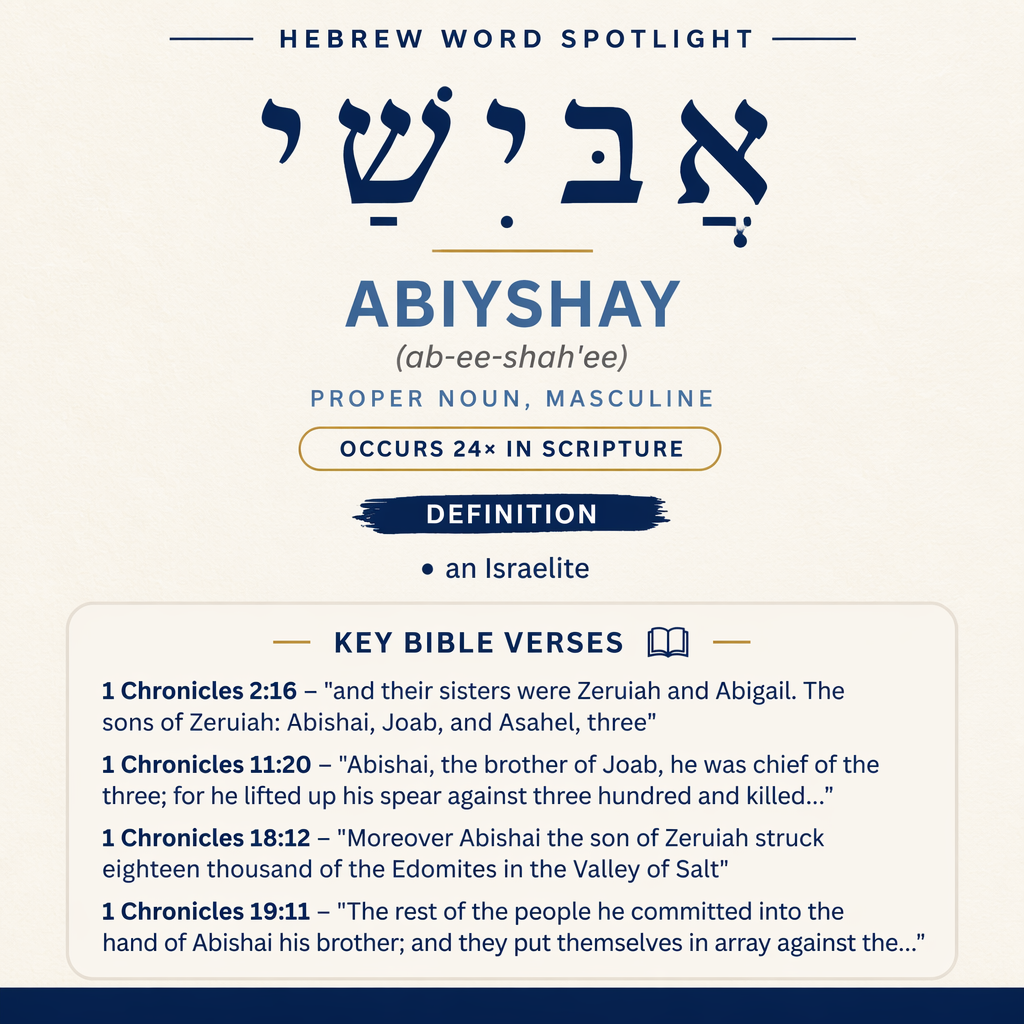
אֲבִישַׁי (Abiyshay) means “an Israelite” and appears 24 times in Scripture, including 1 Chronicles 2:16 and 1 Samuel 26:6–8.
Meaning
אֲבִישַׁי is defined as “an Israelite.” It is a Hebrew proper name used in Scripture.
Learn More →Family Context
In 1 Chronicles 2:16, Abishai is listed as a son of Zeruiah and brother of Joab and Asahel. He is also called “the son of Zeruiah” and “brother of Joab” in 1 Samuel 26:6.
Learn More →Narrative Snapshots
Abishai is described as chief of the three and as striking enemies in 1 Chronicles 11:20 and 18:12. In 1 Samuel 26:7–8, he accompanies David by night and speaks to him about Saul.
Learn More →אֲבִישַׁי (Abiyshay) is a personal name applied to an Israelite who appears in narratives and battle reports across Samuel and Chronicles. In these passages, the name functions to locate him within family relationships, military roles, and decisive moments of counsel and action.
Occurrences
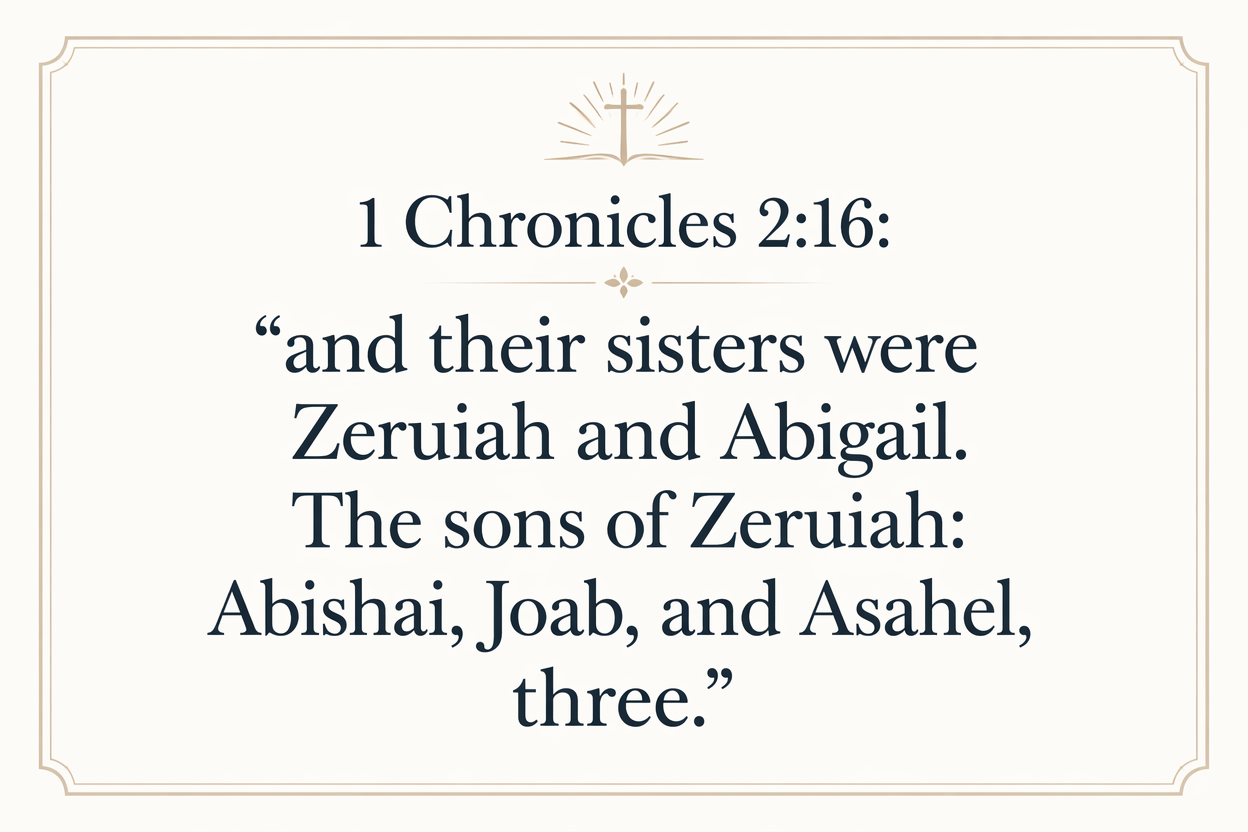
1 Chronicles 2:16: “and their sisters were Zeruiah and Abigail. The sons of Zeruiah: Abishai, Joab, and Asahel, three.”
Here אֲבִישַׁי identifies one of three sons of Zeruiah, set alongside Joab and Asahel. The name’s contribution is genealogical: it anchors him within a sibling group and within a wider family register that also names Zeruiah and Abigail as sisters.
1 Chronicles 11:20: “Abishai, the brother of Joab, he was chief of the three; for he lifted up his spear against three hundred and killed them, and had a name among the three.”
In this notice, אֲבִישַׁי is marked by both kinship (“the brother of Joab”) and status (“chief of the three”). The verse portrays him as a warrior whose fame is tied to a specific feat: raising a spear against “three hundred,” killing them, and gaining “a name among the three,” language that frames his reputation within a recognized circle of fighters.
1 Chronicles 18:12: “Moreover Abishai the son of Zeruiah struck eighteen thousand of the Edomites in the Valley of Salt.”
אֲבִישַׁי is again identified through Zeruiah (“the son of Zeruiah”) and is placed at the center of a military victory. The name points to the agent of the action—he “struck eighteen thousand of the Edomites”—and fixes the event geographically “in the Valley of Salt,” turning the personal name into a marker for an attributed battlefield outcome.
1 Chronicles 19:11: “The rest of the people he committed into the hand of Abishai his brother; and they put themselves in array against the children of Ammon.”
Here אֲבִישַׁי functions as the recipient of delegated command: “the rest of the people” are placed “into the hand of Abishai his brother.” The verse depicts him as a leader entrusted with troops, and his name serves to distinguish the division of forces as they prepare (“put themselves in array”) to face “the children of Ammon.”
1 Chronicles 19:15: “When the children of Ammon saw that the Syrians had fled, they likewise fled before Abishai his brother, and entered into the city. Then Joab came to Jerusalem.”
In this sequel, אֲבִישַׁי is the figure before whom the Ammonites retreat: they “fled before Abishai his brother.” The wording presents his presence as a pressure on the battlefield that contributes to enemy withdrawal into a city, while the final line (“Then Joab came to Jerusalem”) keeps Abishai’s identity intertwined with his brother’s movements within the same campaign scene.
1 Samuel 26:6: “Then David answered and said to Ahimelech the Hittite, and to Abishai the son of Zeruiah, brother of Joab, saying, “Who will go down with me to Saul to the camp?” Abishai said, “I will go down with you.””
אֲבִישַׁי is introduced in a tense episode of approach to Saul’s camp, named alongside Ahimelech and directly addressed by David. The verse builds his identity through a chain of relations (“the son of Zeruiah, brother of Joab”) and then highlights his readiness: he volunteers, “I will go down with you,” placing his name on the moment of accompanying David into danger.
1 Samuel 26:7: “So David and Abishai came to the people by night: and, behold, Saul lay sleeping within the place of the wagons, with his spear stuck in the ground at his head; and Abner and the people lay around him.”
In this nighttime infiltration, אֲבִישַׁי is paired with David as an active participant: “David and Abishai came… by night.” The name signals presence at close range to Saul, with details of the camp’s arrangement—wagons, the spear at Saul’s head, Abner and the people encircling—heightening the risk of the scene in which Abishai is one of only two named intruders.
1 Samuel 26:8: “Then Abishai said to David, “God has delivered up your enemy into your hand today. Now therefore please let me strike him with the spear to the earth at one stroke, and I will not strike him the second time.””
Here אֲבִישַׁי is the speaker urging immediate lethal action. His words interpret the situation as divine delivery (“God has delivered up your enemy into your hand today”) and propose a specific method using the nearby weaponry imagery: “strike him with the spear to the earth at one stroke.” The name thus carries the role of the advocate for a decisive, single blow.
1 Samuel 26:9: “David said to Abishai, “Don’t destroy him; for who can stretch out his hand against Yahweh’s anointed, and be guiltless?””
אֲבִישַׁי is addressed directly as the one being restrained. The dialogue positions him as the immediate agent who might “destroy him,” and the response frames the moral boundary of the scene: the danger of “stretch[ing] out his hand against Yahweh’s anointed.” The name marks the recipient of instruction at a crucial ethical decision point.
2 Samuel 2:18: “The three sons of Zeruiah were there, Joab, and Abishai, and Asahel: and Asahel was as light of foot as a wild gazelle.”
In this war setting, אֲבִישַׁי appears as one of “the three sons of Zeruiah” present together. The verse names the trio and then singles out Asahel’s speed, indirectly situating Abishai within the same band of brothers whose distinct traits and roles will matter in the conflict’s unfolding.
2 Samuel 2:24: “But Joab and Abishai pursued Abner. The sun went down when they had come to the hill of Ammah, that lies before Giah by the way of the wilderness of Gibeon.”
אֲבִישַׁי is coupled with Joab in pursuit: “Joab and Abishai pursued Abner.” The verse ties his name to sustained action across distance and time, noting the sunset and mapping the chase through named landmarks (“the hill of Ammah… before Giah… by the way of the wilderness of Gibeon”), so that Abishai’s identity is linked to relentless tracking in the aftermath of battle.
2 Samuel 3:30: “So Joab and Abishai his brother killed Abner, because he had killed their brother Asahel at Gibeon in the battle.”
In this concluding statement, אֲבִישַׁי is explicitly included in Abner’s death: “Joab and Abishai his brother killed Abner.” The verse also gives motive framed as family retribution: Abner “had killed their brother Asahel… in the battle.” The name therefore sits at the intersection of brotherhood, violence, and the stated reason for the act.

Sense and Usage
Across these passages, אֲבִישַׁי functions as the identifying name of an Israelite who is consistently defined in relation to a close-knit family unit and to military activity. Genealogical notices present him as one of Zeruiah’s sons (1 Chronicles 2:16; 2 Samuel 2:18), and several contexts reinforce this identification by repeating the family ties in prose (“the son of Zeruiah, brother of Joab,” 1 Samuel 26:6; “Abishai his brother,” 1 Chronicles 19:11, 19:15; 2 Samuel 3:30). In effect, the name carries relational information: it does not stand alone but frequently comes with kinship labels that locate him within a recognized network of brothers.
Within that relational frame, the name is attached to actions that display capability and initiative. Chronicles highlights his prominence among elite warriors and assigns him credit for striking down large numbers (1 Chronicles 11:20; 18:12). In the Ammonite war notice, the name marks him as a commander who receives troops “into the hand of Abishai” and as a leader before whom enemies flee (1 Chronicles 19:11, 19:15). Samuel adds scenes where the name is associated not only with combat but also with counsel and decision: Abishai volunteers to accompany David into Saul’s camp at night (1 Samuel 26:6–7) and speaks strongly in favor of killing Saul swiftly with a spear (1 Samuel 26:8), only to be checked by David’s prohibition (1 Samuel 26:9). Later, in pursuit and killing, his name appears beside Joab’s in chasing Abner and in the killing that is explained as retaliation for Asahel’s death (2 Samuel 2:24; 3:30).
As a result, the usage of אֲבִישַׁי in these texts does more than tag a person; it helps the narrative keep clear who acts within moments where brothers act together, where command is handed off, and where speech and violence stand in close proximity. The repeated pairing of Abishai with Joab is especially prominent: they are named together in kinship, in pursuit, and in lethal outcome (1 Chronicles 11:20; 19:11, 19:15; 2 Samuel 2:24; 3:30), giving the name a steady association with coordinated action in the midst of Israel’s conflicts.
Imagery in Context
The scenes that include אֲבִישַׁי often carry concrete, memorable details that cling to the name: a raised spear in a feat remembered among “the three” (1 Chronicles 11:20); a counted victory “in the Valley of Salt” (1 Chronicles 18:12); troops forming battle lines against Ammon (1 Chronicles 19:11); enemies retreating into a city (1 Chronicles 19:15). In Samuel, the name is set within the stark night tableau of Saul asleep “within the place of the wagons, with his spear stuck in the ground at his head” (1 Samuel 26:7), and within the moral tension of whether a spear will be used at “one stroke” (1 Samuel 26:8–9). Even when the setting shifts to a chase at sundown through named terrain (2 Samuel 2:24), the name remains tied to movement, pressure, and the bonds—and wounds—of brotherhood (2 Samuel 3:30).
Sources: Lexical data from Strong’s Exhaustive Concordance and the Open Scriptures Hebrew Lexicon. Occurrence data from the Westminster Leningrad Codex with STEPBible reference data (CC BY). Scripture quotations from the World English Bible (public domain).





