
Unpacking the Meaning of ‘Abiyshuwae in Hebrew
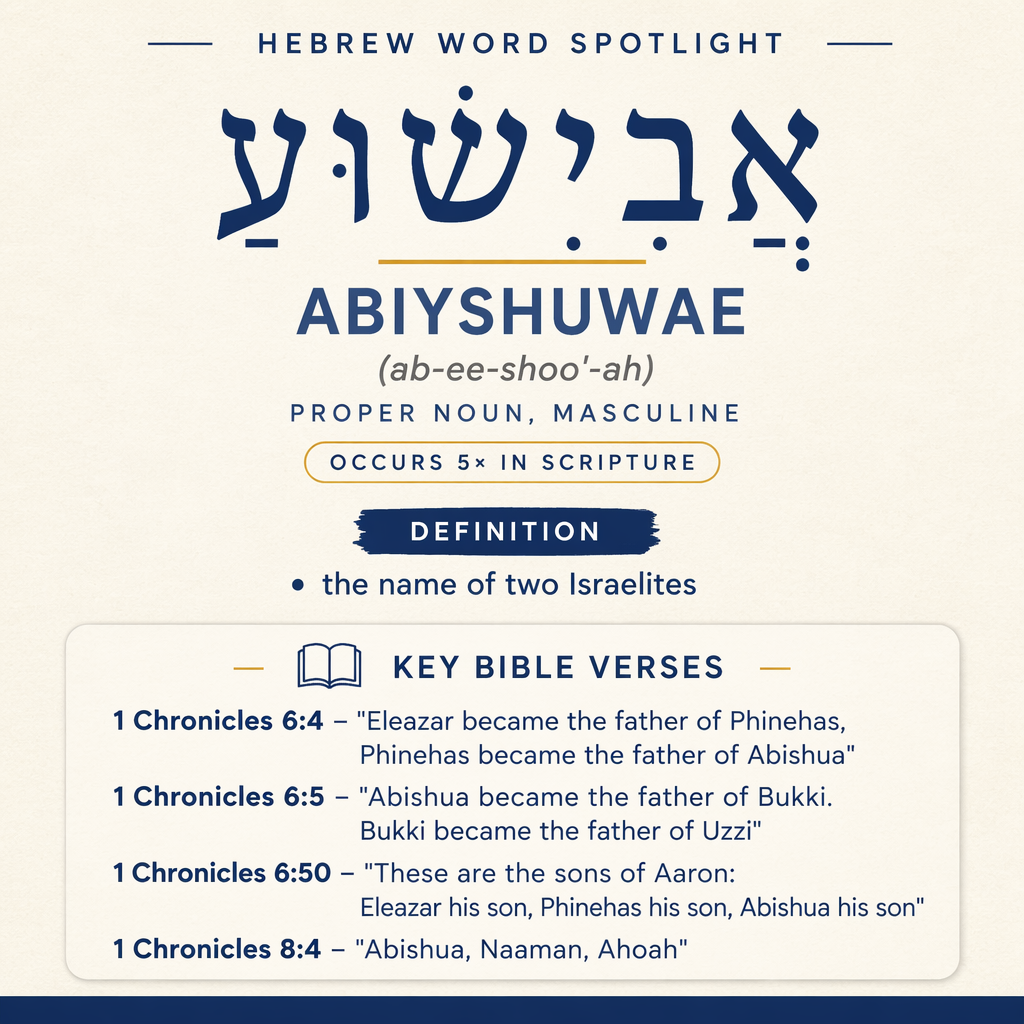
אֲבִישׁוּעַ (Abiyshuwae) is the name of two Israelites, appearing five times in 1 Chronicles 6; 8 and Ezra 7.
Who It Names
אֲבִישׁוּעַ is the name of two Israelites. One occurs in Aaron’s priestly line through Eleazar and Phinehas.
Learn More →Genealogy Links
In 1 Chronicles 6:4–5, Abishua is named as Phinehas’s son and Bukki’s father. Ezra 7:5 includes Abishua in the lineage leading to Aaron the chief priest.
Learn More →Where It Appears
Three occurrences are in 1 Chronicles 6:4–5, 50. Another is in 1 Chronicles 8:4, and one in Ezra 7:5.
Learn More →אֲבִישׁוּעַ (Abiyshuwae) is a personal name borne by two Israelites. In Scripture it appears in genealogical contexts that trace priestly descent from Aaron through Eleazar and Phinehas, and also within a Benjaminite list in Chronicles.
Occurrences
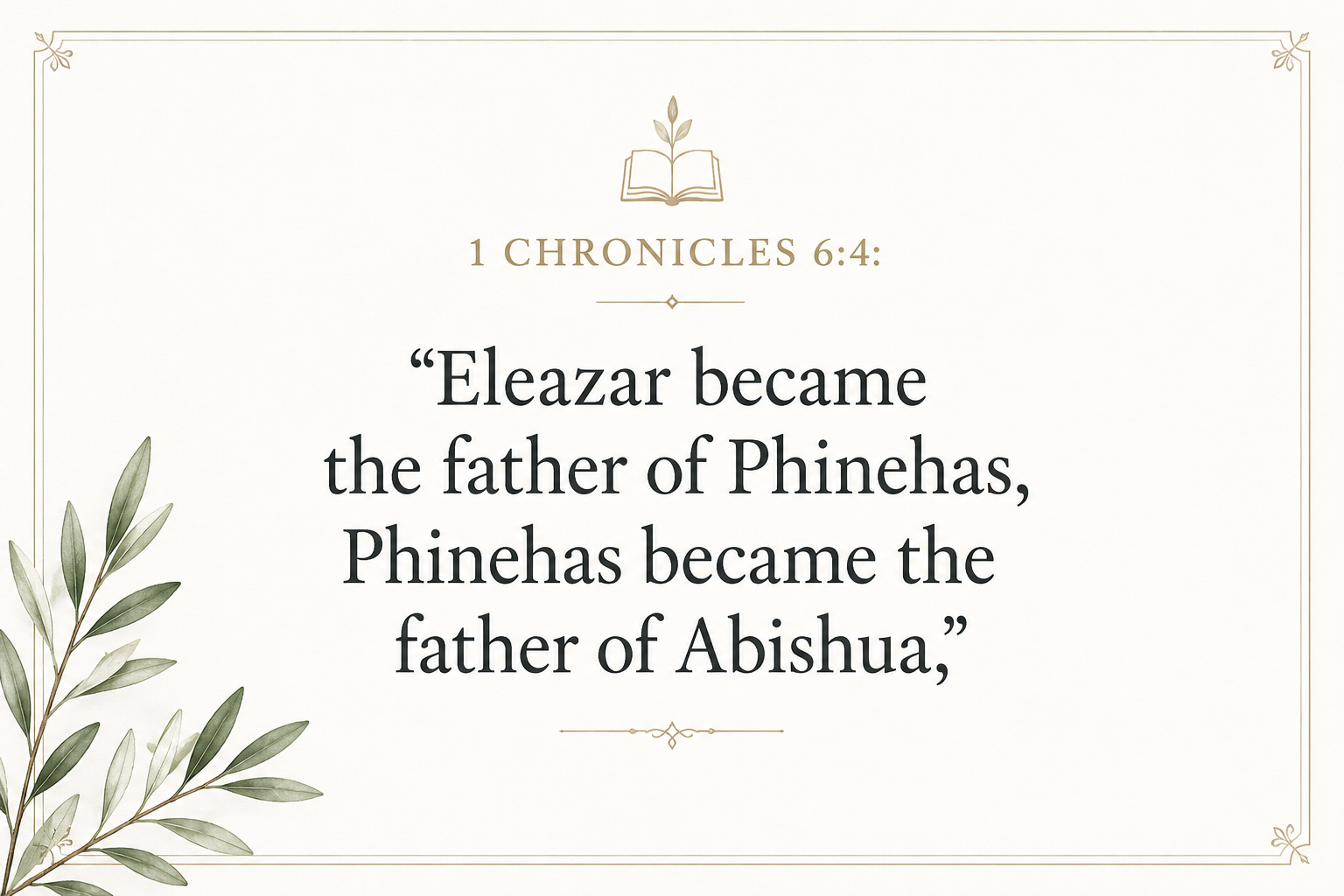
1 Chronicles 6:4: “Eleazar became the father of Phinehas, Phinehas became the father of Abishua,”
Here Abishua appears as the next link in a line of descent: Eleazar fathers Phinehas, and Phinehas fathers Abishua. The verse is structured as a chain of parentage, so the name functions to carry the genealogy forward, identifying a particular generation within an Aaronic-priestly lineage.
1 Chronicles 6:5: “Abishua became the father of Bukki. Bukki became the father of Uzzi.”
This continuation places Abishua as a father as well as a son within the same priestly succession. By naming him between Phinehas (in the prior verse) and Bukki, the text uses Abishua to anchor continuity across generations: the line does not jump from one well-known figure to another, but proceeds step by step, each name marking a specific familial handoff.
1 Chronicles 6:50: “These are the sons of Aaron: Eleazar his son, Phinehas his son, Abishua his son,”
In this summary statement the name is set inside a compact list that explicitly frames the line as “the sons of Aaron.” Abishua is presented in a descending sequence (“Eleazar his son, Phinehas his son, Abishua his son”), where “his son” is repeated to emphasize direct descent. The wording places Abishua firmly inside Aaron’s priestly family, not merely as an Israelite name but as one that belongs to the genealogical account of Aaron’s descendants.
1 Chronicles 8:4: “Abishua, Naaman, Ahoah,”
Here Abishua is one name among several in a list, without the explicit “became the father of” wording found in 1 Chronicles 6. The placement alongside “Naaman, Ahoah” signals a different genealogical setting within Chronicles, where names can be grouped in brief enumerations. In this verse, the contribution of Abishua is to identify one individual among a cluster of related persons, and the brevity of the line gives the name a roster-like function rather than a narrated chain of descent.
Ezra 7:5: “the son of Abishua, the son of Phinehas, the son of Eleazar, the son of Aaron the chief priest—”
Ezra’s genealogy invokes Abishua as part of a backward-traced lineage (“the son of Abishua, the son of Phinehas…”), situating Abishua between Phinehas and the person being traced. The phrasing piles up successive “son of” relationships, and the line culminates in “Aaron the chief priest—,” giving the genealogical recital a clear priestly orientation. Within this structure Abishua serves as a necessary generational marker that links Ezra’s ancestry to Aaron through the established Eleazar–Phinehas sequence.

Sense and Usage
The name אֲבִישׁוּעַ (Abiyshuwae) is used as the name of two Israelites, and the passages show how a single personal name can function in more than one genealogical register. In 1 Chronicles 6 it belongs to a carefully stepped priestly descent: one verse presents Abishua as Phinehas’s son (1 Chronicles 6:4), the next presents him as Bukki’s father (1 Chronicles 6:5), and a later verse repeats his placement within “the sons of Aaron” (1 Chronicles 6:50). Taken together, these references give the name a stabilizing role in the priestly family line: Abishua is not introduced with narrative detail, but with relational statements that identify where he stands between predecessor and successor.
Ezra 7:5 echoes that same priestly chain, but in reverse order, and with a purpose tied to establishing ancestry. The repeated “the son of … the son of …” format uses Abishua as one of the necessary links that makes the claim of descent explicit and traceable, and the closing identification “Aaron the chief priest—” frames the whole recital as priestly pedigree. In this way the name functions not as a label floating in isolation, but as a connector: it binds one generation to another so the genealogy reads as an unbroken line.
By contrast, 1 Chronicles 8:4 places Abishua in a short list without specifying father–son relationships inside the verse itself. The shift in presentation shows that the name can appear in a context where the list is meant to register membership and relatedness without narrating each link of descent in full. This is consistent with the definition that the name belongs to two Israelites: the Chronicler can use the same name in a priestly line (chapter 6) and also in a different tribal-genealogical listing (chapter 8), where the name is simply one item in a set.
Across these occurrences, the main semantic work of the name is identification. It identifies a particular individual in a genealogical framework, and the surrounding syntax (either “became the father of …” or “the son of …”) determines whether Abishua is heard as a forward-moving link or as a backward-pointing ancestral marker. Even when the verse provides no additional description, the consistent embedding of the name within genealogical structures gives it a clear role: Abishua is used to locate persons within Israel’s remembered family lines—most prominently within a priestly descent that is explicitly tethered to Aaron.
Genealogical Imagery
The passages that name Abishua share a restrained, archival feel: the words “became the father of” (1 Chronicles 6:4–5) and “the son of” (Ezra 7:5) evoke the steady rhythm of recorded descent. In these lines the name functions like a bead on a string—one necessary point in a sequence—so the imagery is not of actions or events, but of lineage carefully counted and spoken aloud, generation after generation, until the line reaches “Aaron the chief priest—” (Ezra 7:5).
Sources: Lexical data from Strong’s Exhaustive Concordance and the Open Scriptures Hebrew Lexicon. Occurrence data from the Westminster Leningrad Codex with STEPBible reference data (CC BY). Scripture quotations from the World English Bible (public domain).





