
Who was Gabriel in the bible?
Gabriel is an angel in Luke 1 who identifies himself and is sent from God to Nazareth.

What He Did
Gabriel said, “I was sent to speak to you and to bring you this good news” (Luke 1:19). Luke records that he “was sent from God” (Luke 1:26).
Learn More →Where He Appears
Gabriel appears in Luke 1 speaking in the temple setting with Zacharias (Luke 1:19, 1:21-22). He is also sent “to a city of Galilee named Nazareth” (Luke 1:26).
Learn More →Gabriel is an angel who identifies himself by name and describes his role as one who “stands in the presence of God” and is “sent” with a message. In Luke’s account, Gabriel appears as a divine messenger sent to speak and to bring “good news.”
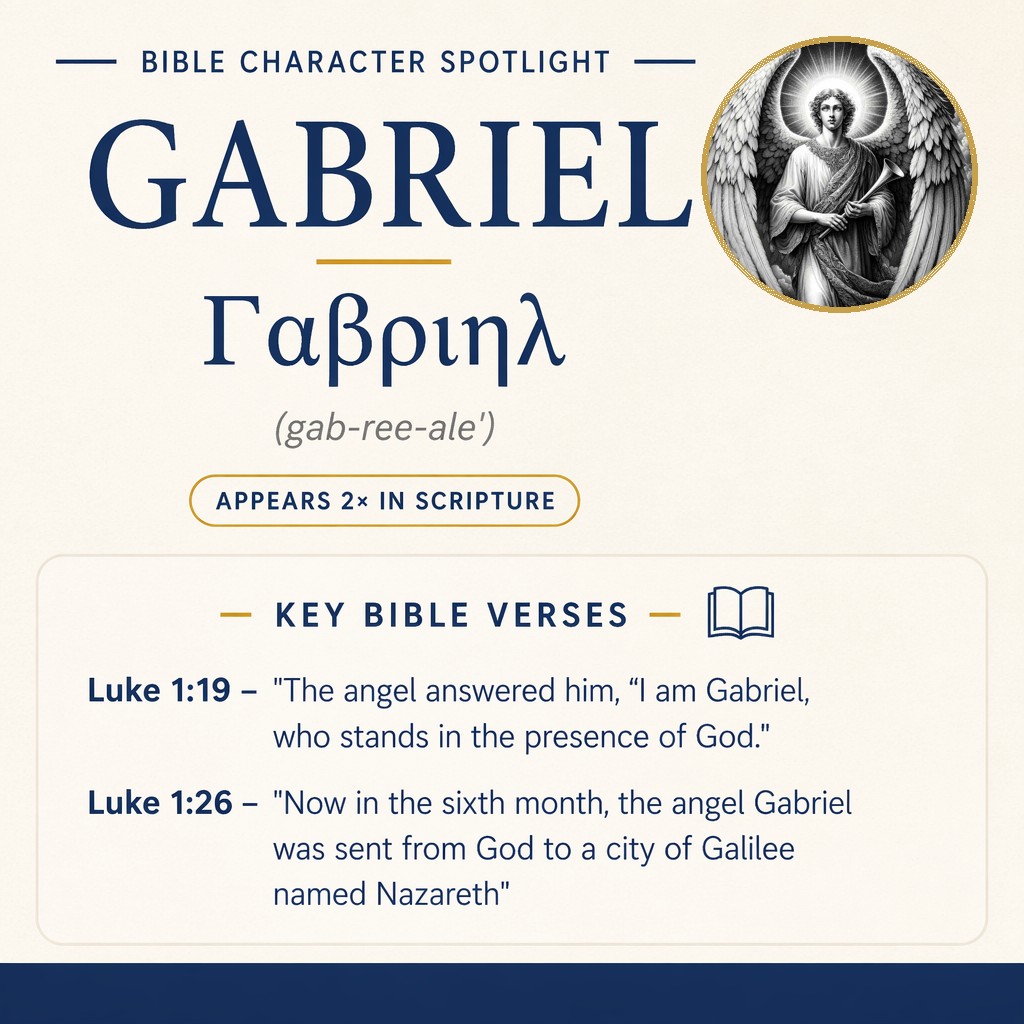
Gabriel in Scripture
Gabriel is named explicitly in two places in Luke 1. The first occurs during an exchange with Zacharias. In that setting, Luke records Zacharias questioning the angel’s message on the basis of age: “Zacharias said to the angel, “How can I be sure of this? For I am an old man, and my wife is well advanced in years.”” (Luke 1:18). Gabriel answers by naming himself, stating his position, and explaining his commission:
“The angel answered him, “I am Gabriel, who stands in the presence of God. I was sent to speak to you and to bring you this good news.”” (Luke 1:19)
The surrounding narrative continues with the angel’s announced consequence for unbelief and a time limit tied to fulfillment: “Behold, you will be silent and not able to speak until the day that these things will happen, because you didn’t believe my words, which will be fulfilled in their proper time.” (Luke 1:20). Luke then describes the public setting in which Zacharias’ delay and changed condition are noticed: “The people were waiting for Zacharias, and they marveled that he delayed in the temple.” (Luke 1:21). When he emerges, the effect is apparent: “When he came out, he could not speak to them. They perceived that he had seen a vision in the temple. He continued making signs to them, and remained mute.” (Luke 1:22). The immediate outcome for Elizabeth is then narrated: “After these days Elizabeth his wife conceived, and she hid herself five months, saying,” (Luke 1:24) and Elizabeth’s own interpretation is quoted: “Thus has the Lord done to me in the days in which he looked at me, to take away my reproach among men.” (Luke 1:25).
The second explicit naming of Gabriel situates him in a later movement of the same chapter. Luke introduces it with a time marker and the angel’s commissioning:
“Now in the sixth month, the angel Gabriel was sent from God to a city of Galilee named Nazareth,” (Luke 1:26)
Luke then provides the addressee and her immediate social setting: the angel is sent “to a virgin pledged to be married to a man whose name was Joseph, of David’s house. The virgin’s name was Mary.” (Luke 1:27). Gabriel’s greeting to Mary is recorded: “Having come in, the angel said to her, “Rejoice, you highly favored one! The Lord is with you. Blessed are you among women!”” (Luke 1:28). Luke notes Mary’s reaction, emphasizing her disturbance and reflection: “But when she saw him, she was greatly troubled at the saying, and considered what kind of salutation this might be.” (Luke 1:29).
Within the earlier portion of the chapter, Gabriel’s message to Zacharias is framed by language about preparing people and turning hearts, which the narrative presents as part of what is being announced. The angelic speech in that setting includes: “He will go before him in the spirit and power of Elijah, ‘to turn the hearts of the fathers to the children,’ and the disobedient to the wisdom of the just; to prepare a people prepared for the Lord.” (Luke 1:17). Taken together, the chapter’s sequence presents Gabriel as a named angelic envoy whose words are connected with divine purpose and fulfillment, and whose appearance produces visible effects in the human recipients and observers—Zacharias’ muteness noticed by “the people” (Luke 1:21–22) and Mary’s being “greatly troubled” and considering the greeting (Luke 1:29).
Name and Meaning
In Greek script the name is written Γαβριήλ, transliterated Gabriel and pronounced gab-ree-ale’. The lexicon information describes the name as being of Hebrew origin (linked with H01403), indicating it is a Greek form that comes from a Hebrew name.
Observation
In Luke 1, Gabriel’s own self-description—“I am Gabriel, who stands in the presence of God. I was sent to speak to you and to bring you this good news.” (Luke 1:19)—presents him chiefly as a messenger whose authority and mission are grounded in being sent from God (Luke 1:19, 1:26).
Frequently Asked Questions
What does the name Gabriel mean?
Gabriel is a name of Hebrew origin.
How many times does Gabriel appear in the Bible?
Gabriel appears 2 times.
Who was Gabriel?
Gabriel is an angel who stands in the presence of God (Luke 1:19).
What was Gabriel sent to do in Luke 1?
He was sent to speak and bring good news (Luke 1:19), and he was sent from God to a city of Galilee named Nazareth (Luke 1:26).
Explore Further
If you found this page about Gabriel interesting and would like to discover more about other biblical characters, explore our comprehensive Encyclopedia of Biblical Characters. For those looking to delve deeper into the Greek origins of these names and terms, our Greek Lexicon is an invaluable resource.
Sources: Name and occurrence data from Strong’s Exhaustive Concordance and STEPBible reference data (CC BY). Scripture quotations from the World English Bible (public domain).





